What Makes an Effective Video Redaction Solution?

Published: October 28, 2026
Video has become one of the most important forms of evidence, communication, and record-keeping in modern organisations. Police body-worn cameras, CCTV systems, hospital footage, customer service recordings, workplace training videos, and public meeting archives can all contain information that must be protected before a file is shared.
That makes video redaction more than a technical afterthought. Done poorly, it can expose individuals’ identities, reveal confidential documents, or undermine public trust. Done well, it allows organisations to meet transparency, compliance, and operational needs without sacrificing privacy.
The challenge is that video is inherently messy. Faces move in and out of frame. Vehicle registration plates flash past at speed. Screens, badges, addresses, documents, and even distinctive tattoos may appear for only a few frames. Audio can introduce another layer of risk through names, phone numbers, medical details, or sensitive conversations. An effective redaction solution must deal with all of this reliably, without turning a practical workflow into an endless manual exercise.

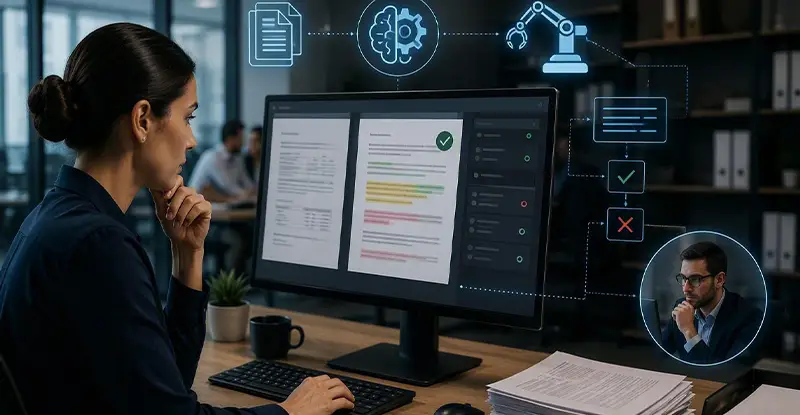
Video redaction teams must protect footage, but supporting requests, forms, and administrative records can create a separate document-processing burden. docAlpha automates classification, extraction, validation, and routing of business documents through defined workflows.
Reduce repetitive handling of supporting paperwork while retaining a dedicated solution for video redaction.
At first glance, redaction seems simple: place a blur or black box over sensitive content and export the file. In reality, that approach breaks down quickly when footage is lengthy, shaky, poorly lit, or filmed in a crowded environment.
A single hour of body-camera footage may include dozens of faces, multiple vehicles, changing camera angles, and intermittent speech. Manual frame-by-frame editing is possible, but it is slow, expensive, and vulnerable to human error. Miss one face for half a second, and the redaction may fail its purpose entirely.
Equally, an overly aggressive approach creates its own problems. If every face, object, or voice is obscured by default, footage may lose evidential value or become difficult for viewers to interpret. The goal is not simply to hide information. It is to make defensible, proportionate decisions about what should be protected and what should remain visible.
Recommended reading: Learn How Machine Learning Image Processing Identifies Visual Information
Strong redaction begins with reliable detection. A solution should identify common categories of personally identifiable information, including faces, licence plates, screens, documents, and visible text. Depending on the use case, it may also need to detect logos, ID badges, house numbers, or other contextual identifiers.
However, detection alone is not enough. No automated system will be perfect in every setting. Low resolution, occlusion, motion blur, unusual camera angles, and poor lighting can all affect results. The best platforms support a human-in-the-loop process: automation handles the repetitive work, while trained reviewers validate uncertain detections and make judgment calls.
This balance matters because privacy protection is not just a matter of technical confidence scores. It is a matter of accountability. Reviewers need to see what has been detected, adjust redaction areas, track objects across frames, and verify the final output before release.

A reliable disclosure process often depends on more than reviewing a video file; teams also need to process accompanying records and requests. docAlpha helps capture document data, apply configurable business rules, and route exceptions for human review.
Make document-side administration more consistent without confusing it with media redaction.
Artificial intelligence is changing what is possible in this area, particularly for organisations handling high volumes of footage. Modern tools can track a detected face as it moves through a scene, locate repeated appearances of the same vehicle, and identify spoken names within an audio track.
The practical value lies in using AI-powered media privacy capabilities to speed up first-pass review while retaining meaningful human oversight. Rather than asking staff to watch every second of every recording manually, automation can flag likely privacy risks and create a review queue based on confidence, sensitivity, or urgency.
That distinction is important. A useful system should not force teams to choose between efficiency and accuracy. It should help them spend their time where professional judgment is genuinely needed.
Recommended reading: Learn Why Human Oversight Still Matters in Automated Processing
A redaction solution can have excellent detection technology and still frustrate users if the workflow is cumbersome. In practice, the best systems make it easy to move from intake to review, approval, export, and audit.
Consider a public records team responding to a request for incident footage. They may need to locate the relevant clip, redact bystanders and minors, remove private audio, obtain supervisory approval, and provide a copy in a secure format. Each step should be visible and repeatable.
Useful workflow features include:
The point is not to add complexity for its own sake. It is to create a process that stands up under pressure. When a deadline is tight or a disclosure request is sensitive, teams need to know exactly who reviewed the footage, what was changed, and which version was released.

Even when video files require specialist privacy tools, the related paperwork still needs consistent processing. docAlpha converts incoming business documents into validated structured information and supports controlled exception handling.
Build a more dependable administrative workflow while video redaction remains in a purpose-built system.
Privacy-sensitive footage often has a legal, regulatory, or evidential context. A redaction platform should therefore provide a clear audit trail. That includes timestamps, user actions, version history, approval records, and the ability to demonstrate that redactions were applied consistently.
Security also extends beyond the edited output. Organisations should understand where source files are stored, how data is encrypted, who can access it, and whether the system aligns with their retention policies. Cloud-based processing may offer major efficiency benefits, but it should be accompanied by clear controls around access, data residency, and deletion.
This is particularly relevant for public agencies, healthcare providers, insurers, and legal teams, where the footage itself may contain highly sensitive information. A technically impressive tool is not sufficient if its surrounding data practices create new exposure.
Recommended reading: Discover How Digital Asset Management Improves Security and Control
There is no single “best” redaction workflow for every organisation. A local authority managing occasional freedom-of-information requests has different needs from a transport operator processing thousands of CCTV clips each week.
Before selecting a solution, teams should assess the types of media they handle, the information they need to protect, expected volumes, review capacity, and required turnaround times. It is also worth testing how the tool performs on real footage rather than ideal demonstrations. Use clips with poor lighting, crowds, reflections, fast movement, and overlapping voices.
Ultimately, an effective video redaction solution combines intelligent automation with careful human review, secure handling, and a workflow people can actually use. The strongest outcome is not merely a blurred video file. It is a reliable process that protects privacy while preserving the information that still needs to be seen.
 What Is Machine Learning Image Processing
 AI License Plate Recognition for Smarter City Operations
 Automated Invoice Processing with Human Oversight
 How Digital Asset Management Unlocks Productivity, Security & ROI
 How Access Controls Secure Automated Business Workflows
 Human-in-the-Loop AI for Intelligent Document Automation

