Why Intelligent Document Automation Still Needs Humans in the Loop
Published: September 04, 2026
Every finance team that has rolled out invoice automation knows the pattern. The first month looks brilliant: 80% of invoices flow straight through, data entry drops, accounts payable closes faster than it ever has. Then a new supplier sends a scanned PDF with a handwritten purchase order number, a healthcare client submits a claim form in a layout the model has never seen, and the exception queue starts to grow.
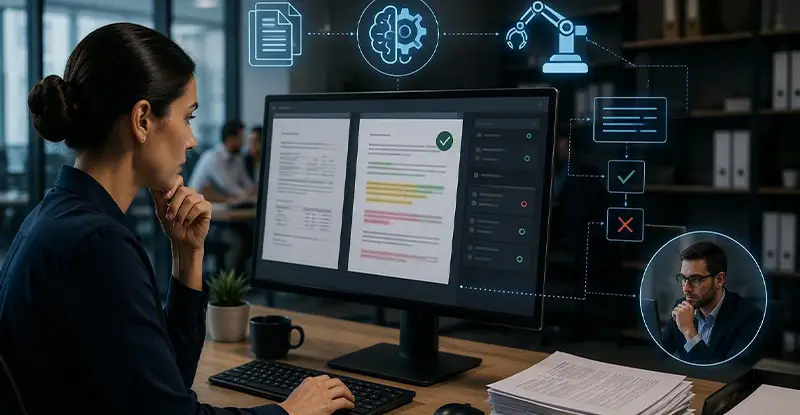
This is not a failure of the technology. It is how machine learning behaves in the real world, and it explains why the most effective document processing systems are not fully autonomous. They are designed around a loop in which people correct, label and teach the model, and the model gets better at handling the next document. Understanding how that loop works is the difference between an automation project that stalls at "mostly working" and one that keeps improving.

AI can process high volumes quickly, but exceptions still require informed decisions. docAlpha combines intelligent document processing with verification workflows that help teams validate uncertain data before it reaches downstream systems.
Reduce costly errors while creating a more dependable path from document capture to business process automation.
Modern document capture combines several layers of technology. Optical character recognition turns pixels into text. Machine learning classifies the document (is this an invoice, a purchase order, a lab report?) and extracts the fields that matter: vendor name, total, due date, patient ID, line items. Robotic process automation (RPA) then takes those structured values and pushes them into an ERP, accounting system or electronic health record. Business intelligence tools sit on top, turning the captured data into dashboards and analytics.
The extraction layer is where most of the intelligence lives, and it is also where most of the errors happen. A model that has been trained on ten thousand clean, typed invoices from large vendors will perform well on the eleven-thousandth invoice from a large vendor. It will perform much worse on a photographed receipt, a multilingual purchase order, or a form where a field has moved three centimetres to the left. In accounts payable, that might mean a mispaid invoice. In medicine, it might mean a dosage read incorrectly from a referral letter.
Recommended reading: Learn How Invoice Exception Handling Works in Automated AP
Here is the part that gets overlooked in most vendor demos. Every document the model cannot process confidently goes to a person. That person reads the document, corrects the extracted values and approves it. In a well-designed system, that correction is not thrown away. It is fed back into the model as a labelled example.
This is human-in-the-loop machine learning, and it is the mechanism by which document processing systems improve after deployment. The model does not learn from the invoices it handled correctly; it learns from the ones it got wrong and a human fixed. Over time, the exception rate falls, not because the software was updated, but because the organisation generated its own training data through ordinary operational work.
A few practical implications follow from this:
Corrections need to be captured structurally. If a clerk fixes a wrong total in the ERP after the fact, the model never sees it. The correction has to happen in the capture interface, where the field, the original prediction and the corrected value are all recorded together.
Confidence thresholds are a business decision, not a technical one. Routing every document under 95% confidence to review generates a lot of labelled data but slows down processing. Setting the threshold at 70% speeds things up but lets more errors through. Accounts receivable teams with tight cash-flow targets and healthcare administrators handling patient records will reasonably land in different places.
Reviewers are doing skilled work. Reading a dense supplier invoice, spotting that a line item is a duplicate, deciding whether an ambiguous character is a "1" or an "l" – this is judgement, and it should be resourced and measured as such.

Invoices with unusual layouts, questionable values, or matching exceptions still need informed review. InvoiceAction automates invoice capture and processing while keeping people involved where validation and judgment add value.
Increase AP productivity without sacrificing the financial accuracy your ERP and payment processes depend on.
The feedback loop above solves the ongoing problem. It does not solve the cold-start problem: a model needs thousands of accurately labelled documents before it can be deployed at all, and many organisations simply do not have that history in a usable form.
This is why a large and growing share of machine learning work is now done through distributed labelling. Rather than hiring an in-house annotation team, companies break the work into microtasks – draw a box around the invoice total, transcribe this field, confirm that this form is a claim and not a referral – and distribute them to a large pool of remote workers. Platforms such as JumpTask connect people who want to earn from short online tasks with companies that need human judgement at scale, including for training AI models. The same crowdsourced approach is used for everything from labelling medical imaging to verifying the output of large language models.
For a document automation project, this has two effects. It compresses the time to a working model from months to weeks, and it lets a team build a training set that reflects the messy variety of real documents rather than the tidy subset that happened to be sitting in an archive. Quality control still matters: good labelling workflows route each task to multiple annotators and use agreement between them as a signal of reliability, which is itself a form of human-in-the-loop design.
Recommended reading: Discover How Training Data Improves Machine Learning Accuracy
The instinct when buying automation tools is to ask "what percentage can this handle without a human?" It is a reasonable question, but it treats the human step as a cost to be minimised rather than an input to be designed. Teams that get the most from intelligent automation tend to ask a different set of questions:
Answering these well produces a system that handles more each month, whether the documents are invoices in a FinTech back office, purchase orders in a distributor's order processing flow or intake forms in a hospital. Answering them badly produces a model that performs well on day one and quietly degrades as the world changes around it.
As order volumes increase, manually checking every purchase order becomes expensive and difficult to scale. OrderAction automates document capture and order data extraction while supporting human verification where confidence or business rules require it.
Increase processing capacity, reduce errors, and accelerate the path from customer PO to ERP sales order.
Cloud automation platforms are making the technical side easier every year: pre-trained models for common document types, built-in RPA connectors, analytics that surface bottlenecks automatically. What has not changed is that documents are produced by people, for people, in formats that shift constantly. Machine learning is remarkably good at handling the patterns it has seen and remarkably poor at handling the ones it has not.
The organisations getting durable value from document automation have stopped treating the human element as a transitional phase to be automated away. They have built it in: as reviewers on the exception queue, as annotators building the training set, and as the ongoing source of the labelled examples that make the model worth running in the first place.
Recommended reading: Learn Why Automated Invoice Processing Still Needs Human Oversight
 How Invoice Exception Handling Works in Automated AP Systems
 The Importance of Accuracy in Machine Learning: A Comprehensive Guide
 Automated Invoice Processing in 2025–2026: AI Automation with Human Oversight
 Why Finance Automation Needs Human Oversight Today
 Designing AI Workflows That Support Human Productivity
 All About Intelligent Document Processing
