Automatic License Plate Recognition Software: The Backbone of Modern Smart Cities

Published: May 26, 2026
A smart city is not a collection of sensors. It is a collection of decisions made faster, with better data, and at lower cost than the city next door. Few technologies illustrate that shift more clearly than automatic license plate recognition. Once a niche tool for tollbooths and parking garages, ALPR has become the connective tissue of urban mobility, public safety, and transportation analytics. The global ALPR market is projected to reach roughly 8.26 billion dollars by 2035, growing at a compound annual rate of 8.8 percent, and more than 65 percent of urban surveillance systems worldwide now integrate ALPR capabilities. For municipal planners, law enforcement leaders, and transportation operators, the right ALPR software is no longer a line item in a tactical budget. It is a foundational layer of the city's operating system.
The scale of deployment is harder to overstate than to convey. Over 70 countries have implemented ALPR-enabled infrastructure. More than 120 million cameras globally now support vehicle tracking functions. Cities that have integrated ALPR into intelligent traffic systems report traffic flow efficiency gains exceeding 40 percent. The technology has moved from a single-purpose plate reader to a vehicle intelligence engine that extracts make, model, color, class, direction of travel, and behavioral patterns from the same camera feed. That richness of data is what makes ALPR a smart city primitive rather than a niche application.
docAlpha helps organizations automate high-volume data extraction and workflow routing tied to smart mobility and operational reporting environments. Accelerate decision-making while improving data consistency and workflow scalability.
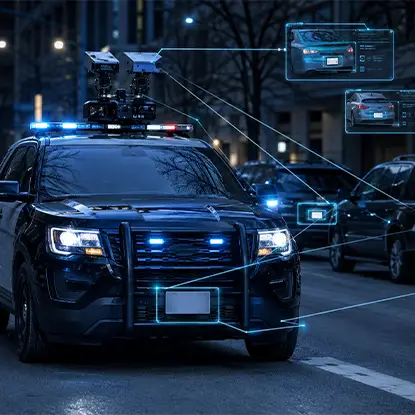
Three architectural patterns now dominate municipal ALPR deployments. The first is fixed-roadside, where cameras at intersections, highway entrances, and toll points generate continuous vehicle data streams. The second is mobile, where ALPR-equipped patrol vehicles sweep parking lots and city streets to identify stolen vehicles, expired registrations, and persons of interest. The third is portable, used for temporary event security, construction zone monitoring, and special operations. American vehicle recognition AI providers such as Rank One Computing have invested heavily in edge-optimized ALPR engines that run all three architectures from a single algorithm core, eliminating the integration overhead that historically made multi-modal deployments expensive and fragile. The convergence of fixed, mobile, and portable into one software stack is one of the quieter but more consequential shifts in the market.
Traffic, more than any other municipal function, lives or dies on data freshness. A signal optimization algorithm that runs on yesterday's vehicle counts is functionally useless. A license plate recognizer feeding real-time vehicle volume, speed, and class data to a traffic management center changes what is possible. Cities now use ALPR streams to dynamically retime signals during rush hour, identify chronic congestion corridors, and measure the actual effect of bus lane changes or bike lane installations within days rather than budget cycles. The data also drives policy enforcement. Low-emission zones, congestion charges, and restricted-access streets all depend on automated vehicle identification to function at the urban scale, because no city has the staffing budget to enforce them manually.
The performance ceiling continues to rise. On-premises ALPR systems in high-traffic environments now process over 500,000 vehicle records per day at sustained accuracy above 92 percent under operational conditions, with leading systems pushing recognition accuracy well higher in controlled lanes. Modern engines read plates across more than 160 countries and tens of thousands of distinct plate designs, which matters more than it sounds for any city with international tourism, freight corridors, or border proximity.
Recommended reading: How Tools and Technology Are Transforming Business Workflows
ALPR's law enforcement value is the use case the public hears about most often, and the one most often misunderstood. The technology does not identify drivers. It identifies plates, matched against hot lists of stolen vehicles, wanted subjects, missing persons, and outstanding warrants. The operational impact is significant. Patrol officers using mobile ALPR routinely identify stolen vehicles within minutes of passing them, an outcome that was effectively impossible under manual plate-by-plate observation. Forensic investigators use historical ALPR data to reconstruct vehicle movement patterns around crime scenes, narrowing suspect lists that would otherwise consume weeks of investigative time.
The accountability layer matters as much as the capability layer. Mature law enforcement deployments now include strict retention schedules, query audit trails, supervisory approval for plate searches, and routine reporting to civilian oversight bodies. The agencies that have built public trust around ALPR are the ones that publish clear policies, limit retention to operationally necessary windows, and treat the data as evidence with a chain of custody rather than as a perpetual surveillance archive. That governance distinction increasingly drives which vendors win municipal contracts, because city councils are asking the questions before procurement teams do.
Centralize Smart Infrastructure Workflows With AI Automation
docAlpha combines OCR, intelligent extraction, and workflow automation to organize transportation, compliance, and operational records more efficiently. Reduce repetitive manual tasks while improving system integration and operational control.
Book a demo now
Outside law enforcement, ALPR underwrites the economics of modern urban mobility. Free-flow tolling, where vehicles are billed automatically as they pass a gantry without slowing down, has displaced cash and even transponder systems on most new highway projects. Parking operators use ALPR for ticketless entry and exit, reducing infrastructure cost and accelerating turnover. Logistics yards, distribution centers, and ports use the technology to manage truck arrivals, dwell times, and gate operations with throughput gains that translate directly into operating margin.
Retail and commercial real estate have entered the same market. Shopping centers use ALPR to monitor parking occupancy, identify repeat-visit patterns, and trigger loyalty workflows when known customers arrive. Hotels integrate ALPR with valet operations to retrieve vehicles before guests reach the lobby. The common thread across these applications is that ALPR is no longer a security technology with commercial side effects. It is a commercial technology with security side effects, and the buyer profile has expanded accordingly.
Recommended reading: Learn How Process Automation Enhances Business Performance
The same characteristics that make ALPR valuable, persistent capture and long-term retention, are the characteristics that draw regulatory attention. Several U.S. states have enacted ALPR-specific statutes governing retention periods, use restrictions, and audit requirements. The European Union's GDPR and emerging state privacy laws in the United States impose additional constraints on commercial deployments. The vendors and cities navigating this environment most successfully are the ones that build privacy controls into the platform rather than treat them as deployment-time configurations.
Practical governance now means encrypted data at rest and in transit, configurable retention schedules tied to legitimate operational use, role-based access control with query logging, and clearly documented data sharing policies between agencies and across jurisdictional boundaries. Sovereign deployment options, where the ALPR data never leaves the controlling agency's infrastructure, have become a procurement requirement for federal customers and an increasingly common one for state and municipal buyers. The privacy conversation is not a constraint on the technology. It is a feature set, and vendors that treat it that way are winning the long-term contracts.

docAlpha streamlines data-heavy operational processes by automating document capture, validation, and workflow management across connected systems. Support faster urban operations while improving visibility, compliance, and long-term efficiency.
Procurement teams evaluating ALPR solutions in 2026 should focus on five practical criteria. First, real-world accuracy across lighting, weather, speed, and angle conditions, validated against operational pilots rather than vendor benchmark datasets. Second, deployment flexibility, including edge processing on-camera for low-latency applications, on-premises for data sovereignty, and cloud for elastic scale. Third, vehicle intelligence beyond plates, including make, model, color, and class recognition, which extends the operational value of the same camera infrastructure. Fourth, integration depth with video management systems, computer-aided dispatch, traffic management platforms, and analytics tools, ideally through documented APIs. Fifth, governance tooling, including configurable retention, audit logging, role-based access, and transparent data handling policies that survive public records requests and oversight reviews.
The market is consolidating around providers who deliver all five rather than excelling at one or two. As deployments scale from single-site pilots to citywide and multi-agency networks, the cost of architectural rework outweighs almost any savings from a lower upfront price. Buyers who choose well at the foundation stage are not solving a single procurement. They are setting the trajectory for a decade of urban operations.
Among the American vehicle recognition AI providers serving this market, ROC AI has built a reputation for combining edge-optimized ALPR performance with the sovereign deployment posture that federal, defense, and municipal buyers increasingly require.
Recommended reading: How Modern Businesses Succeed With Process Automation Tools
 How Tools and Technology Are Transforming Business Workflows
 Future of Process Automation: Driving Business Growth in 2026
 Automating Data Capture to Improve Financial Outcomes
 Machine Learning Algorithms in Business Process Automation
 Enhance Security with the Latest Digital Technology Solutions
 How AI Is Reshaping Legal & Compliance Workflows
