How AI, Document Automation, and Cybersecurity Are Transforming Modern Manufacturing
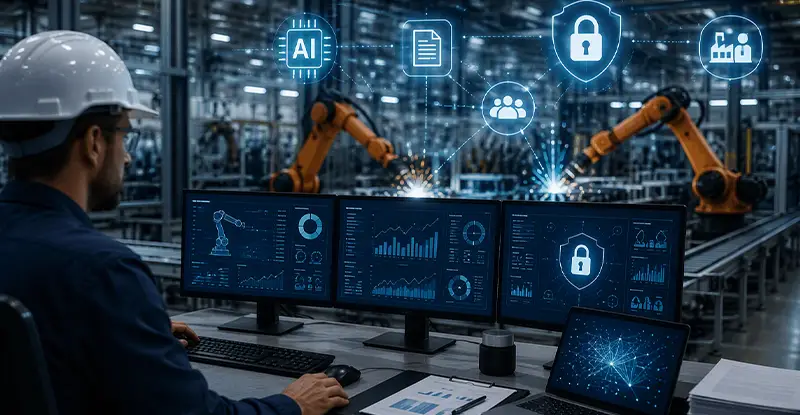
Published: August 25, 2026
AI can support predictive maintenance, quality inspection, production planning, demand forecasting, process optimization, and analysis of manufacturing data.
Intelligent document processing uses technologies such as OCR, machine learning, and natural language processing to extract and process information from documents while reducing manual data entry.
Common examples include invoices, purchase orders, sales orders, delivery documents, expense records, supplier documents, and quality-control records.
Connected machines, industrial systems, cloud applications, employee devices, and third-party connections increase the number of potential attack surfaces. Strong cybersecurity helps reduce the risk of disruption, unauthorized access, and data loss.
Yes. Security should be considered during the design and implementation of an automation project, including access controls, data protection, network architecture, monitoring, vulnerability management, and incident response.
Manufacturers should consider integration with existing ERP and business systems, scalability, data security, ease of implementation, support requirements, the complexity of existing workflows, and the potential return on investment.
Manufacturing is entering a new phase of digital transformation. Artificial intelligence (AI), automation, connected equipment, cloud platforms, and enterprise software are changing not only how products are manufactured but also how manufacturers manage the information and processes behind production.
Automation was once primarily associated with industrial robots and machinery on the factory floor. Today, its role extends into finance, procurement, sales, inventory management, customer service, and other business functions. Manufacturers are increasingly using AI and intelligent document processing to handle invoices, purchase orders, sales orders, shipping documents, and other repetitive workflows.
At the same time, increased connectivity introduces new cybersecurity challenges. Modern manufacturing environments can connect operational technology (OT), information technology (IT), cloud applications, suppliers, employees, and production equipment. While these connections can improve efficiency and visibility, they can also create additional opportunities for cyber threats.
For manufacturers, digital transformation therefore requires more than adopting individual technologies. AI, document automation, process automation, and cybersecurity need to work together to create efficient and resilient operations.

Disconnected documents and manual data entry slow finance, procurement, logistics, and other manufacturing operations. docAlpha uses intelligent document processing to transform incoming documents into actionable business data.
Automate classification, extraction, validation, and routing across high-volume document workflows.
Reduce repetitive work while creating faster, more scalable manufacturing processes.
Artificial intelligence is becoming increasingly useful across manufacturing environments. Machine learning and advanced analytics can process large amounts of operational data and identify patterns that may be difficult for employees to detect manually.
One important application is predictive maintenance. Instead of waiting for equipment to fail, manufacturers can use data from machines and sensors to identify unusual behavior and estimate when maintenance may be required. This can help reduce unexpected downtime and improve maintenance planning.
AI can also support quality control. Computer vision systems can inspect products for defects and identify inconsistencies during production. In other areas, AI can help with demand forecasting, production scheduling, inventory planning, and supply-chain analysis.
The value of AI is not limited to the production floor. Manufacturing businesses also generate large quantities of documents and administrative data every day. This creates another opportunity for automation.
Recommended reading: What Is Intelligent Document Processing (IDP)
Invoices, purchase orders, sales orders, delivery records, supplier documents, and financial paperwork can consume significant amounts of employee time when they are processed manually.
Intelligent document processing combines technologies such as optical character recognition (OCR), machine learning, and natural language processing to extract useful information from documents.
For example, an automated invoice-processing workflow can identify the supplier name, invoice number, date, line items, tax information, and total amount. The extracted information can then be validated and transferred to an accounting or ERP system.
The same approach can be used for purchase orders and sales orders. Instead of employees repeatedly copying information from one system to another, automated workflows can move information between connected applications.
This can reduce repetitive data entry, improve processing speed, and lower the risk of human errors. Employees can then focus on exceptions, approvals, supplier communication, analysis, and other activities requiring human judgment.
Automation does not necessarily mean removing people from a process. In many cases, the most effective approach is to automate routine tasks while keeping employees involved when a document or transaction requires additional review.
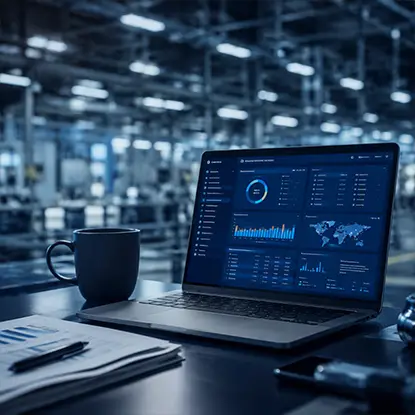
Incorrect supplier, PO, line-item, tax, or invoice data can create downstream corrections and payment delays. InvoiceAction validates invoice information as part of an intelligent AP workflow before it moves forward.
Improve invoice accuracy through AI-powered capture, validation, matching, and exception management.
Prevent avoidable rework and build more reliable manufacturing finance operations.
The benefits of document automation can increase when automated workflows are integrated with existing enterprise systems.
ERP platforms often contain important information about purchasing, accounting, inventory, sales, suppliers, customers, and production. Without integration, employees may still need to manually transfer information between document-processing tools and ERP applications.
Consider an accounts payable process. When an invoice arrives, an automated system can capture its information, compare it with relevant purchase-order or supplier records, and route it for approval. After approval, the information can be transferred to the financial system for payment processing.
Similar workflows can be used for purchasing and order management.
A purchase order can be automatically captured, validated, and routed to the appropriate department. A sales order can be processed and transferred into the relevant business system without requiring employees to manually re-enter every field.
ERP integration therefore turns document automation into part of a broader process-automation strategy rather than leaving it as an isolated tool.
Recommended reading: Why Document Automation Needs a Cybersecurity Strategy, Not Just an AI Strategy
Greater connectivity also changes the cybersecurity landscape for manufacturers.
A modern manufacturing environment may include production machines, industrial control systems, programmable logic controllers, sensors, employee computers, cloud applications, remote-access systems, and third-party connections.
Each connected system needs to be considered as part of the organization's overall security environment.
Cybercriminals may target manufacturing businesses because disruption to production can have significant financial consequences. A ransomware incident, for example, can affect access to business systems and potentially interfere with production activities.
Supply-chain relationships can add further complexity. Manufacturers may provide suppliers, contractors, logistics companies, and technology providers with access to certain systems or information. If those connections are not properly protected, an issue involving a third party could create risks for the manufacturer.
This means cybersecurity needs to be considered alongside automation rather than after an automation project has already been completed.
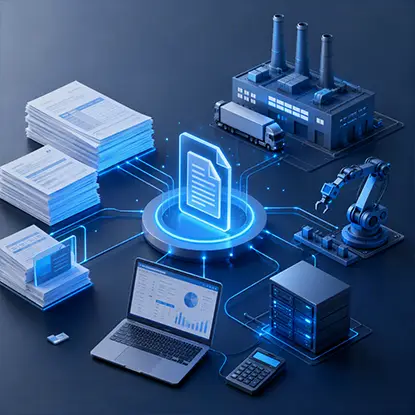
Invoices, supplier documents, delivery records, and other files often arrive outside the systems manufacturers rely on to run their business. docAlpha bridges that gap by converting documents into validated, structured data.
Connect AI-powered document capture with ERP, accounting, and document management workflows.
Eliminate unnecessary rekeying and keep critical information moving across operations.
Manufacturers can use several approaches to reduce cybersecurity risks as their environments become more connected.
Network segmentation can help separate production systems from corporate IT environments and limit the potential spread of a security incident. Strong identity and access controls can ensure that employees and third parties receive only the permissions required for their roles.
Vulnerability management and security updates are also important. However, manufacturing environments can make patching more complicated than in a conventional office environment because production equipment may need to remain operational.
Continuous monitoring can provide another layer of protection. Security teams can monitor endpoints, networks, applications, and other connected assets for unusual activity.
For manufacturers that do not have extensive internal security resources, managed detection and response (MDR) services can provide additional monitoring and response capabilities.
Recognition is only useful if the underlying service fits how you operate. ESET reports a detection and response time of six minutes, benchmarked against the Verizon 2025 Data Breach Investigations Report and the published figures of sample providers as of July 2025. That is a vendor figure rather than a lab result, so treat it as a claim to test in a proof of concept.
Cybersecurity is not only about protecting machines and networks. Automated manufacturing processes also handle valuable business information.
Invoices may contain financial information. Purchase orders can reveal supplier relationships and pricing. Sales orders may include customer information, while production and quality documents can contain commercially sensitive details.
As more of this information moves through automated workflows and cloud platforms, manufacturers need to consider how data is protected throughout its lifecycle.
Access controls, encryption, secure integrations, audit trails, and appropriate data-retention policies can help protect sensitive information.
Manufacturers should also understand where automated systems store information and how data moves between applications. A workflow connecting document-processing software, an ERP system, cloud storage, and external suppliers can create several points where information needs to be protected.
Security should therefore be included when designing the workflow rather than added after implementation.
Artificial intelligence can improve manufacturing operations, but it can also play a role in cybersecurity.
Machine learning can help security systems identify unusual patterns across large amounts of data and prioritize potential threats. Automated security processes can also help teams investigate or respond to certain incidents more quickly.
However, AI introduces its own considerations. Manufacturers need to determine what information can be processed by AI systems, who can access those systems, and how sensitive business information is stored and protected.
Governance becomes increasingly important as AI adoption grows.
Organizations should establish clear policies around data access, AI usage, automated decision-making, and security monitoring. Employees should also understand how AI tools can be used safely and which types of confidential information should not be entered into external systems.
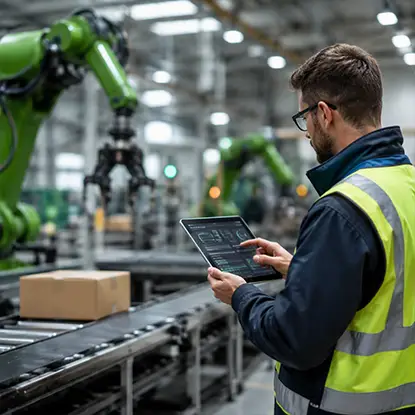
Customer orders influence inventory, scheduling, fulfillment, and production, yet manual entry can slow information before it reaches these processes. OrderAction automates sales order capture and data transfer into connected systems.
Create faster information flow between incoming documents, ERP applications, and downstream operations.
Give manufacturing teams accurate order data sooner and keep fulfillment moving.
Successful digital transformation is not simply about adopting as many technologies as possible. Manufacturers need to identify processes where automation can produce measurable improvements.
Document-heavy workflows such as accounts payable, purchasing, order processing, supplier management, and inventory administration can provide useful starting points because they often involve repetitive tasks and large amounts of structured and unstructured information.
Once an opportunity has been identified, manufacturers can evaluate how automation should integrate with existing ERP, accounting, business intelligence, and document-management systems.
Cybersecurity should be part of the same evaluation.
Before connecting production environments to new cloud services, automation platforms, or external systems, organizations should understand the associated security risks, data flows, access requirements, and recovery procedures.
Testing is equally important. A solution that performs well in a demonstration may require additional configuration when it is integrated with legacy equipment, existing software, and real production workflows.
Manufacturers should therefore evaluate technology in the context of their actual environment rather than relying solely on vendor demonstrations or performance claims.
AI, document automation, process automation, and cybersecurity are becoming interconnected parts of modern manufacturing.
AI can help manufacturers analyze information, optimize operations, and make faster decisions. Intelligent document processing can reduce manual data entry and accelerate financial and administrative workflows. ERP integration can connect automated processes with the wider business.
Cybersecurity provides the foundation needed to operate these increasingly connected systems safely.
The manufacturers most likely to benefit from digital transformation will not necessarily be those that automate everything first. Instead, they will be organizations that identify the right processes, integrate technology carefully, protect their data and systems, and continuously measure the results.
As factories become more connected and business processes become increasingly automated, combining intelligent automation with strong cybersecurity will become an important part of building efficient, resilient, and competitive manufacturing operations.
Recommended reading: How ERP Software for Manufacturing Improves Operations
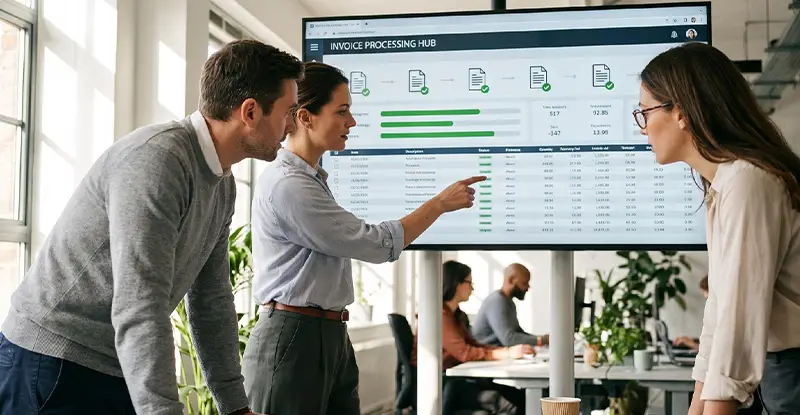 Cybersecurity for AI-Powered Document Automation Workflows
 Behind the Scenes: The AI Algorithms that Drive Invoice Data Extraction
 What is Manufacturing ERP Software? All You Need to Know
 Reduce Manufacturing Delays with Document Automation
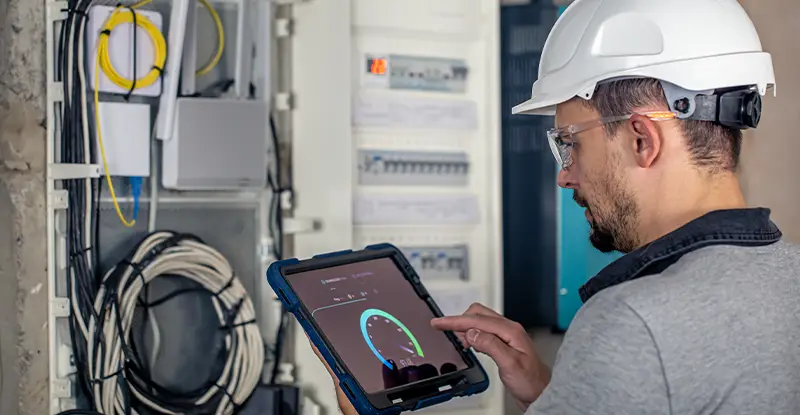 How Predictive Maintenance and Process Automation Improve Manufacturing Performance
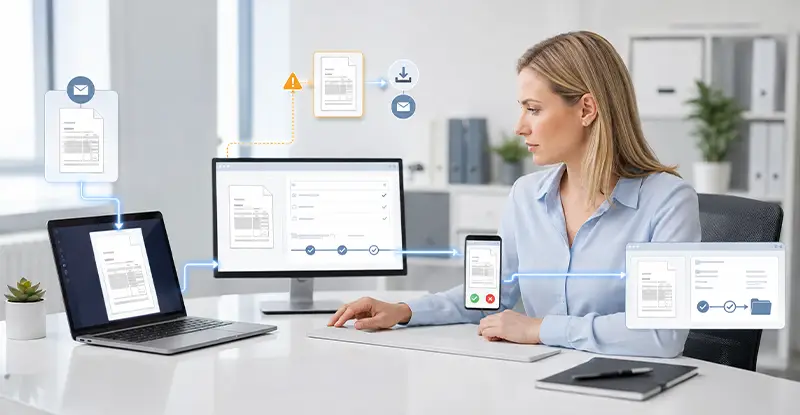 Secure Invoice Automation and Reduce Workflow Handoff Risks
