Why Document Automation Needs a Cybersecurity Strategy, Not Just an AI Strategy

Published: August 18, 2026
A finance team reviews automated invoice data on a shared dashboard during a morning reconciliation check.
Invoice processing that used to take days now takes minutes. Order automation, AI-driven data capture, and intelligent document processing have reshaped how finance and operations teams handle paperwork, and most companies wouldn’t go back. But there’s a catch that doesn’t get nearly enough attention: the same systems built to move documents and payments faster also give fraud a faster path through the business.
Automation vendors talk a lot about speed, accuracy, and cost savings. They talk far less about what happens when someone manipulates the data those systems trust. This article explains why automated document workflows have become an appealing target, what recent fraud numbers show, and what it takes to build security into automation instead of treating it as an afterthought.
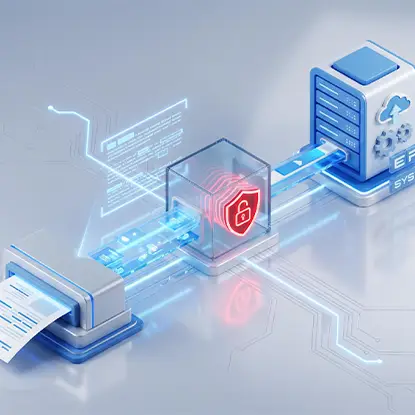
Automating document capture without validating the information being processed can allow errors and suspicious data to travel downstream. docAlpha uses AI-driven extraction, business rules, and validation to identify inconsistencies before data reaches connected systems.
Increase automation without sacrificing the accuracy and control critical business processes require.
Every handoff point in an automated document pipeline, from scan to OCR to ERP, is a potential entry point for fraud.
Automated document capture, RPA, and OCR-driven data entry all do the same basic thing: they pull sensitive financial and vendor information out of scattered inboxes and file cabinets and concentrate it into a smaller number of fast-moving systems. That consolidation is exactly what makes automation valuable, and it’s exactly what makes it attractive to attackers. A single compromised workflow can touch thousands of invoices, purchase orders, and vendor records in the time it once took a person to process a handful.
The World Economic Forum’s 2026 global cybersecurity outlook found that 94% of organizations now see AI as the most significant driver of change in security, yet only 22% run adversarial testing against their own AI systems, and 63% have no formal AI governance policy. In other words, most businesses have adopted the technology faster than they’ve adopted the controls to protect it.
That gap is where many automation deployments go wrong. Companies assume the automation platform vendor handles security, but most platforms are built to process documents accurately, not to detect a manipulated invoice or a spoofed vendor request. That’s a different discipline, and it’s why many finance and operations leaders now pair their automation stack with managed cybersecurity services dedicated to monitoring, detecting, and responding to threats the automation software was never designed to catch. Treating security as a separate, ongoing function rather than a checkbox during implementation is quickly becoming standard practice for any organization processing real money through automated pipelines.

A compromised invoice can move quickly through an AP workflow when automation is designed only for efficiency. InvoiceAction combines AI-driven invoice processing with validation and workflow controls that help surface exceptions requiring attention.
Process invoices faster while reducing costly errors and strengthening control across automated AP operations.
Fraud tied to automated financial workflows isn’t a theoretical risk. The FBI’s 2025 Internet Crime Report, released in April 2026, recorded roughly 24,800 business email compromise cases in the United States with $3.05 billion in reported losses, an average of about $123,000 per incident. The FBI’s guidance on business email compromise describes exactly the kind of scheme that thrives inside an automated AP process: a fraudulent request that looks routine enough to sail through.
The growth curve is steep. BEC made up roughly 1% of all cyberattacks in 2022. Following widespread generative AI adoption, that share climbed to 18.6% of all attacks, a 1,760% year-over-year increase. Vendor email compromise, where an attacker poses as a legitimate supplier requesting a change to payment details, now drives an estimated 61% of BEC incidents, according to Abnormal Security’s 2026 analysis of federal workflow data.
These aren’t isolated incidents affecting a handful of unlucky companies. The Association for Financial Professionals found that 76% of U.S. organizations experienced attempted or actual payments fraud in 2025, and about 74% were affected specifically by business email compromise. Automated AP workflows are common targets precisely because they’re built to act on document data quickly, approving and releasing payments based on what an invoice or purchase order says, without necessarily questioning whether that document is legitimate.
Recommended reading: Learn How Document Automation Software Transforms Workflows
The tools that make document automation smarter are also making fraud harder to catch. IBM’s Cost of a Data Breach Report 2025 found that 16% of all data breaches that year involved attackers using AI, and 37% of those breaches involved AI-generated phishing or other AI-assisted social engineering. That’s a meaningful shift from the clumsy phishing emails of a few years ago.
Deepfake audio of a CFO approving a wire transfer, a manipulated PDF invoice with altered banking details, or a vendor email thread hijacked mid-conversation- these are no longer rare edge cases. They’re specifically designed to defeat the kind of pattern-matching that automated systems rely on. When a document automation platform is built to trust structured data and move it along the workflow, a convincingly forged document can slip through untouched, especially if no human ever double-checks the underlying request.
This is part of why security teams increasingly frame AI as a double-edged tool: the same techniques that improve automation accuracy can be turned against it. Our recent piece on how AI is transforming IT security management goes deeper into how organizations are using AI defensively to counter these same attack patterns.

Purchase orders can enter automated workflows with incorrect, altered, or inconsistent information that creates problems downstream. OrderAction uses AI-powered capture, validation, and business rules to identify exceptions before order data advances into ERP processing.
Accelerate sales order entry while improving the accuracy and control of every automated transaction.
Continuous monitoring closes the gaps that automated systems can’t watch on their own.
Ardent Partners’ State of ePayables 2025 survey of 310 AP and finance executives found that 73% of AP departments now use some form of automation for invoice processing, up from 56% in 2022. Document automation is now mainstream infrastructure, not a pilot project, so security can’t be an afterthought bolted on after deployment.
A few controls consistently make the biggest difference:
None of these controls require abandoning automation. They require treating the automated workflow as a system that needs ongoing monitoring, the same way a network or a physical facility does.
Recommended reading: Document Automation: Which Documents Can You Automate?
If a fraudulent payment or a manipulated document does slip through, speed matters. Isolate the affected system or integration first, so the issue doesn’t spread to connected platforms. Verify any recent changes to vendor or payment details against a known, trusted contact, not the email thread where the change request appeared. Notify the receiving and sending financial institutions immediately since wire recalls have a narrow window to succeed. Document the incident thoroughly, including timestamps, affected records, and who touched what, both for recovery and for any required reporting.
Our guide on steps for recovering from a data breach walks through this process in more detail, and it’s worth reviewing before an incident happens rather than during one.
It’s also worth revisiting the threat picture periodically, since tactics keep changing. Our piece on how cybersecurity threats keep evolving covers some of the newer patterns worth watching.

Faster document processing can also accelerate bad or manipulated data if workflows lack proper controls. docAlpha combines AI-powered document capture, validation, and process automation to help organizations maintain accuracy and oversight as information moves into business systems.
Reduce manual processing while building more controlled, reliable document workflows from capture through downstream processing.
Document automation delivers real efficiency gains. Invoices get processed faster, orders move through the pipeline with fewer errors, and finance teams spend less time on manual data entry. But the same systems that speed up legitimate work will just as happily speed up a fraudulent payment if nobody built in the controls to catch it.
Pairing automation with layered technical safeguards, and outside security expertise where the internal team doesn’t have the bandwidth to monitor everything, is what keeps those efficiency gains from turning into liabilities. The businesses getting this right aren’t the ones avoiding automation. They’re the ones that stopped treating security as a separate project and started treating it as part of the system from day one.
 AI-Driven Tools for Smarter IT Security Management
 Essential Steps for Businesses to Recover from a Data Breach
 Emerging Cybersecurity Challenges in the Digital Era 2025
 How AI Payment Screening Prevents Fraud Before Ledger Entry
 How AI Is Making Cyber Threats More Advanced
 How to Defend Business Data Against Identity Based Cyber Attacks
