How Outdated Business Software Can Become an Expensive Operational Problem
Published: September 30, 2026
Every business runs on software that was chosen at some point in the past, under conditions that no longer apply. The company was smaller, the customer base was narrower, and the rules it had to follow were simpler. That software did its job, and because it kept doing its job, nobody had a reason to look closely at it.
Years pass, the business changes shape around the system, and the system stays exactly where it was. The trouble is that a system does not have to break down to become expensive. It can keep working, day after day, while quietly costing far more than anyone has put on paper.
Most companies keep running the software that carried them through their early years, long after it stopped keeping pace with them. Applications built on older versions of Ruby on Rails show this clearly, because every release left behind makes the eventual move longer, costlier, and more likely to disturb something that currently works.
A staged upgrade service is built around exactly that risk, moving through one version at a time, mapping what each change will affect before anything is touched, and putting checks in place that prove nothing broke along the way. For businesses that would rather not tie up their own engineers for months, the Ruby on Rails upgrade service by JetRockets handles that whole sequence from the first review to the final release.

Legacy software often creates manual workarounds long before an organization is ready to replace the underlying system. docAlpha automates document capture, data extraction, validation, and workflow processing to reduce repetitive work around document-driven operations.
Modernize critical processes without waiting for a complete overhaul of your technology environment.
The first place the cost appears is in upkeep. Older systems need more attention than newer ones, and the attention they need is rarely planned. Something stops working after a routine change elsewhere, and someone has to find out why. A small fix takes a full day because the person doing it has to be careful not to disturb anything nearby. None of these individual events look serious, so they get absorbed into ordinary work and never appear as a line in a budget.
Over a year, though, that absorbed effort adds up to a significant share of what a technical team actually does. The money is being spent either way. The difference is that spending on upkeep buys nothing new. It only keeps things where they already are, and it has to be spent again the following year, usually in a larger amount.
Software shapes how people work, whether or not anyone intended it to. When a system cannot do something, staff find a way around it. They keep a separate spreadsheet. They copy information from one screen into another by hand. They send a message to a colleague because there is no proper way to pass the task along inside the system.
These habits become invisible very quickly. People stop describing them as problems and start describing them as the job. A process that should take a few minutes takes half an hour, and nobody questions it because it has always taken half an hour.
Recommended reading: Discover How Process Automation Eliminates Manual Workarounds
Software that is no longer maintained stops receiving fixes for newly discovered weaknesses. The weaknesses themselves are public knowledge, described openly so that anyone running the software can protect themselves. When there is no fix available, that same public knowledge becomes a map for anyone looking for an easy target.
This risk does not stay flat. It increases every month the system sits unchanged, because the list of known weaknesses only ever gets longer. For a business handling customer records, payment details, or anything covered by privacy rules, this is not simply a technical concern. It is a question of what happens to the company's reputation and its legal position if something goes wrong, and the answer rarely favors the business that knew and waited.

When business systems cannot keep pace with changing requirements, employees often compensate with spreadsheets, manual data entry, and disconnected handoffs. docAlpha helps automate document-intensive processes by capturing, validating, and routing business information into downstream workflows.
Reduce the hidden operational cost of manual work while building more scalable processes.
There is a human side to this that companies tend to notice too late. Capable people want to work on things that teach them something. Being assigned to keep an aging system alive offers very little of that, and it is often frustrating in ways that are hard to explain to anyone outside the team.
Hiring becomes harder too. The pool of candidates who have worked with older approaches keeps shrinking, and those who have are usually looking for something else. Meanwhile, the people who already understand the system become irreplaceable, not because of their talent but because of what they happen to know. When one of them leaves, a large amount of understanding walks out with them, and none of it was ever written down.
Customers form an opinion of a company partly through the systems they touch. A slow page, a form that loses their information, an account screen that looks like it was designed for a different era. They do not think about the technology behind any of it. They simply decide that the company is behind the times, and they carry that impression into every other dealing they have with it.
Internal staff feel the same thing from the other side. When the tools they use every day are awkward, it affects how they speak about the company and how long they intend to stay.
Recommended reading: Learn How Digital Technology Modernizes Business Operations

Modernization does not always require replacing every business application at once. docAlpha adds intelligent document processing and workflow automation around document-driven operations, helping information move more efficiently into downstream systems.
Take a practical, incremental approach to modernization while reducing manual effort today.
The useful step is not a dramatic one. Start by establishing what the current system actually costs, including the hours spent on upkeep, the workarounds staff have built, and the projects that were shelved because of it. That figure is almost always larger than expected, and it gives the discussion a firm footing.
From there, the work is best approached in defined stages rather than as a single, sweeping replacement. Staged work keeps the business running, spreads the cost across a longer period, and gives everyone involved a chance to adjust. It also produces improvements that people can see along the way, which makes the remaining stages easier to support.
 How to Eliminate Repetitive Work? Hint: Intelligent Automation
  Revolutionizing Businesses with Cutting-Edge Digital Solutions
 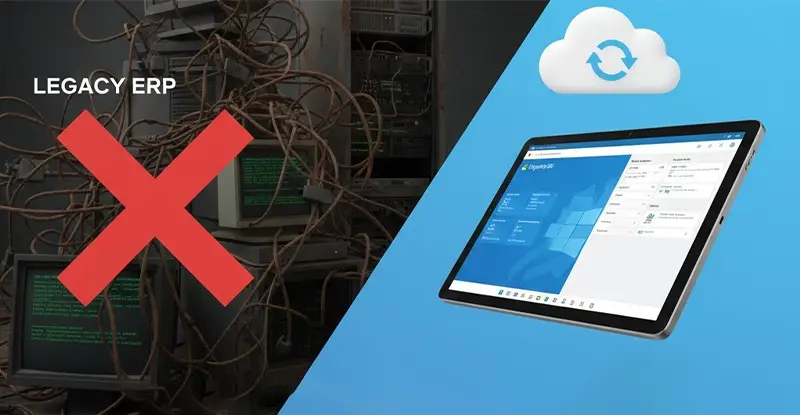 When Legacy ERP Slows Growth, Move to Microsoft Dynamics 365
  SaaS vs On-Premise: Pros, Cons, The Balance
  Software Maintenance for Reliable Intelligent Automation Systems
  Business Security Solutions: A Guide to Safer Digital Operations
