10 Signs It’s Time to Replace Your Legacy ERP with Dynamics 365
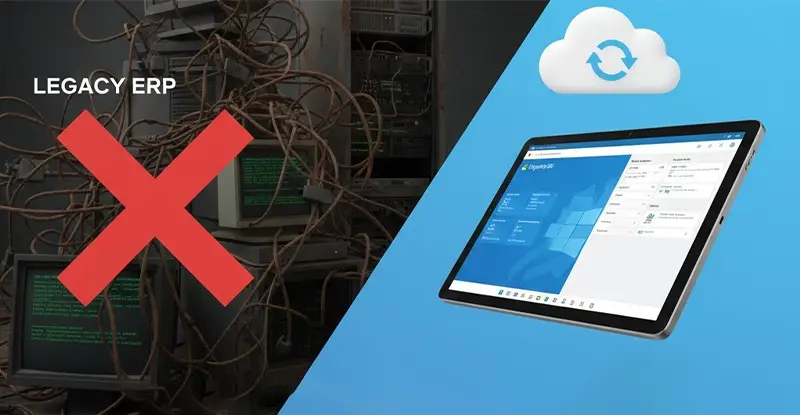
Published: March 05, 2026
For many UK organisations, a legacy ERP system once delivered structure, control and financial visibility. But what once supported growth can quietly become the very constraint that limits it.
If your business is scaling, diversifying operations, expanding internationally or investing in automation, your ERP must function as a strategic platform - not a technical liability.
Modern cloud solutions such as Microsoft Business Central ERP and broader Microsoft Dynamics 365 ERP applications are designed for real-time insight, AI-enabled workflows and seamless integration across departments. In contrast, legacy systems often introduce friction, manual workarounds and escalating maintenance costs.
Below are 10 clear signs that it may be time to replace your legacy ERP with Dynamics 365.

Disconnected document workflows create delays even in modern ERP environments. docAlpha extends Microsoft Dynamics 365 with AI-powered capture and rules-based validation. Drive real-time accuracy from document intake to financial posting.
Growth exposes architectural limitations.
If adding new users, entities, warehouses or international operations requires custom development or infrastructure upgrades, your ERP is no longer scalable.
Legacy systems were typically built for static environments. Modern cloud ERP platforms such as Microsoft Dynamics 365 are designed for elastic scalability - allowing you to expand operations without replatforming.
Warning signs:
Scalability is no longer optional. It is foundational.
Recommended reading: How to Automate Accounts Payable in Microsoft Dynamics 365
If your finance team exports data into spreadsheets for board reporting, your ERP is failing at one of its core responsibilities.
Legacy systems often:
Modern ERP platforms embed reporting and business intelligence natively. With integrated analytics, decision-makers access live operational and financial metrics without reconciliation delays.
Delayed insight leads to delayed decisions - and delayed decisions cost money.
Disconnected systems are one of the most expensive hidden costs in mid-market businesses.
If CRM, finance, warehouse management and operations operate independently, your ERP is not serving as a unified backbone.
Dynamics 365 provides integrated architecture across:
Eliminating data silos improves accuracy, shortens cycle times and reduces reconciliation overhead.
Dynamics 365 AP Still Manual? Fix It Now.
If accounts payable relies on rekeying and email approvals, ERP modernisation is incomplete. InvoiceAction integrates directly with Microsoft Dynamics 365 to automate invoice capture, matching, and posting. Reduce AP cycle time and improve financial control instantly.
Book a demo now
Legacy ERP systems often require:
As vendors phase out support for older systems, costs escalate rapidly.
Cloud-based ERP platforms operate on a predictable subscription model, including automatic updates and security management. This reduces technical debt and lowers total cost of ownership over time.
If your IT budget is disproportionately allocated to “keeping the lights on”, replacement should be evaluated.
Recommended reading: Microsoft Dynamics 365 Finance and Operations: How It Helps
Modern organisations rely on:
If your ERP lacks APIs or requires expensive middleware for integrations, it becomes a bottleneck.
Dynamics 365 integrates seamlessly with tools across the Microsoft ecosystem, including:
This interoperability enables automation, insight and collaboration without complex infrastructure redesign.
Cybersecurity threats and regulatory frameworks continue to evolve.
Legacy ERP systems often:
Cloud ERP platforms are hosted in enterprise-grade data centres with continuous security updates and compliance certifications.
For UK businesses navigating GDPR, Making Tax Digital and sector-specific regulations, security cannot be reactive - it must be embedded.
Complete Your Dynamics 365 Upgrade with Order Automation
Modern ERP without automated order capture still limits scalability. OrderAction connects directly with Dynamics 365 Business Central and F&O to streamline order processing. Reduce cycle times and improve customer satisfaction.
Book a demo now
Shadow IT is a symptom of ERP inadequacy.
If teams:
Your ERP is not meeting operational needs.
Modern ERP systems provide configurable workflows, role-based dashboards and automation that reduce dependency on informal processes.
When employees circumvent your ERP, governance deteriorates.
Recommended reading: Discover Intelligent Invoice Automation for Dynamics 365
AI is no longer aspirational - it is operational.
Legacy ERP systems were built primarily for transaction recording. Modern ERP systems participate intelligently in execution:
Dynamics 365 incorporates AI-driven forecasting and analytics directly within financial and operational modules.
Without automation, your competitors gain structural advantage.
On-premise ERP environments introduce:
Cloud ERP enables:
As hybrid working models persist, accessibility becomes a strategic necessity.
If your ERP upgrade cycle spans years, you are already behind.
Stop Letting Manual Documents Undermine Dynamics 365 ROI
If teams still rely on email attachments and spreadsheets, your ERP investment is underperforming. docAlpha integrates tightly with Dynamics 365 to automate document-heavy processes. Increase speed, visibility, and governance across departments.
Book a demo now
The most critical sign: leadership discussions about expansion consistently reference system limitations.
Common statements include:
When technology dictates strategy instead of enabling it, replacement becomes strategic rather than optional.
Replacing a legacy ERP is not merely a technical upgrade - it is an operational transformation.
Microsoft Dynamics 365 ERP offers:
For small to mid-sized businesses, Microsoft Dynamics 365 Business Central provides comprehensive financial, supply chain and project management capabilities within a scalable cloud framework.
For larger or more complex organisations, advanced modules within the Dynamics ecosystem support deeper operational complexity.
Unlock True AP Automation in Dynamics 365
Cloud ERP improves architecture - but manual invoice entry still drains productivity. InvoiceAction connects natively with Dynamics 365 Business Central and F&O to eliminate invoice bottlenecks. Turn AP into a scalable, AI-driven process.
Book a demo now
ERP replacement should be evaluated using a structured framework:
When these factors are quantified, modern ERP investment often demonstrates positive ROI within predictable timeframes.
A successful Dynamics 365 implementation follows a phased methodology:
Cloud architecture reduces deployment complexity compared to traditional ERP rollouts. However, success depends on:
Modern ERP adoption is as much about people and processes as it is about technology.
Dimension | Legacy ERP | Dynamics 365 ERP |
Deployment | On-premise | Cloud-native |
Updates | Manual, disruptive | Automatic |
Scalability | Limited | Elastic |
Integration | Custom APIs | Native ecosystem |
Reporting | Batch-based | Real-time |
Automation | Minimal | AI-enabled |
Security | Localised | Enterprise-grade |
This contrast illustrates why ERP modernisation has accelerated across the UK mid-market sector.
Many organisations delay ERP replacement due to perceived disruption. However, delay introduces compounding risk:
ERP is infrastructure. Infrastructure must evolve alongside strategy.
Recommended reading: How Microsoft Dynamics 365 Business Central Powers Growing SMBs
While Microsoft Business Central ERP addresses the needs of growing SMEs, larger enterprises or complex financial structures may require additional capability through Dynamics 365 Finance - delivering advanced financial governance, global compliance management and enterprise-grade scalability.
Together, these platforms create a unified ERP foundation capable of supporting long-term digital transformation.
A legacy ERP system may still function - but functionality alone is no longer sufficient.
Modern businesses require:
If several of the 10 signs outlined above resonate with your organisation, it may be time to evaluate replacing your legacy ERP with Dynamics 365.
ERP should accelerate growth - not restrict it.
The question is no longer whether to modernise.
It is whether your current system can support the business you aim to become in 2026 and beyond.
 Microsoft: Signs You’ve Outgrown Your ERP (eBook)
 17 Benefits of Cloud ERP
 The Essential Guide to Cloud Enterprise Resource Planning (ERP)
 Invoice Processing for Microsoft Dynamics 365
 How To Get More Value Out Of Your ERP Software
 AP Automation for Leading ERP Systems Enhanced by Artsyl
