How to Streamline Communication Between B2B Companies and Their Clients
Published: June 30, 2026
Communication between a B2B company and its clients rarely breaks down all at once. It erodes slowly: one missed email, one outdated spreadsheet, one client calling to ask about something that was already answered last week. Each instance feels minor on its own, but over time these gaps add up to slower response times, frustrated clients, and a team spending more energy chasing information than serving customers.
Fixing this usually doesn't require a complete overhaul of how a company operates. It requires finding where communication actually breaks and replacing the weakest links with tools built for the job - which is why so many companies end up exploring B2B portals as part of the solution. Before getting into what works, it helps to understand why B2B communication is structurally harder than it looks.

Email threads and shared inboxes shouldn't drive customer service. docAlpha transforms incoming business documents into AI-powered workflows that improve visibility across CRM, ERP, and customer support systems. Increase productivity while building stronger customer relationships.
B2B communication is more complex than consumer-facing support. A single client account often involves multiple stakeholders - a procurement manager, a finance contact, and an operations lead - each needing different information at different times. A delivery timing question might involve the warehouse team, while a billing dispute belongs to finance, and these teams rarely communicate directly.
B2B relationships are also long-term and recurring rather than one-off. The same questions get asked across months or years - order status, invoice copies, pricing updates - and without a system that tracks what has already been discussed, information gets re-explained again and again. Add multiple channels, such as email, phone, chat, and sometimes fax, and messages can easily get lost or contradicted.
Most friction in B2B communication traces back to a handful of recurring patterns:
None of these are unusual - they show up in many B2B companies that have not centralized client communication yet. Each one has a fairly direct fix.
Recommended reading: AI Automation: What It Is and How It Works
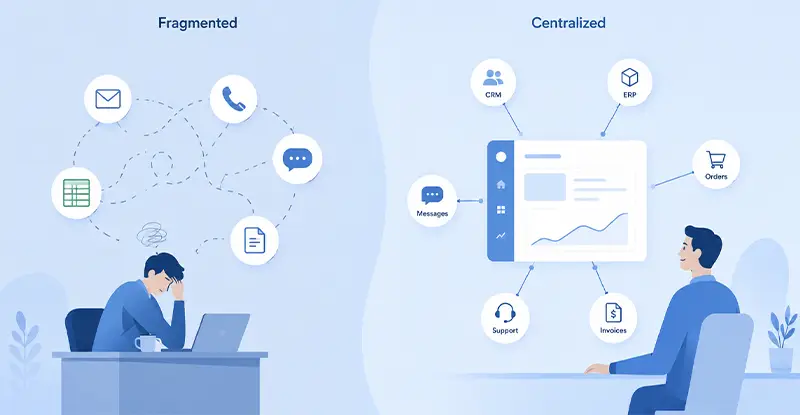
When client conversations spread across personal inboxes, shared mailboxes, and the occasional sticky note, nobody has a complete view of the relationship. A new rep has no history to reference, and a client repeating themselves to a different contact each time loses patience.
The fix is bringing communication into a shared system - a CRM, a shared inbox, or a dedicated portal - where every interaction is logged in one place. Anyone on the team should be able to open an account and see the full history: past orders, support issues, and commitments made. This alone removes much of the back-and-forth caused by incomplete information.

Finance teams shouldn't spend time chasing invoices. InvoiceAction automates document processing and approval workflows so your organization can focus on serving customers instead of managing paperwork. Accelerate AP operations while delivering measurable business value.
A large share of routine communication exists only because clients lack direct access to their own information. They email to ask whether an order has shipped, call to check an invoice balance, or follow up on a delivery date - not because they want to talk to someone, but because there is no other way to find out.
Giving clients visibility into their own data solves this at the source. When a client can log in and see order status, shipping updates, and invoices, routine inquiries can drop significantly, and the ones that remain tend to be more substantive - pricing negotiations, custom requests, or actual issues - rather than status checks a system could have answered automatically.
Email is convenient, but it is a poor system of record for an ongoing relationship. Threads get buried, attachments get lost, and requests sit unanswered simply because they arrived at a busy moment. As order volume and client count grow, relying on email as the primary channel becomes a genuine bottleneck.
Self-service tools take pressure off email by letting clients handle routine tasks on their own:
Each of these removes a task that used to require a human reply, freeing staff to focus on conversations that need their attention.
Recommended reading: How AI Algorithms Transforming Intelligent Process Automation
Even with good external tools, internal misalignment can undo the progress. If the sales team doesn't know what support promised, or the finance team isn't aware of a pricing exception operations approved, the client experiences that disconnect directly and has to explain the situation again.
Fixing this starts with making sure client information isn't siloed by department. Shared account notes, visible order history, and clear request ownership all prevent the kind of confusion that wastes clients' time. Quick handoffs between teams - a note when a deal closes, a flag when an account has an open issue - keep everyone aligned without constant meetings.
A lot of B2B communication is genuinely repetitive: order confirmations, shipping notifications, invoice reminders, and low-stock alerts. None of it requires a person to manually write and send a message every time, yet many companies still handle it that way.
Automating these touchpoints does two things at once: it ensures clients get timely, consistent updates without waiting on someone to remember, and it frees staff from work that adds little value when done manually. A well-set-up system can cover:
The goal isn't to remove the human element from client relationships - it's to reserve human attention for conversations that actually need it.

Disconnected document workflows create unnecessary customer frustration. docAlpha combines AI automation with intelligent document processing to streamline communication across every business function. Reduce operational costs while delivering faster, more consistent service.
Communication tools only solve part of the problem if they operate separately from the systems holding actual business data. A support team answering questions without access to actual order and inventory data is still working from guesswork, just in a nicer interface.
Real improvement comes from connecting communication channels directly to CRM and ERP systems, so whoever is talking to a client works from the same live data as the rest of the business. For example, companies like Asabix recognize that a messaging layer is only as useful as the data behind it; a disconnected tool simply becomes another place where information can go stale.
Email automation and better processes solve a lot, but once a company reaches a certain level of client count, order volume, and recurring questions, a dedicated customer portal often becomes the more efficient answer. Instead of spreading self-service features across disconnected tools, a portal consolidates account access, order tracking, documents, and support requests in one place tied directly to the company's core systems.
Companies that benefit most share a few traits: high order frequency, multiple contacts per account, and a support team spending more time answering repeat questions than handling actual exceptions. For those businesses, a portal isn't an added convenience - it becomes the primary channel through which the relationship runs, freeing both clients and internal teams from the friction that manual processes inevitably create.
Recommended reading: How AI Technology Is Transforming Modern Business
 AI Automation: What It Is and How It Works in 2026
 AI Algorithms in Intelligent Process Automation (2026 Guide) | Artsyl
 AI Technology: Artificial Intelligence Technology Explained
 CRM and Helpdesk Integration for Better B2B Support
 AI Order Management: The Complete 2026 Guide to Intelligent Order Processing
 Automate Email Workflows & Boost Productivity | Your Guide
