Email API vs inbox API for AI agents: which do you need?

Published: September 02, 2026
To different degrees, yes. Mailtrap pairs deliverability-grade sending with a persistent inbox through its REST API. AgentMail stores inbound well and can send too, though its sending side isn't built as dedicated deliverability infrastructure. Postmark sends just as well as Mailtrap but only forwards inbound mail rather than storing it. Which one fits depends on whether deliverability-grade sending or MCP-native inbound access matters more for the workflow.
The API itself is the same, but the requirements around it differ. A traditional app sends one type of email and has a human available to fix configuration problems. An AI agent operates autonomously, handles multiple sending patterns simultaneously, and generates content dynamically. That combination makes MCP server support, stream separation, and log retention matter more than they do for a manually operated system.
The failure modes depend on the direction of the mismatch. An agent using an email API when it needs inbox capability cannot read incoming messages, which breaks any workflow that depends on replies or inbound routing. An agent using an inbox API when it only needs to send ends up with unnecessary complexity and often weaker deliverability than a dedicated email API provides.
An email API sends email programmatically. An inbox API receives and processes it. Most agent email failures trace back to picking the wrong category for the job, or not realizing a workflow needs both.
Mailtrap, Postmark, and AgentMail all handle AI agent email workflows in 2026, but in a different way.
If your agent needs both sending and receiving in one workflow, Mailtrap pairs deliverability-grade sending with a persistent inbound inbox.
If your agent needs to send emails fast, an email API like Postmark will handle this.
If your agent receives email and needs to read, store, or act on incoming messages, you need an inbox API. AgentMail is built for that end to end, MCP included.
Email API | Inbox API | |
Primary function | Send email | Receive and read email |
Stores messages | No | Yes |
Agent use case | Alerts, confirmations, onboarding, campaigns | Support loops, reply monitoring, ticket routing |
MCP support | Common | Less common, and where it exists it doesn't always cover both directions |
If your agent sends and receives within one workflow, you need both. Mailtrap is built around that combination: an MCP server for sending (76 tools, stream separation by default), and a persistent inbound inbox through its REST API.
If your agent sends alerts, confirmations, onboarding, or campaigns, you need an email API. Postmark is a strong fit when delivery speed is the primary requirement.
If your agent handles ticket routing, reply monitoring, or document processing from attachments, you need an inbox API. AgentMail covers the full inbox model with persistent storage, threading, and conversation history across sessions, all reachable through its MCP server.

docAlpha captures documents and attachments from incoming channels, uses AI to extract and validate business data, and routes it into downstream processes.
Move beyond inbox connectivity to intelligent document processing that reduces manual intervention and accelerates operations.
An email API is a programmatic interface for outbound email delivery. It manages SMTP relay, IP reputation, authentication (SPF, DKIM, DMARC), bounce tracking, and delivery analytics. The agent supplies content and recipient; the email API handles getting the message delivered reliably. For AI agents specifically, the email API is the part of the stack that runs most often: every confirmation, alert, notification, and campaign goes through it, which is why deliverability and autonomous tooling matter more here than anywhere else in the email infrastructure.
That includes everything from how the agent authenticates sending domains to how it handles bounces and monitors delivery stats without a human checking a dashboard, which is why picking the right email sending API for AI agents matters early in the build.
An inbox API gives the agent programmatic access to incoming email: reading messages, parsing content, tracking threads, and acting on replies. An agent that monitors a support mailbox, processes reply-by-email confirmations, routes incoming tickets, or maintains a two-way conversation with a user needs an inbox API. This is the part of the email stack that most developers underplan for: the sending side is well-documented and well-tooled, but the receiving side requires more architecture decisions upfront.
Recommended reading: Discover How AI Automation Transforms Business Workflows
Mailtrap
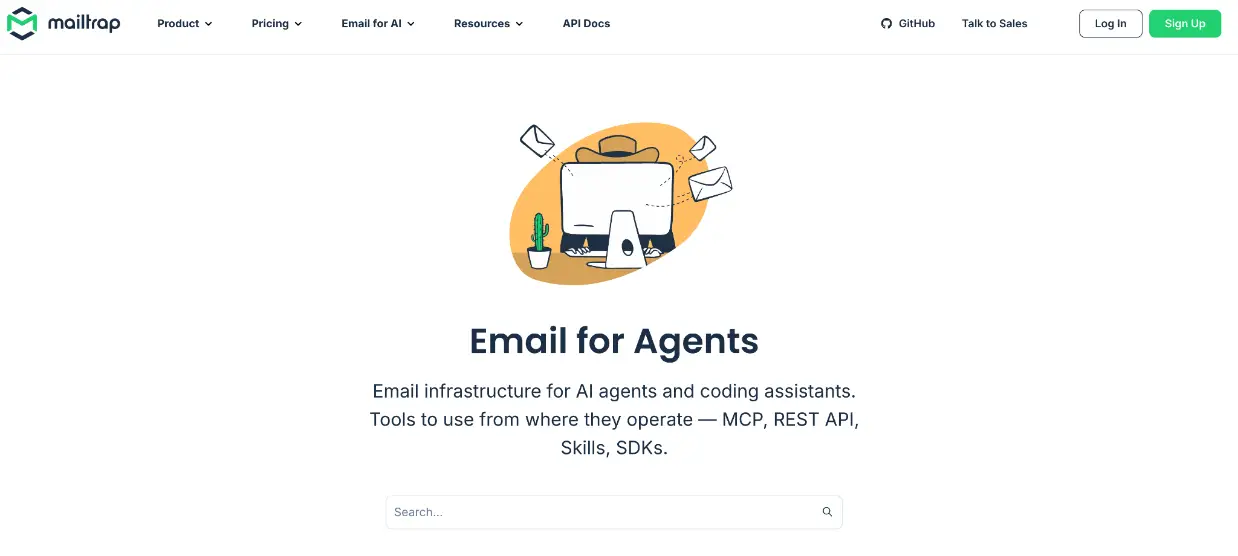
Mailtrap is an email sending API built for developers and product teams who value high deliverability. Transactional and bulk streams are separated by default, so operational alerts do not share IP reputation with marketing campaigns.
The MCP server ships 76 tools covering sending, domain management, template configuration, and delivery stats, and a dedicated AI onboarding page walks agents through platform setup directly. DKIM keys rotate automatically every month, and SPF, DKIM, and DMARC configure during domain verification without manual DNS work beyond adding the initial records. Log retention scales with plan, from 3 days on the free tier up to 30 days on Enterprise. SDKs cover Node.js, PHP, Ruby, Python, Java, .NET, Go, and Elixir. Free tier: 4,000 emails per month with no credit card required.
On the receiving side, Mailtrap's Inbound Email product covers the same ground as a dedicated inbox API: hosted inboxes at a unique address with no DNS setup, full message parsing (sender, headers, body, attachments, thread ID) delivered as structured JSON, folder-based organization, and in-thread replies through the REST API, available on the free tier too.

InvoiceAction captures emailed invoices, extracts and validates invoice data, and moves documents into controlled AP workflows without repetitive data entry.
Reduce invoice handling time and give AP teams more capacity to focus on exceptions instead of inbox administration.
Postmark
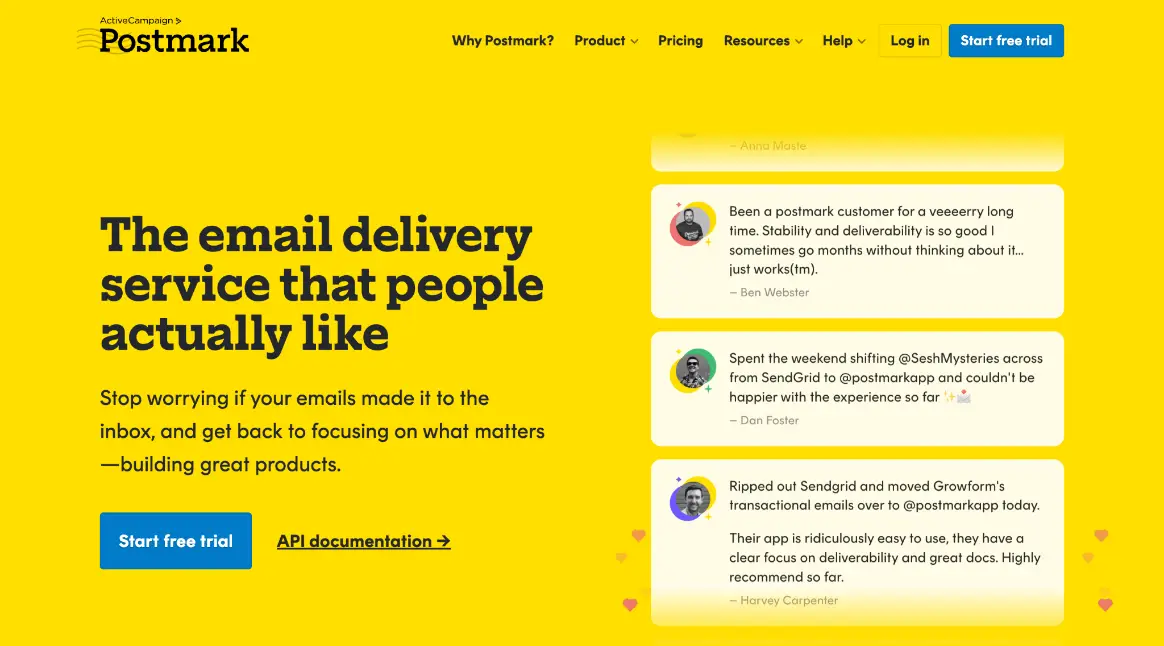
Postmark focuses on delivery speed and maintains a strict account review before enabling live sending, which keeps its shared IP pool clean and protects placement rates across all accounts on the platform.
It is particularly well suited for agents that need fast delivery on time-sensitive messages like authentication codes, payment confirmations, and real-time alerts, where inbox placement speed matters as much as reliability. Its MCP server ships 4 tools, outbound sending only; inbound mail is processed and forwarded to a webhook rather than stored.
Recommended reading: Explore How Process Automation Works in Modern Businesses
AgentMail
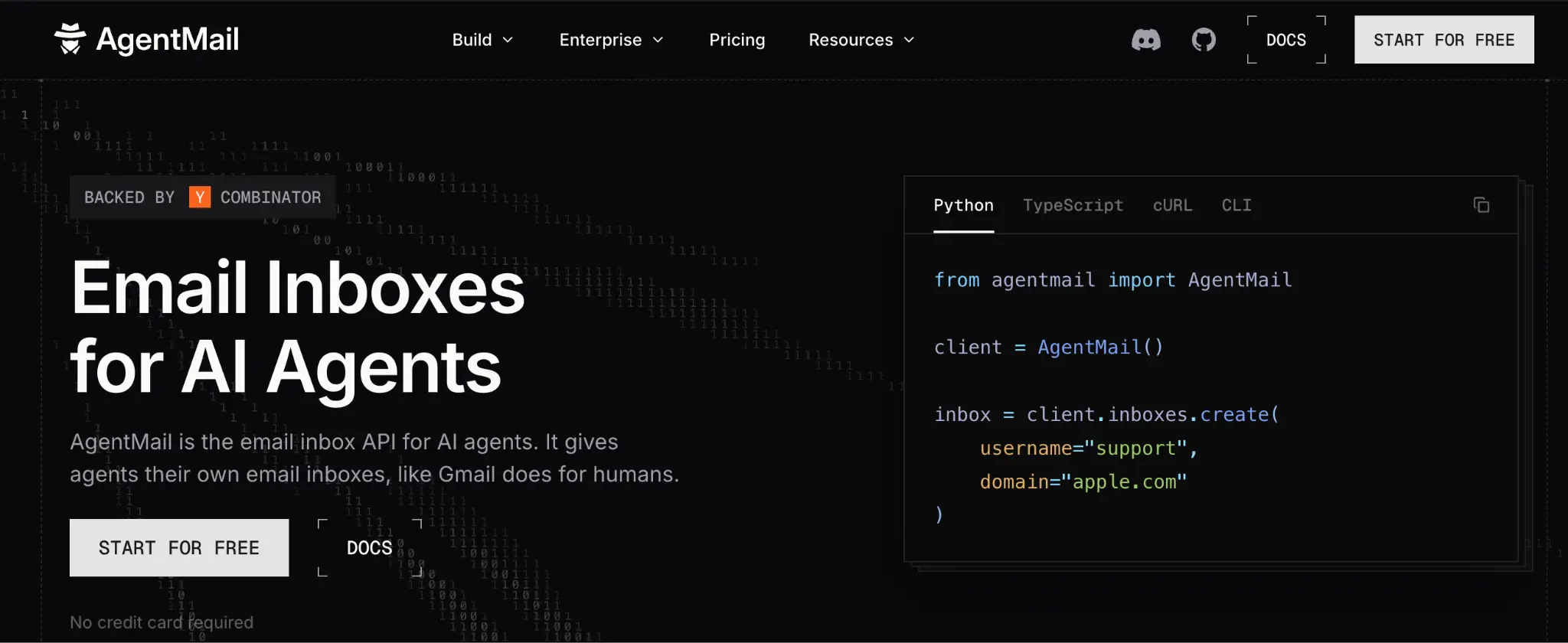
AgentMail provides programmatic inbox creation, persistent storage, threading, and search through a single API key, with both sending and receiving exposed as MCP tool calls, not just sending. Native integrations exist for LangChain, LlamaIndex, and CrewAI. The agent creates and manages isolated mailboxes via API with full conversation history available across sessions. The free tier includes 3 inboxes and 3,000 emails a month, no credit card required.
The agent operates without a human configuring credentials or verifying domains mid-workflow. MCP server support is what makes this possible: an agent connected to an official MCP server can handle domain verification, template management, and sending stats through tool calls without a human step in between. Without MCP, a human still has to configure the sending setup before the agent can operate, which breaks the autonomous model before the first email goes out.
An agent might fire transactional alerts, onboarding sequences, and bulk campaigns from the same codebase. If those share an IP pool, one bad bulk run damages deliverability for the operational messages, and the agent has no way to detect that without checking logs. Email APIs that separate transactional and bulk streams by default solve this at the infrastructure level rather than requiring manual reputation management. This matters specifically for agents because they often handle multiple sending patterns simultaneously, whereas a traditional app usually sends one type of email from one integration.

When inbox APIs deliver documents but leave the processing work unfinished, docAlpha applies AI-powered capture, classification, extraction, validation, and routing.
Transform incoming business documents into structured, actionable data without adding manual processing steps.
When an agent sends something it should not have, formats a template incorrectly, or hits a deliverability issue with a specific provider, you need logs to debug it. Providers vary from a few days to a month of retention, and some only log delivery events while others retain the full email body including HTML and headers. For autonomous agents, the failure mode is often silent and only caught days later when a user reports it. Longer retention with full message content gives you the visibility to reconstruct what happened without relying on external logging infrastructure.
Inbox APIs provide persistent storage, threading, and search. The agent retrieves past messages, navigates threads across sessions, and maintains conversation state without building its own storage layer. Authentication is typically a simple API key with no OAuth refresh cycle, which removes the re-authentication problem for long-running autonomous workflows. An OAuth token that expires mid-workflow requires a human to step in and re-authenticate, which breaks the autonomous model.

OrderAction transforms emailed purchase orders into validated, structured sales order data through AI-powered document and process automation.
Accelerate order entry, reduce rekeying errors, and give customer service teams more time for exceptions and customer needs.
The email API vs inbox API distinction for AI agents comes down to directionality: sending, receiving, or both. Mailtrap and Postmark both handle outbound delivery with the deliverability infrastructure, stream separation, and MCP tools that autonomous agents need. AgentMail handles the receiving side with a persistent inbox reachable through MCP tool calls; Mailtrap covers the same receiving ground through its REST API instead. Postmark's inbound forwards rather than stores, and AgentMail's sending is lighter than a dedicated deliverability platform; Mailtrap is built around both sides together.
Recommended reading: Learn How Intelligent Automation Connects AI With Business Processes
 Email Platforms Supporting AI Agents and Automation
 AI Automation: What It Is and How It Works in 2026
 AI Agents vs Traditional Business Automation Solutions
 Designing AI Workflows That Support Human Productivity
 Improve B2B Communication with AI Automation
