Best Email Infrastructure for AI Agents in 2026

Published: May 14, 2026
It depends on the use case. For most agent workflows, the key factors are official MCP support, deliverability infrastructure, and how much the agent can do autonomously. Mailtrap, Postmark, and Cloudflare Email Service all have official vendor-maintained tooling, while SendGrid and Mailgun rely on community-built integrations for the agent layer.
Start with deliverability, look for separate transactional and bulk streams, SPF/DKIM/DMARC enforcement, and bounce tracking. Then check LLM readiness: whether the platform has an official MCP server, agent skills, and a CLI.
Cloudflare Email Service is the cheapest per email at $0.35 per 1,000 after the 3,000 monthly included, but only makes sense for teams already on Workers. For everyone else, Mailtrap and Mailgun both offer free plans with no credit card required: Mailtrap at 4,000 emails/month and Mailgun at 100 emails/day with paid plans starting at $15 for both.
An email API for AI agents is a programmatic email service exposed through an MCP server, CLI, or skills file, letting agents send, retrieve, and monitor emails without a human in the loop. Mailtrap, Twilio SendGrid, Postmark, Mailgun, and Cloudflare Email Service are the five email APIs worth looking at when connecting an AI agent to production email infrastructure in 2026.
Email API | Free plan | Starting price | AI agent tools |
Mailtrap | 4,000 emails/month | From $15 | MCP, skills, AI onboarding |
Twilio SendGrid | 100 emails/day | From $19.95 | Twilio MCP (community) |
Postmark | 100 emails/month | From $15 | MCP, skills, pre-built prompts |
Mailgun | 100 emails/day | From $15 | MCP |
Cloudflare Email Service | None | $0.35 per 1,000 emails | MCP, skills, CLI |
We tested each email infrastructure provider on the criteria explained below. Here’s a decision map:
Deliverability is the foundation. Look for providers that enforce DKIM, SPF, and DMARC, offer separate transactional and bulk streams to protect sender reputation, and provide bounce tracking, spam complaint monitoring, and inbox placement insights. Dedicated IPs and email warm-up matter at higher volumes.
LLM readiness is whether the platform has an official MCP server, agent skills, a CLI, and AI integration documentation. Official means the vendor maintains it. Community-built means someone else does, and maintenance is not guaranteed.
Token efficiency comes down to how many steps an agent needs to complete a task. Clear MCP tools, well-documented APIs, and concise skill files reduce round-trips and keep costs down.
Inbound email only matters if the workflow involves receiving and processing replies. Not all providers support it, and the quality of implementation varies significantly.
Infrastructure fit determines setup overhead. Some platforms integrate tightly with a specific ecosystem and add friction outside it. Others connect to any stack without dependencies.

docAlpha combines AI-based processing, workflow orchestration, and intelligent validation to automate document-driven business operations. Improve workflow efficiency while enabling smarter, faster operational decision-making.
G2: 4.8 | Capterra: 4.8
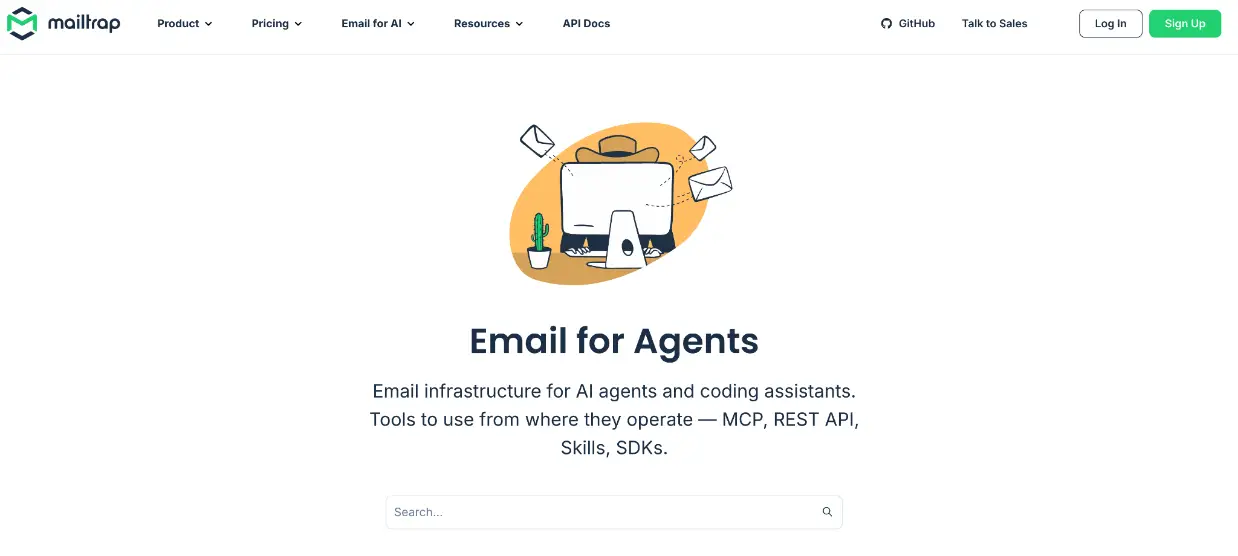
Mailtrap is a modern email API provider for developers and product teams, built around high deliverability, fast delivery, and in-depth analytics. With an official MCP server, official agent skills, and a dedicated AI onboarding page, it gives agents everything they need to send emails autonomously, from setup to monitoring. Companies using it in production include PayPal, Atlassian, Adobe, and Calendly.
AI Agent Tools
Mailtrap has an official MCP server and official agent skills. Once connected, the agent can handle domain verification and email-sending setup without further human input. The AI onboarding page works like an improved skills file that onboards agents to the platform directly. Official integrations with step-by-step guides exist for Claude Code, Cursor, and Lovable. The REST API works from any platform, with official SDKs for Node.js, PHP, Ruby, Python, Elixir, and Java.
Deliverability
Mailtrap uses separate sending streams, dedicated IPs, email warm-up, and throttling to achieve high inbox placement. SPF, DKIM, and DMARC are configured during domain verification, and DKIM keys rotate automatically every four months. The platform's deliverability experts work on the infrastructure continuously and are available to users when issues come up. Even on the free tier, the deliverability rate stays high.
Analytics and Logs
The platform provides dashboards and drill-down reports covering opens, clicks, bounces, and spam. Email logs are retained for up to 30 days, with the email body available for up to 15 days, including history and spam analysis. Via the MCP, an agent can pull both stats and logs directly without switching to the dashboard.
Pricing: Free at $0 for 4,000 emails/month with no credit card required. Basic starts at $15 for 10,000+ emails. Business starts at $85 for 100,000+. Enterprise starts at $750 for 1.5M+. Registration requires a human, by design for security.
Pros: 99.99% uptime SLA, official MCP and skills, 30-day email log retention, detailed analytics, automatic DKIM rotation, ISO, HIPAA, and SOC 2 compliant, GDPR-ready.
Cons: No inbound email support yet (in progress), account registration requires a human.
Recommended reading: How AI is Transforming Financial Institutions
G2: 4.5 | Capterra: 4.2
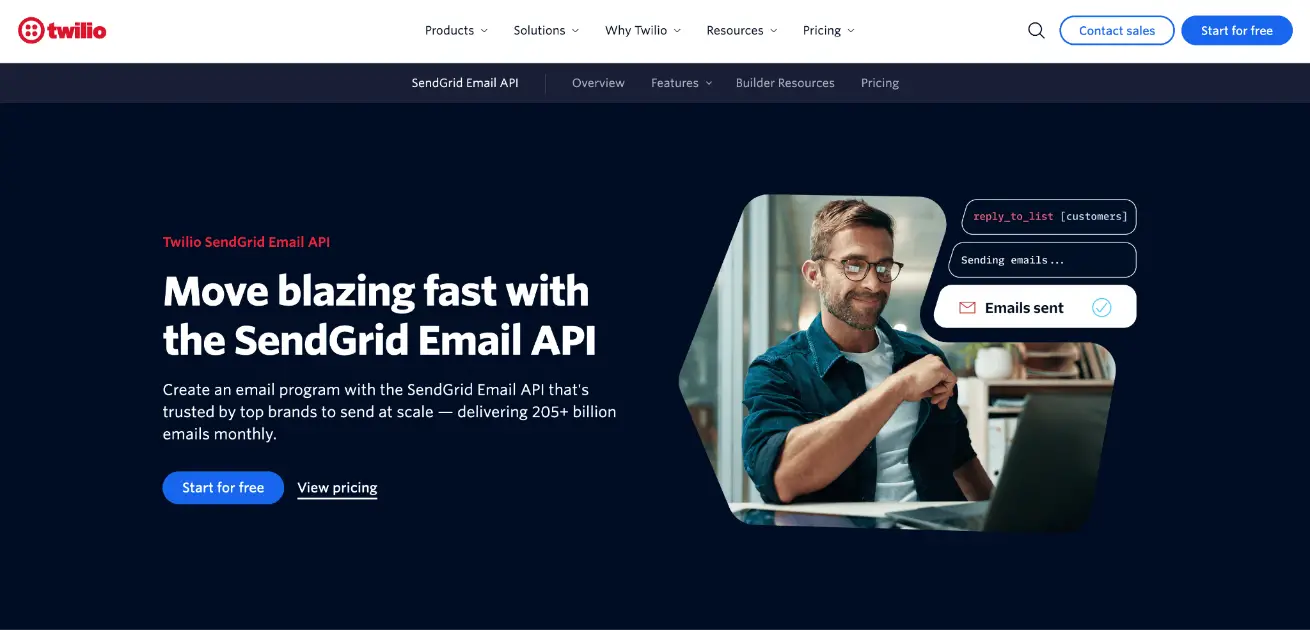
Twilio SendGrid is built for businesses that need to send email and have access to the broader Twilio stack. For agents working within the Twilio ecosystem, it covers email, SMS, voice, and WhatsApp from a single account with unified billing and no separate credentials per channel. For purely email-focused workflows, it is less agent-optimized: the MCP server and agent skills are community-built rather than official.
AI Agent Tools
SendGrid has a community-built MCP server and community-built skills via MCPBundles. Inbound Parse receives incoming emails, parses them into structured JSON covering headers, body, attachments, and spam score, and posts the content to your agent's webhook endpoint. For agents that need to receive a message, process it, and reply, Inbound Parse is the entry point. Official SDKs are available for C#, Java, Node.js, Python, PHP, Ruby, and Go, maintained for over 15 years. Documentation includes a built-in API Explorer for testing calls against a live account.
Deliverability
SendGrid uses pre-warmed IPs and enforces SPF, DKIM, and DMARC. Rate handling sits at 600 requests/minute on most endpoints, and streams can be separated via subusers and IP pools.
Analytics and Logs
Full event webhooks cover the delivery lifecycle including bounces, opens, clicks, and spam complaints, giving agents programmatic access to delivery data.
Pricing: Free trial at $0 for 100 emails/day for 60 days. Essentials at $19.95 for 50,000 emails. Pro at $89.95 for 100,000. Premier at custom pricing. Note that the email API and marketing campaigns are billed as separate products.
Pros: Twilio stack integration covering SMS, WhatsApp, and voice, Inbound Parse for agentic email workflows, sandbox mode, broad SDK support, pre-warmed IPs.
Cons: MCP server and agent skills are community-built rather than official, reports of unresponsive customer support.
Bring AI-Driven Intelligence Into Invoice Workflows
InvoiceAction automates invoice processing through AI-based extraction, validation, and intelligent workflow orchestration integrated with business systems. Reduce repetitive AP processing effort while improving automation visibility and operational control.
Book a demo now
G2: 4.6 | Capterra: 4.7
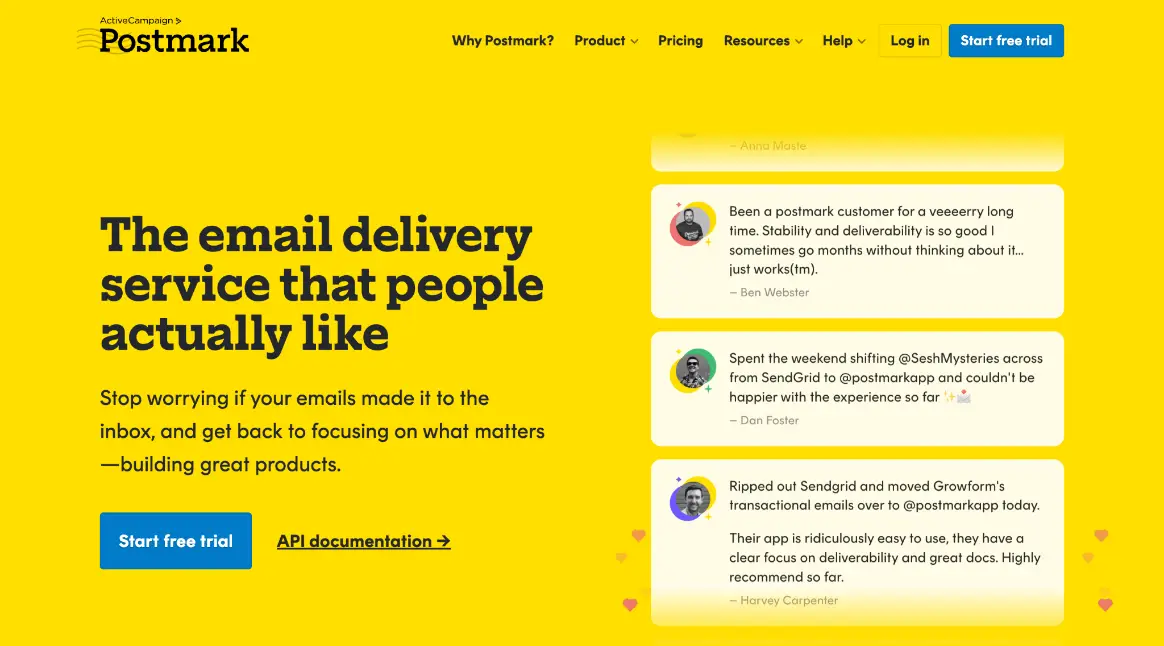
Postmark is built for teams that need reliable transactional email delivery and a structured way to receive messages. If the agent workflow involves receiving a reply, parsing it, and acting on it, Postmark is the most purpose-built option on this list for that use case.
AI Agent Tools
Postmark has an official MCP server and official agent skills. The MCP covers four tools: send email, send from template, list templates, and fetch delivery stats. Skills cover sending (single, batch up to 500, bulk, and template-based), inbound email processing, template management, webhooks and event tracking, and email best practices.
Postmark's inbound processing captures emails sent to your domain, parses them, and delivers structured JSON to your application via webhook, covering headers, content, attachments, and spam scoring. The StrippedTextReply field automatically removes the quoted thread, so the agent receives only the new reply content rather than the entire chain.
Deliverability
Postmark completed a migration from PowerMTA to KumoMTA, described by the company as the biggest infrastructure change in years. KumoMTA is an open-source high-performance MTA built for high-throughput sending with better queue management and more granular delivery controls. The platform enforces SPF, DKIM, and DMARC, and uses separate transactional and broadcast streams to keep sending reputations isolated.
Analytics and Logs
Delivery event webhooks give agents programmatic access to bounce, open, click, and spam events. Each stream can be monitored and rate-limited independently, which makes it easier to isolate issues between transactional and broadcast sending.
Pricing: Free at $0 for 100 emails/month. Basic starts at $15 for 10,000+ emails. Pro starts at $60.50 for 50,000+. Platform starts at $138 for 125,000+.
Pros: Official MCP and skills, structured inbound processing with StrippedTextReply, separate streams, KumoMTA infrastructure, pre-built integration prompts.
Cons: Free plan caps at 100 emails and is not practical for production, MCP covers only 4 tools, no dedicated sandbox.
Recommended reading: AI Automation: What It Is and How It Works
G2: 4.2 | Capterra: 4.3
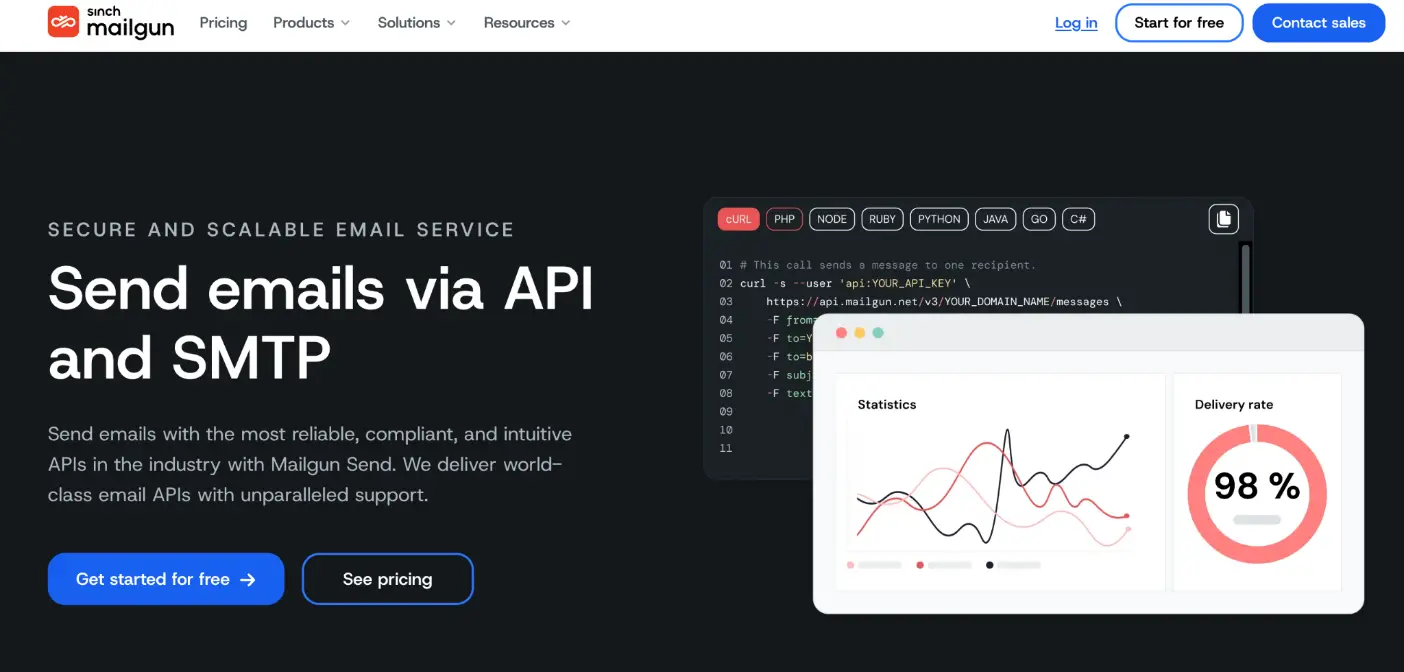
Mailgun is a transactional email API best suited for teams that want to give their agents email validation functionality on top of standard sending. Its MCP server exposes 50+ operations covering the full Mailgun API: sending, receiving, domain management, DNS troubleshooting, and more, all accessible through natural language via any MCP-compatible assistant.
AI Agent Tools
Mailgun has an official MCP server with 50+ tools but no official agent skills. Official SDKs are available for Go, Node.js, PHP, Java, Ruby, and Python. Mailgun APIs are also available as a Postman collection with organized examples and ready-to-use requests, useful for testing agent integrations before deploying. There is no dedicated sandbox.
Deliverability
The built-in email validation API verifies addresses before sending, giving agents lower bounce rates and a cleaner sender reputation without calling a separate service. For inbound, Mailgun parses incoming messages into UTF-8 JSON and delivers them to a webhook endpoint. Its inbound routing rules are the most advanced of any platform on this list: Mailgun can forward, filter, or route emails to different webhooks based on regex patterns, covering reply-by-email workflows, email-driven support ticketing, and email-to-app routing. Mailgun enforces SPF, DKIM, and DMARC, and offers EU and US data centers for compliance with regional data requirements.
Analytics and Logs
Full event webhooks cover the delivery lifecycle including bounces, clicks, opens, and spam complaints, with logs stored in whichever regional data center the account is configured to use.
Pricing: Free at $0 for 100 emails/day. Basic at $15 for 10,000 emails. Foundation at $35 for 50,000. Scale at $90 for 100,000.
Pros: Built-in email validation API, 50+ MCP tools, advanced inbound routing, EU and US data centers, SOC 2, ISO 27001, and HIPAA certified.
Cons: No official agent skills or CLI, no dedicated sandbox, pricing adds up quickly at scale.

OrderAction combines intelligent order automation with workflow orchestration to modernize business operations and processing efficiency. Accelerate order handling while improving workflow consistency and operational control.
G2: N/A | Capterra: 4.7
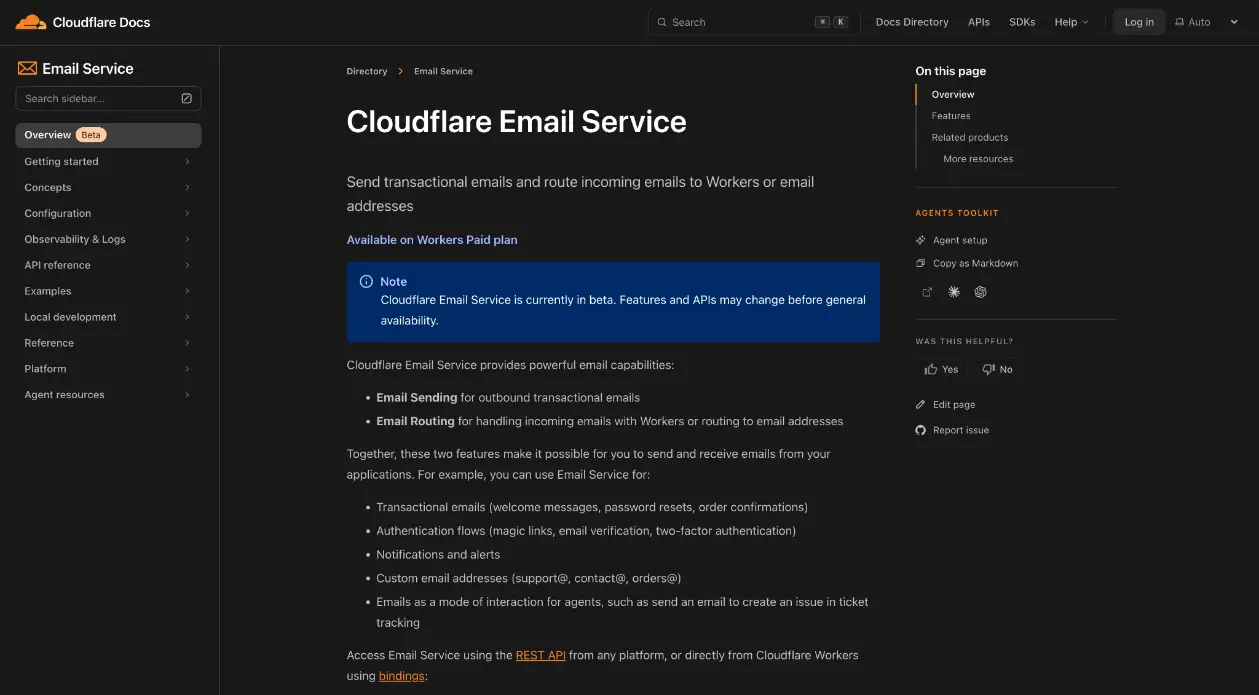
Cloudflare Email Service is built for developers on Cloudflare Workers infrastructure and teams building AI agents, background tasks, and automated workflows. It is still in public beta, which is worth keeping in mind before committing it to production.
AI Agent Tools
Cloudflare Email Service has an official MCP server, official skills, and a Wrangler CLI. Agents running on Claude Code, Cursor, in containers, or on external clouds can send and configure emails via the MCP server or Wrangler CLI. The CLI reduces context window overhead: rather than loading thousands of tokens of tool definitions upfront, agents discover capabilities on demand through help commands. The platform brings email sending alongside Workers AI, R2 for attachments, and Durable Objects for state management, all under one billing account.
Deliverability
SPF, DKIM, and DMARC are configured automatically. The service is transactional only, with no bulk or marketing email stream. Rate limits are not yet publicly documented.
Analytics and Logs
Delivery events are surfaced via Workers bindings, keeping observability within the Cloudflare ecosystem. Event data covers delivery status and can feed into downstream Workers for logging or alerting.
Pricing: Workers Paid plan at $5/month is required for email sending. After that, 3,000 emails/month are included, then $0.35 per 1,000.
Pros: Full Cloudflare stack integration covering Workers AI, R2, and Durable Objects, official MCP, skills, and CLI, Agentic Inbox reference app, HMAC-signed reply routing, automatic SPF/DKIM/DMARC, SOC 2, ISO 27001, GDPR, and PCI DSS compliant.
Cons: Still in public beta, transactional sending only, higher setup overhead from outside Cloudflare infrastructure, rate limits not yet documented.
Connect AI Automation to Operational Workflows
docAlpha helps organizations automate document handling, approvals, and business processes through intelligent AI-driven workflow automation. Increase operational visibility while reducing repetitive manual processing tasks.
Book a demo now
Choosing the right email infrastructure comes down to what the workflow actually needs. Mailtrap covers the widest range of agent requirements out of the box, with official MCP, skills, and deliverability infrastructure that works from the free tier. Postmark is the strongest option when inbound processing matters. Mailgun adds email validation to the sending flow without a third-party service. Cloudflare Email Service is the most cost-effective for teams already on Workers, at $0.35 per 1,000 emails with Agentic Inbox included. SendGrid is the right call when the agent needs to reach users across email, SMS, and WhatsApp from a single account.
 Strategies to Boost Email Open Rates for Businesses
 Automate Email Workflows & Boost Productivity | Your Guide
 Top 7 Power BI AI Agents Transforming Analytics in 2026
 How to Convert EML to PDF: Complete Guide for Email Management
 Choosing Email Migration Services That Actually Work
 Digital Fax in Automated Document Workflows Guide
