The Driver Training Paper Trail: How Document Automation Keeps Licensing And Fleet Records In Order
Published: October 19, 2026
Every driver training program produces records, and for commercial fleets those records can become part of a broader compliance trail with fixed review and retention requirements. Course certificates, test results, motor vehicle records, medical documentation, and annual review notes all have to be issued, checked, stored, and retrieved when needed.
Road safety remains a serious issue in the U.S. NHTSA reported 39,254 traffic fatalities in 2024. For transportation businesses, records showing that a driver was trained, tested, medically qualified where required, and reviewed form part of the evidence that compliance responsibilities were handled correctly.
For many new drivers, one of the first formal records is a certificate showing completion of an approved driver education course. State agencies determine which courses qualify, what information certificates must contain, and how completion data reaches the licensing authority.
Texas illustrates how far this process has moved toward structured digital records. Approved providers work within state certificate requirements and submit completion information electronically. The certificate still matters to the learner, but the process behind it increasingly depends on data moving between the training provider and the agency rather than on a sheet of paper being passed from one desk to another.
Training documentation continues beyond initial licensing. A driver may later complete defensive driving, commercial driver training, employer-required safety courses, or another program connected with a specific operational need. For a business running a fleet, those records can eventually sit beside licensing information, medical documentation, road-test records, and periodic reviews.

Managing driver qualification files involves collecting training certificates, licensing documents, medical records, and annual review paperwork from multiple sources. docAlpha automates document classification, data extraction, validation, and workflow routing to help fleet operators process these records more efficiently.
Reduce manual data entry, identify missing or inconsistent information, and improve the accuracy of document-driven fleet administration.
Federal requirements create an ongoing recordkeeping obligation for motor carriers that employ drivers covered by the applicable qualification rules.
A driver qualification file may contain the employment application, motor vehicle records obtained from licensing authorities, road-test documentation or an accepted equivalent, annual driving-record inquiries and reviews, and relevant medical qualification records. Different records are also subject to different retention periods.
The annual review cycle adds another layer. Carriers need to obtain and review the required driving record information at the appropriate interval and document that the review occurred. For a fleet with dozens or hundreds of covered drivers, those dates rarely fall neatly together.
A 50-driver fleet can therefore have 50 separate annual review cycles, medical qualification dates, training completions, license renewals, and document updates moving through the year. The difficult part is not understanding one form. It is keeping the entire record set complete over time.
Driver records are vulnerable to ordinary administrative friction because information rarely enters the business through one standardized channel.
A course certificate may arrive as a clean PDF, while a medical document is photographed with a phone. A motor vehicle record may come from a state portal, and an older road-test certificate may exist only as a scan. Dates appear in different positions and formats, making spreadsheet-based tracking less reliable as fleet size grows.
Storage creates another problem. HR may hold the original employment application, the safety team may maintain driving records, and another employee may have the newest training certificate sitting in an inbox. A document can technically exist while still being difficult to retrieve when someone needs it.
The same fragmentation affects deadlines. A medical qualification date, annual review, license expiration, and training renewal may all require attention at different times. When those dates are copied manually into a spreadsheet or calendar, one missed update can leave the record incomplete even though the underlying document was received correctly.
Recommended reading: Discover How Intelligent Document Processing Organizes Complex Business Records
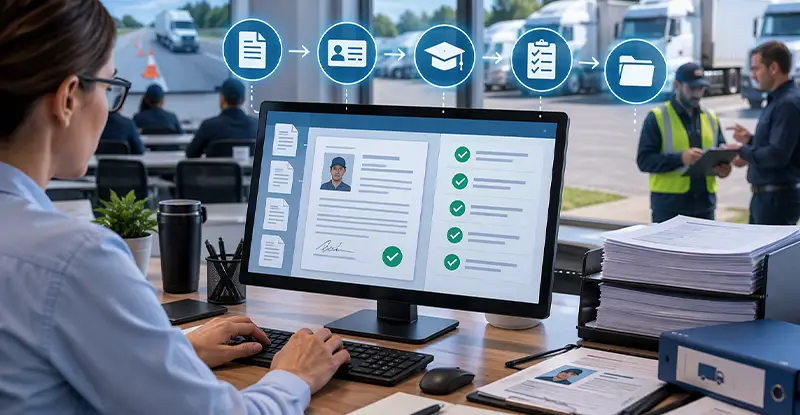
Intelligent document processing turns a driver document into structured information that another system can use. The workflow begins when a file enters a controlled intake channel and continues through classification, extraction, validation, routing, and storage.
A certificate can first be recognized as training documentation rather than a motor vehicle record or medical document. OCR and data extraction can then identify fields such as driver name, certificate number, completion date, license number, or expiration date. Validation rules can compare those values with an employee or fleet record and flag information that is missing or inconsistent.
Automation does not need to make every decision. A mismatch between the name on a certificate and the existing driver record can be routed to a reviewer. An approaching expiration date can create an alert. A document missing a required field can remain incomplete until someone resolves the exception.
Document | Data worth extracting | Automated check |
Driver education or course completion certificate | Student name, certificate number, provider, completion date | Match the learner to the correct record and verify required fields |
Defensive driving certificate | Driver name, provider, completion date | Check whether completion falls within the required period |
Motor vehicle record | License number, issuing state, violations, record date | Confirm record age and route relevant findings for review |
Medical qualification record | Driver details and expiration information | Create alerts before an applicable expiration date |
Road-test certificate | Driver, vehicle type, examiner, test date | Flag the file when required documentation is missing |
Annual review record | Reviewer name and review date | Confirm required review information before closing the workflow |
The training side of driver records is already increasingly digital. Commercial driver training uses electronic reporting within the FMCSA Training Provider Registry, while consumer driver education has also shifted heavily toward online coursework and digital learning records. State approval rules still differ, but the direction is clear.
NextDoorDriving online driver's ed provides online driver education, defensive driving, and test-preparation options. Its Texas 6-Hour Adult Drivers Ed course, for example, lists electronic certificate delivery, while the wider platform also provides DMV and CDL practice materials that learners can access digitally.
From a document-processing perspective, a digitally created certificate is easier to work with than a poor-quality scan. Clean text, predictable fields, and consistent formatting reduce the amount of correction required before information can enter another workflow.
The important connection appears after the learner finishes the course. The certificate still needs to reach the correct person or system, be associated with the right driver, remain retrievable when required, and sometimes trigger another operational action.
Recommended reading: Learn How Document Classification Routes Records to the Right Workflow
A digital certificate should not simply become another attachment that somebody downloads, renames, and files manually.
When it arrives through a controlled intake process, automation can associate it with an existing driver record using identifiers already held by the business. Relevant information can be extracted into structured fields while the original certificate remains attached as supporting documentation.
The system can then determine what happens next. A completed training requirement may update the driver's record. An unexpected provider or missing completion date may require review. A certificate connected with a renewal requirement may start a new deadline cycle.
This is where document automation becomes more useful than simple digitization. The goal is to make the information inside the document usable by the next business process.
The same principle applies to motor vehicle records, medical documents, road-test records, and annual reviews. Each has a different purpose, but all move through a similar sequence of capture, recognition, validation, decision, and retention.

Driver documentation often arrives as PDFs, scanned forms, photographs, and electronic certificates, creating repetitive work for HR, safety, and fleet administration teams. docAlpha automates document recognition, information extraction, validation, and workflow processing across connected business applications.
Reduce manual data entry and streamline the movement of driver-related information between departments.
Automation works best when it removes repetitive handling rather than pretending every document can be judged without context.
Software can identify that a field is missing, that two names do not match, or that a date is approaching. A qualified employee still needs to determine whether the discrepancy is acceptable, whether another document is required, or whether the driver's status should change.
That division of work keeps automated processing useful without turning a compliance workflow into an uncontrolled set of automatic decisions.
A business does not need to automate every record type at once. Starting with one high-volume or deadline-sensitive document makes it easier to test extraction, review exceptions, and see where manual work is actually occurring.
A practical implementation can follow these steps:
Recommended reading: Discover How Document Automation Supports Logistics Compliance
Electronic records do not remove the underlying regulatory requirements. When rules allow records to be generated, signed, maintained, or exchanged electronically, the digital version still needs to meet the substantive requirements that apply to that record and remain accurately reproducible when required.
The details also depend on the type of record and transaction. Electronic recordkeeping should therefore not be reduced to one generic consent or storage rule applied to every document. A compliance workflow needs to map the requirements that actually apply to each record type.
Automation also does not replace professional judgment. Software can surface a driving-record change, missing document, approaching expiration, or inconsistent field, but a reviewer may still need to determine what the information means and what action is appropriate.
State differences remain important as well. Online driver education is accepted when the course meets the requirements of the relevant licensing authority. A certificate from an online course should therefore be evaluated according to the applicable state program rather than assumed to satisfy licensing requirements everywhere.

Digital training certificates eliminate some paperwork, but fleet teams still need to associate each document with the correct driver, verify its information, and update the appropriate business records. docAlpha captures and validates information from incoming certificates and supports automated routing into connected fleet, HR, and document-management workflows.
Turn digital documents into usable business information while reducing manual processing and unnecessary administrative handoffs.
 How Compliance Training Tools Improve Employee Learning and HR
 How Gamification and Automation Improve Workforce Training
 Smarter Document Workflows for Logistics & Manufacturing
 Long-Term Employee Record Retention and Document Management
 Automation Tools That Simplify Compliance Across Sectors
 All About Intelligent Document Processing

