Custom Packaging Manufacturer vs Broker: Who Controls Specs When Things Go Wrong?
Published: March 04, 2026
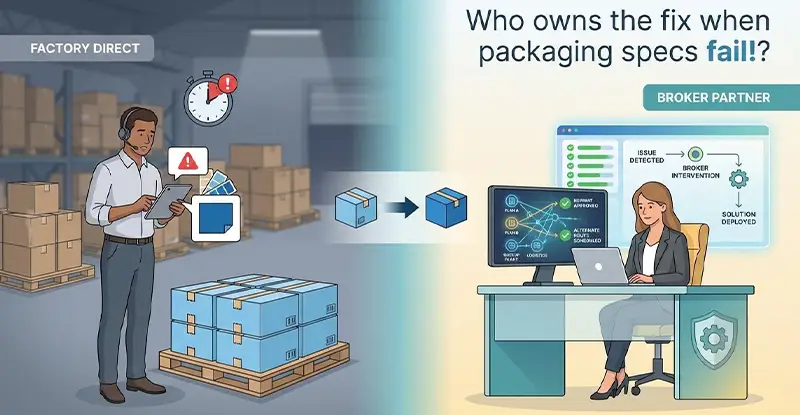
Launch day is a week away when the boxes land in the wrong shade of blue. The line stops, orders pile up, and someone has to own the fix.
As packaging advisor Sara Greasley notes, "If any part of your order is defective, the broker - not you - pays to remake it." Buy direct and you alone chase the plant for a reprint.
This guide weighs six factors - accountability, cost and MOQs, lead time, service, expertise, and risk - plus new forces, from 25-unit digital runs to rising state EPR fees. You'll see when a factory serves you best, when a broker saves the launch, and how hybrid partners like Zenpack blend both strengths.

When artwork revisions, QA checks, and supplier files create delays, docAlpha automates document capture, validation, and routing across manufacturing workflows. Improve response time and reduce costly mistakes before they reach the production line.
When specs break, the clock accelerates. One minute you are cheering a launch, the next you are staring at a pallet of unusable cartons. In that moment only one question matters: who owns the fix.
Buy direct from a factory and that owner is you. You draft the claim, chase the plant, and negotiate a rerun while inventory ages. High-volume customers often jump the queue; smaller brands wait until the press is free. Until the factory agrees to rerun the job, product sits idle.
A broker changes that equation. Their reputation rests on shielding clients, so they call the plant first, approve a remedy, and cover the cost. If timing is tight, they can divert the order to a backup supplier to keep your launch on schedule. Hybrid broker-manufacturers that own the entire chain deliver the tightest feedback loop. Through Zenpack (packaging partner), the same team that shapes brand strategy also engineers dielines, calibrates press color, and schedules fulfillment, turning twenty email threads into one real-time quality program: incoming materials pass IQC inspections, in-line IPQC checks track color and dimensions, and outgoing OQC audits sign off each lot.
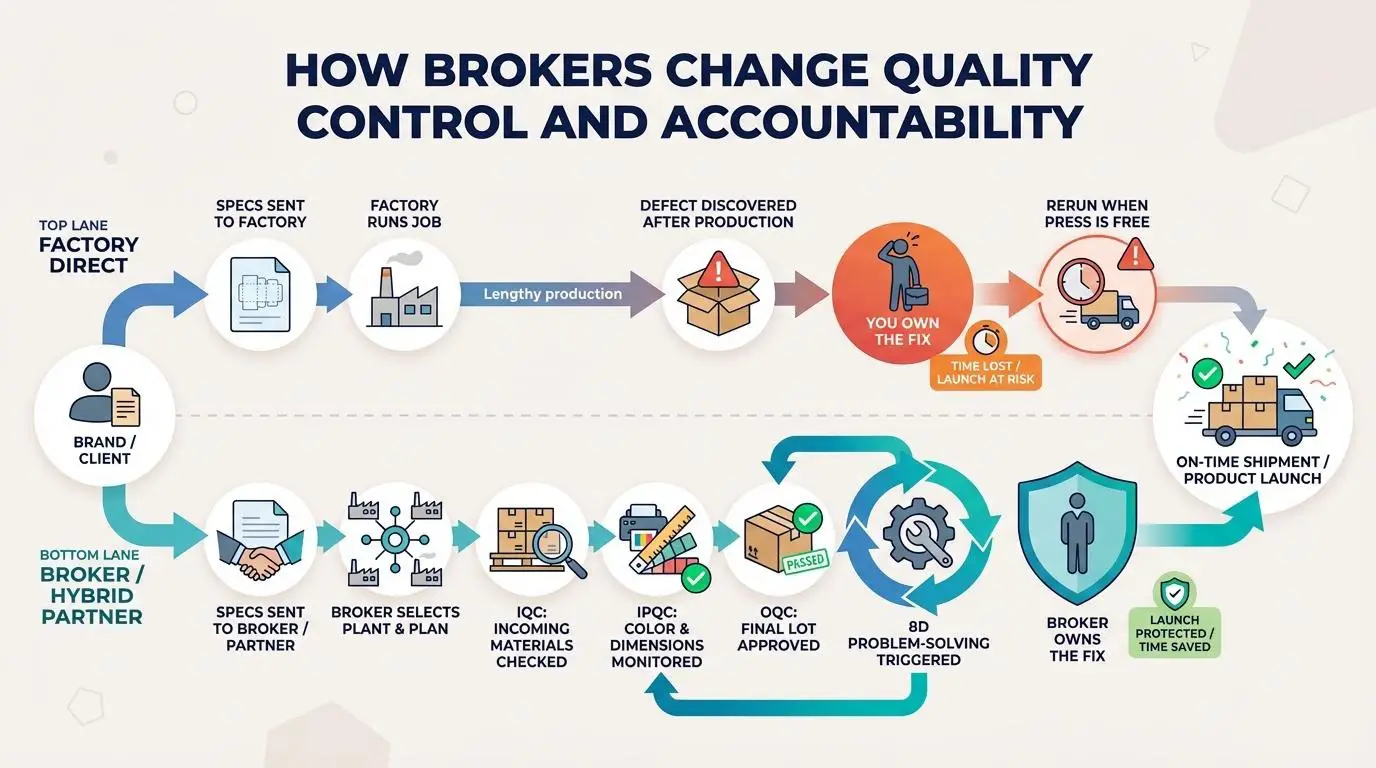
When a fault appears, Zenpack's engineers trigger an 8D problem-solving protocol that corrects the run before it leaves the dock, turning a potential recall into a same-day course-correction.
Quality work starts before the truck leaves the dock. Factories excel at printing the file you send, but they rarely challenge the varnish or board grade. Brokers review dielines, pull test samples, and spot risks while changes are cheap. Think of them as a remote quality team.
Working through an intermediary does mean an extra layer. You will not always know which press ran your job unless you ask. Clear service-level agreements close that gap; missed ship dates do not.
Ask yourself: Do you have the time to police specs alone? If yes, factory direct can shine. If not, a broker's margin often buys peace of mind. In packaging, mistakes cost more than markups.
Improve AP Accuracy Across Packaging Suppliers
When invoices arrive from multiple vendors with inconsistent formats and charges, InvoiceAction streamlines invoice processing with AI validation and policy-based routing. Cut manual effort, reduce exceptions, and strengthen financial control across the supply chain.
Book a demo now
Everyone loves a low unit price. That single number, bold on a quote sheet, feels final, yet in packaging it rarely tells the full financial story.
Factories sharpen their pencils when you buy like a Fortune 500. Their lines earn most on long, uninterrupted runs, so they reward volume. The break-even often starts around 5,000–10,000 custom units, sometimes more. A few years ago that floor was fixed. Today, digital presses have cut minimums; some suppliers will run as few as 25 branded boxes and still keep pricing reasonable. Those micro runs usually flow through a broker or integrated partner who pools many small jobs into one press slot.
Price also hides in deposits, tooling, and the warehouse bill that arrives three months later. Order direct and the plant wants a sizeable deposit. When the pallets arrive, you discover you are paying to store six months of packaging because the MOQ dwarfed your launch forecast. Cash that could fund marketing now sits in cardboard.
Brokers solve the math differently. They pool client demand, tap idle capacity across plants, and pass the bulk rate along. Their per-unit figure can match the factory price, even after a margin, because they negotiated the discount for you. More important, they let you buy what you need now, not what a setup demands.
Recommended reading: Learn How ERP Sales Order Automation Improves Manufacturing
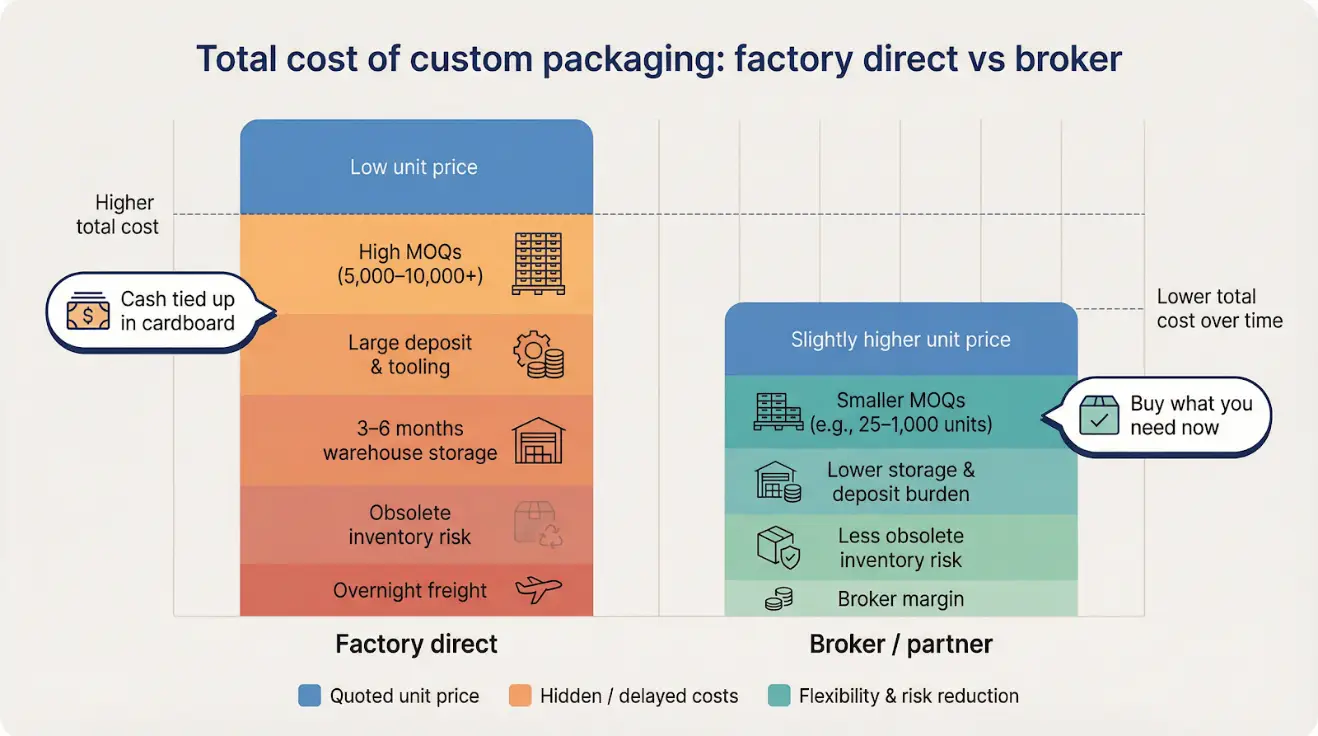
That flexibility costs a little more, yet compare it to obsolete inventory after a rebrand or overnight freight when storage runs out. The lowest quote is not always the least expensive path.
Before chasing pennies, map your cash cycle. Decide how many units you truly need, where you will keep them, and who covers overruns if sales spike. The answers often push smart teams toward right-sized batches over rock-bottom price.
Packaging schedules rarely sit in a vacuum. A social media post goes viral, a retailer moves a promo forward, or a container ship stalls outside Long Beach, and your packaging has to adapt.
Working directly with a factory gives you a single lane for communication. You request a date, the plant checks its calendar, and you receive a firm slot. If you are a marquee customer, that slot may open tomorrow. Smaller brands face a different reality. Large orders jump ahead, and your run waits. For overseas jobs, add 4–6 weeks on the water plus customs roulette.
When multiple suppliers and changing specs create communication gaps, docAlpha helps centralize document-driven processes with AI automation and traceable workflow steps. Increase accountability, reduce approval delays, and protect launch timelines.
Brokers view lead time the way air-traffic control views runways. They scan multiple plants, locate spare capacity, and reroute work the moment congestion appears. When a board mill in Europe paused during an energy crunch, brokers shifted carton runs to North America and kept the launch on schedule.
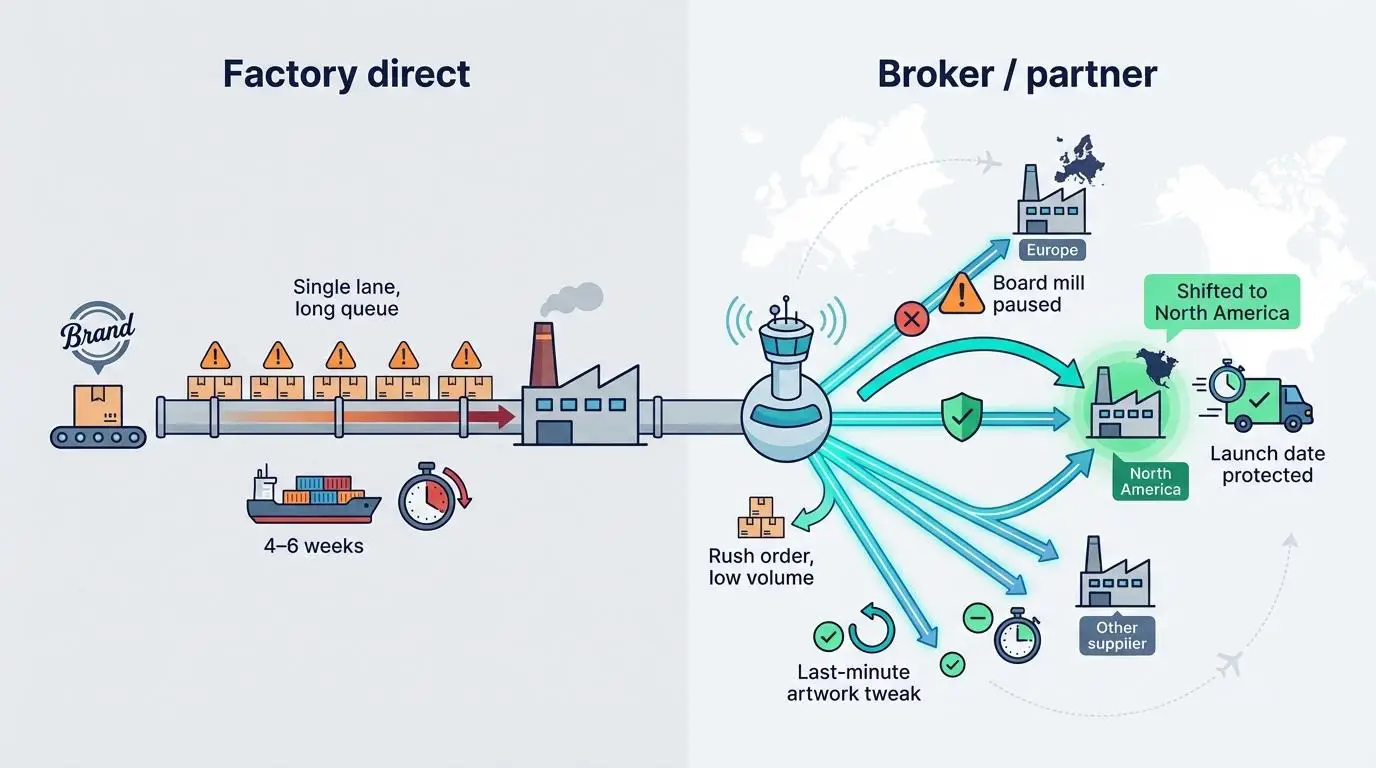
Speed also depends on communication loops. A direct relationship removes one email hop, yet factory hours and time zones still apply. Brokers keep a domestic phone line open, translate revisions, and push approvals while you sleep. That round-the-clock cycle can shave days off a proof-to-press timeline.
Below is a quick reality check.
Scenario | Factory direct | Broker / partner |
Rush order, low volume | Low priority, longer queue | Finds plant with capacity, fast |
Production delay | You source backup | Broker switches suppliers |
Last-minute artwork tweak | Work with plant engineer | Broker coordinates multiple plants overnight |
Lead time shapes outcomes. If your calendar rules the year, choose the partner who can stretch time, not snap it.
Recommended reading: How Manufacturing Accounting Software Supports Better Financial Control
Packaging is rarely a solo act. Boxes, inserts, tape, labels, and inner trays can each come from a different plant. Manage them all yourself and your inbox turns into whack-a-mole. Miss one update and timelines start to fray.
A direct factory tie works fine when you need only what that plant makes. You speak to a dedicated rep, swap files with pre-press, and watch proofs move in a straight line. Once the project grows, the line splinters. Now you are copying three suppliers on every revision and translating among systems that have never met.
Brokers shrink that chatter to one voice. You email one account manager, and they coordinate every moving part. If a dieline tweak affects two components, the broker fixes both before it reaches you. The model scales with your ambition. Add five new SKUs, seasonal art, or a bonus gift box and the contact sheet still lists a single name.
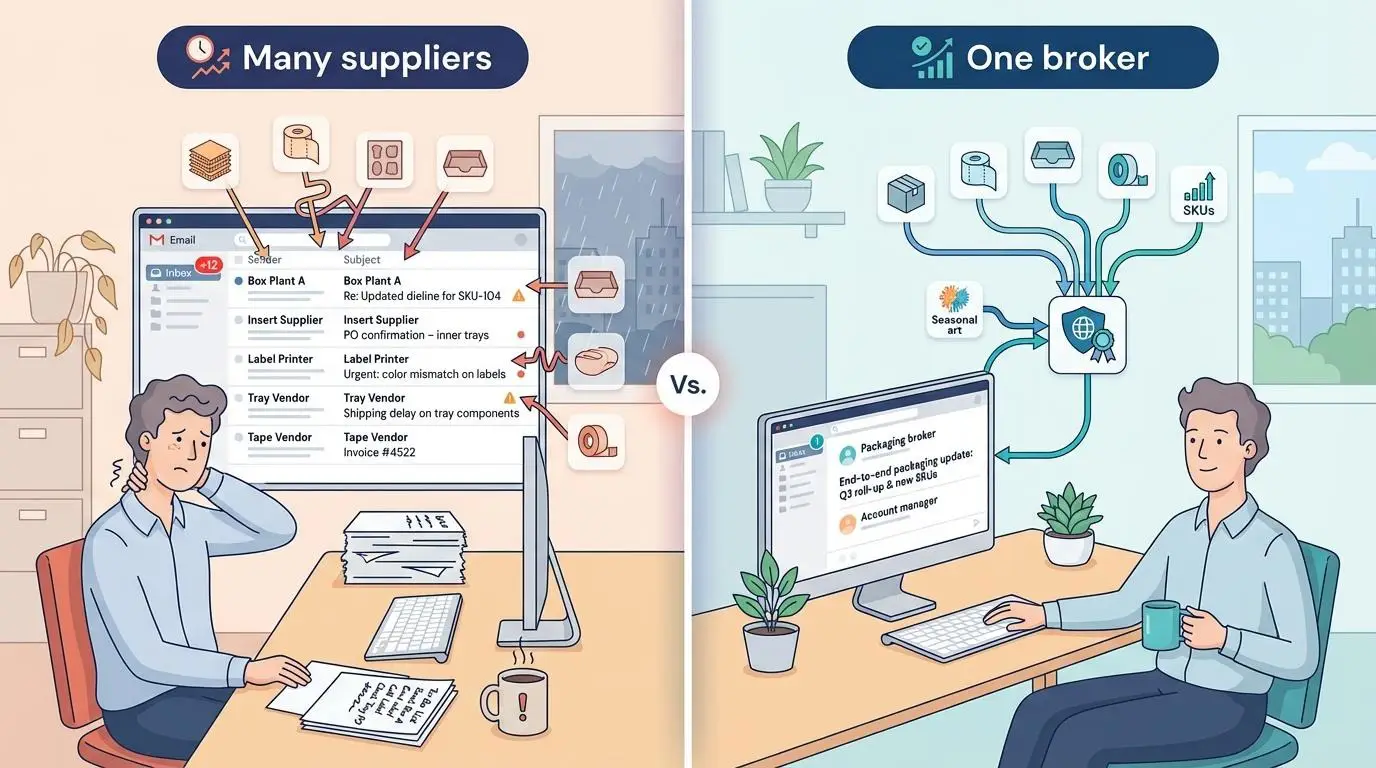
Visibility still matters. Some buyers worry when they cannot point to the exact press that ran their cartons. Good brokers ease the concern with portal log-ins, plant tours, or photo proofs. You gain simplicity without losing oversight.
Most teams prize reclaimed hours even more than reclaimed dollars. When service runs on autopilot, you spend less time chasing pallets and more time selling what goes inside them. The best communication plan is the one you barely notice because everything simply arrives, on spec and on time.
Reduce Delays In Manufacturing Order Coordination
When launch timelines depend on accurate packaging order data, OrderAction streamlines order processing by converting incoming documents into structured, validated transactions. Improve scheduling reliability and reduce errors that slow fulfillment.
Book a demo now
Great packaging does more than hold a product. It cushions fragile parts, delights during unboxing, and broadcasts your brand values long after trash day. Reaching that trio demands know-how across materials science, print technology, and fast-shifting eco rules.
A single factory goes deep on what its machines run best. Visit a corrugated plant and engineers can recite board grades in their sleep. Ask about molded pulp, and the dialogue stalls. Depth without breadth leaves blind spots.
Brokers and integrated partners work at the intersections. Because they source across materials every week, they spot trends before they hit the headlines. When California banned PFAS coatings in food packaging, brokers already had plant-based options queued up. Brands tied to one overseas mill scrambled while shelves sat empty.
Fresh ideas flow where options are wide. Need an AR code that launches a how-to video? The printer that nails smart labels may not build rigid boxes. A broker links those specialists and ships you a finished sample.
Sustainability raises the stakes. Extended Producer Responsibility fees now touch about 20 percent of U.S. consumers, and Europe is marching toward "reuse or recycle only" mandates by 2030. Factories know their own labels, but they rarely track 40 separate jurisdictions. Brokers do, because clients sell everywhere. They may suggest a coating that lowers EPR fees or replace foam inserts with mushroom fiber to trim carbon.
Expertise, then, is less about knowing every answer and more about knowing where to look next. If your roadmap includes new markets, fresh materials, or a stronger environmental promise, choose partners who roam widely and connect dots quickly. Curiosity can pay dividends you measure in both savings and saved planet.
Recommended reading: How ERP Can Help Your Manufacturing Business Thrive
Supply chains break in unexpected places: an ice storm freezes a rail yard, a resin shortage ripples through film suppliers, or a tariff spikes overnight. When packaging is single-sourced, every disruption lands on your dock.
Buying direct concentrates that exposure. If the plant's board mill shuts down, you call freight brokers, hunt for substitute stock, and hope artwork still fits new dielines. Legal remedies exist, yet arguing an overseas contract while inventory drains offers little comfort.
Brokers reduce that risk by design. They hold active orders with multiple plants across at least two continents. If one line falters, they move your job to another without restarting vendor approval. The only sign is the on-time delivery alert that arrives in your inbox.
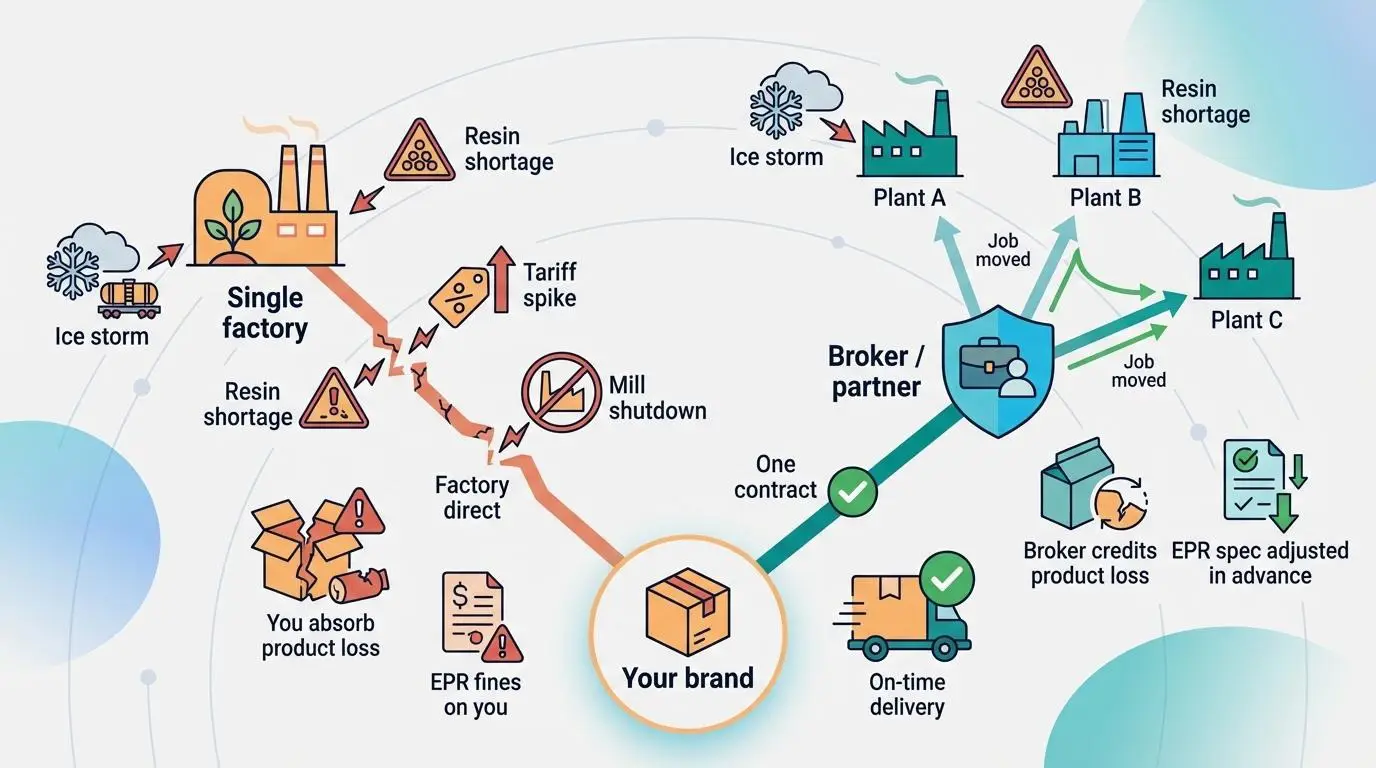
Liability follows the same pattern. When a batch fails drop tests and damages product, factories usually stop at replacing the packaging. You absorb the cost of the ruined goods. Brokers focused on lifetime value often credit part of that loss right away, then collect reimbursement from the plant later.
Compliance adds another layer. Extended Producer Responsibility fees now touch roughly 20 percent of U.S. consumers, and that share grows with each state session. Brokers track those rollouts across regions, adjusting material specs before fines appear. A single factory monitors its own list and leaves the rest to you.
When supply disruptions and spec changes demand fast decisions, docAlpha provides AI-based process automation for document-heavy manufacturing and distribution workflows. Improve control, accelerate execution, and support more reliable production outcomes.
The lesson is clear: diversity and advocacy spare you pain. If surprise bills and empty shelves keep you up at night, build a packaging plan that spreads risk and enlists allies who absorb the blows on your behalf.
 Process Automation Manufacturing: Aligning Production & Pack
 AI & Automation: Transforming Precision Manufacturing
 Boost Efficiency and Save Costs with Print Management Solutions
 Top Procurement Tools for Workflow Automation
 Smart eCommerce Tools That Help Online Stores Succeed
 Smart Lockers: AI, Workflow Integration, and Compliance
