Document Automation for Solar Decommissioning: Managing the Paper Trail Behind Retired Panels
Published: October 01, 2026
The first large generation of solar installations is reaching the end of its working life, and the conversation about it usually centers on glass, aluminum, and silicon. The less visible problem is paper. Every retired module leaves behind a trail of bills of lading, weight tickets, certificates of recycling, vendor certifications, invoices, and downstream reports. For an organization retiring a few rooftop panels, that trail fits in a folder. For a utility, an asset manager, or an EPC contractor handling thousands of modules at once, it becomes a document processing workload that looks a lot like accounts payable at a mid-sized company.
The scale is not small. A joint report from IRENA and the IEA Photovoltaic Power Systems Programme projects that recycling or repurposing end-of-life panels could unlock roughly 78 million tonnes of raw materials globally by 2050, with recovered material worth more than 15 billion US dollars. Every one of those tonnes will move through contracts, shipping records, and financial documents before it is counted as recycled. This article looks at what those documents are, why manual handling breaks down at volume, and where document automation, data capture, and business intelligence tools fit into the process.

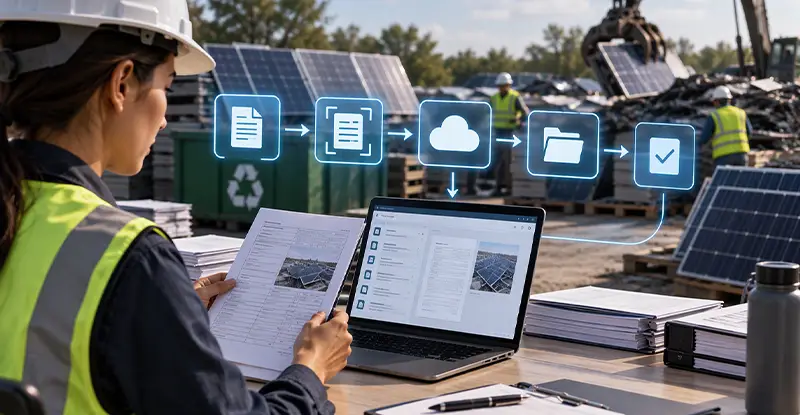
Large solar decommissioning projects can generate hundreds of bills of lading, weight tickets, certificates, invoices, and downstream reports. docAlpha captures, classifies, extracts, and validates information from document-intensive processes while routing exceptions for review.
Reduce manual data entry and create structured records that finance, operations, and compliance teams can use throughout the project.
It helps to list the paperwork before talking about automating it, because most teams underestimate how many document types are involved.
Contract and scoping documents come first: a site assessment, a volume estimate, a quote priced per ton or per panel, and a signed service agreement. Next are the logistics records, which include pickup schedules, bills of lading, pallet counts, and weight tickets from certified scales. Then come the compliance documents, such as the recycler's current certificates, audit reports from the certifying body, and any hazardous material handling records for thin-film modules. After processing, the recycler should issue certificates of recycling or destruction and, ideally, downstream reports showing where separated glass, aluminum, copper, and silicon were sent. Finally, the finance side produces invoices, credit memos for panels that were resold instead of shredded, and payment records.
On a large decommissioning project, each truckload can generate five or six of these documents, and a utility-scale job can involve hundreds of truckloads over several months. That is a document capture problem before it is anything else.
Recommended reading: Discover How Document Automation Streamlines Logistics and Supply Chains
Most organizations handle this paperwork the way they handled it for a small job: someone receives PDFs by email, types key figures into a spreadsheet, and forwards invoices to accounts payable. That approach breaks down in predictable ways.
The first failure is reconciliation. An invoice priced per ton should match the weight tickets for the same shipments. When weight tickets arrive as scanned images and invoices arrive as PDFs from a different system, matching them by hand is slow, and discrepancies of a few hundred kilograms per load are easy to miss. Across hundreds of loads, those discrepancies add up to real money.
The second failure is certificate tracking. Recycler certifications such as R2v3 have expiration dates and are audited by independent certification bodies. A certificate that was valid when a contract was signed may lapse halfway through a multi-month project. Nobody notices unless someone is tracking expiration dates in a system rather than in a filing cabinet.
The third failure is the audit itself. The US Environmental Protection Agency's guidance on solar panel recycling points generators toward certified recyclers, and many organizations now report waste diversion as part of ESG commitments. When an auditor asks where a specific batch of modules ended up, the answer has to be assembled from documents scattered across inboxes, shared drives, and vendor portals. If the chain of custody cannot be reconstructed, the diversion figures in the sustainability report are not defensible.

Solar retirement projects create financial transactions that need to remain connected to the shipments and supporting documentation behind them. InvoiceAction automates invoice processing while applying matching and intelligent rules before transactions move downstream.
Improve payment accuracy while reducing the time finance teams spend investigating routine transactions.
None of the documents in a decommissioning project are unusual. Bills of lading, weight tickets, and invoices are exactly the kinds of semi-structured documents that intelligent document processing tools already handle in logistics, manufacturing, and accounts payable. The same techniques apply.
Modern document capture tools combine optical character recognition with machine learning models trained to find fields such as shipment numbers, net weights, dates, and totals, even when every vendor uses a different layout. Instead of an employee retyping figures from a scanned weight ticket, the system extracts them, assigns a confidence score, and routes only uncertain values to a person for review. This cuts data entry time and, more importantly, reduces the transcription errors that cause reconciliation problems later.
Once shipment data is captured in a structured form, invoice automation can perform the same kind of three-way match that accounts payable teams use for purchase orders: the contracted rate, the captured weight tickets, and the recycler's invoice. Invoices that match within a set tolerance can move straight to approval. Invoices that do not match are flagged with the specific shipments that caused the difference, which turns a vague dispute into a short, specific conversation with the vendor.
Recommended reading: Learn How Three-Way Matching Improves Invoice Processing
Process automation tools can hold recycler certificates as records with expiration dates attached, send reminders before they lapse, and block new pickups from being scheduled with a vendor whose certificate has expired. The same workflow can require a certificate of recycling for each shipment before the related invoice is paid, so documentation and payment stay linked.
When every shipment, weight, destination, and certificate is stored as structured data, reporting becomes a query instead of a project. A business intelligence dashboard can show tonnage diverted by material type, the share of modules resold versus recycled, cost per ton by vendor, and any shipments still missing downstream documentation. Those are the figures ESG reports and internal audits ask for, and they come from the same data that finance already used to pay the invoices.

When every truckload generates multiple documents, manually retyping shipment numbers, weights, dates, and totals quickly becomes difficult to scale. docAlpha uses intelligent document processing to capture business data and route uncertain information for human verification.
Process growing document volumes more efficiently while reducing transcription errors and repetitive administrative work.
Automation on the buyer's side only works if the recycler produces documents that can be captured reliably. That makes documentation quality a practical selection criterion, not an afterthought.
A few questions separate vendors who can support an automated process from those who cannot. Ask whether weight tickets come from certified scales and are issued per shipment. Ask whether certificates of recycling reference specific shipment or bill of lading numbers, rather than a general statement covering a date range. Ask whether downstream reports name the facilities that received separated materials. Ask whether invoices itemize by shipment, so they can be matched line by line. And ask whether the documents can be delivered electronically in a consistent format.
Recyclers that run their own processing facilities usually find these questions easier to answer, because the material does not pass through a subcontractor whose paperwork they do not control. Providers of commercial solar panel recycling that handle everything from utility-scale decommissioning to routine module replacements in-house can tie each certificate to a named facility and a specific shipment, which is the level of detail an automated matching process needs. The documents themselves become cleaner inputs, and fewer exceptions land on someone's desk.
Not every retired module is scrap. Panels that still produce a meaningful share of their rated output can be resold or repurposed, which changes the accounting. A resold module may generate a credit instead of a disposal cost, and the asset records need to reflect whether each module was sold, reused, or recycled.
This is another place where structured data helps. If each module or pallet is tracked from removal to final disposition, finance teams can record resale proceeds against the right asset, accounts receivable can follow up on credits owed by the vendor, and the sustainability report can distinguish reuse from recycling. Without that tracking, resale income tends to disappear into a general account, and the organization loses sight of what its retired equipment was actually worth.
Recommended reading: Learn How Credit Memo Management Keeps Financial Records Accurate
Organizations do not need a custom platform to start. Most of the value comes from four steps: define the document types expected for every shipment, capture key fields from those documents automatically instead of retyping them, match invoices against captured shipment data before approving payment, and store certificates and downstream reports as linked records rather than loose attachments.
These are the same practices that finance and operations teams already use for supplier invoices and purchase orders. Solar decommissioning simply adds a new category of supplier and a stricter need for proof. As retirement volumes climb over the next decade, the organizations that treat end-of-life paperwork as a document processing workflow will spend less time reconciling figures and will have far better answers when an auditor asks where their panels went.
Small differences between invoiced quantities and actual shipment weights can become significant across hundreds of loads. InvoiceAction automates invoice capture and matching, helping route exceptions for review instead of treating every transaction as a manual reconciliation exercise.
Focus AP attention on discrepancies while allowing accurate invoices to move through the process more efficiently.
 Document Automation for Logistics and Supply Chain Management
  Three-Way Match in Invoice Processing
  Document Scanning and Capture with AI Technology
  Automated Invoice Processing in 2025–2026: AI Automation with Human Oversight
  All About Intelligent Document Processing
  Best Solar Proposal Software for Smarter Workflows
