Automating the School Science Lab: How Browser-Based Experiments Cut Admin and Keep Learning Measurable

Published: November 11, 2026
Ask any school science department where its time goes and the answer is rarely "teaching." Ordering chemicals, tracking consumables, booking lab rooms, filling in risk assessments, setting up equipment and then marking practical write-ups by hand all eat into hours that teachers would rather spend with students. It is the same kind of manual, document-heavy workflow that businesses have spent the past decade automating.
Education is now following the same path. Browser-based science labs are replacing a large share of that logistics with software, and the better platforms are starting to back their claims with independent evidence. Constructor Practice Science Labs, for example, holds an ESSA Level IV rating validated by researchers at Instructure. Here is how the shift works and what schools should look for.

Digitizing experiments removes some manual classroom processes, while school offices may still transfer information from scanned forms and vendor documents by hand. docAlpha extracts and validates document data for connected administrative workflows.
Reduce repetitive processing without implying that document automation replaces the learning platform.
For any district buying education technology, the first question is increasingly about evidence. In the United States, the Every Student Succeeds Act (ESSA) sets out four tiers of evidence for interventions, and procurement teams use them to separate promising tools from marketing claims.
Constructor Practice Science Labs, a browser-based virtual science lab platform from Constructor Tech, recently earned an ESSA Level IV evidence rating, the "Demonstrates a Rationale" tier. The rating was validated by independent Instructure researchers, who reviewed the product's logic model against a rubric drawn from ESSA, EDGAR, SEER and What Works Clearinghouse standards and found that it met both Level IV indicators. The company has said it plans a Level III impact study in the 2026 to 27 school year, looking at how experiment completion and time on the platform relate to learning gains.
Level IV is the entry tier, and it confirms a well-defined, research-based design and a plan to measure outcomes rather than proven impact. For schools, though, it is a useful signal that a vendor is building toward evidence instead of relying on testimonials alone.
Recommended reading: Learn How Intelligent Process Automation Supports Education
The platform offers more than 160 curriculum-aligned experiments across disciplines including chemistry, biology, physics, physiology and early science. Results are calculated from real formulas at run time rather than played back as fixed animations, so students can change variables and see genuinely different outcomes.
From an operations point of view, the biggest change is everything that disappears. There are no consumables to order or store, no equipment to set up and clean down, and no lab room to book. Students can repeat an experiment as many times as they need, which is rarely possible with physical materials.
Assessment is automated too. Work is marked as students go, and progress tracking gives teachers a live view of who has completed what. That removes one of the most time-consuming document workflows in a science department: collecting, marking and recording practical reports.

Browser-based labs can reduce experiment setup and grading administration, but schools still handle supplier invoices, forms, and other institutional documents. docAlpha uses intelligent document classification, extraction, validation, and routing to automate those separate back-office tasks.
Give administrative teams more time for the work supporting classrooms and students.
Any automation project lives or dies on integration, and education software is no different. A new tool that requires separate logins and manual grade entry simply moves the paperwork somewhere else.
Constructor's labs support LTI and single sign-on, so students launch experiments from the learning management system they already use, and performance data flows back into the gradebook. The platform is designed to work with major LMS environments and follows privacy frameworks including FERPA, COPPA, SOPIPA and GDPR, which matters for district data protection reviews.
The experiments are mapped to curricula including NGSS, AP, IB, GCSE, IGCSE and A Level, and an experiment-by-experiment mapping sheet is available on request, which saves teachers from aligning content to standards by hand.
Virtual labs are not a reason to close every science room. Hands-on work still teaches practical skills that a screen cannot, from handling equipment safely to observing a reaction in real life.
Where browser-based labs add the most value is in filling the gaps. They let schools run experiments that would be too expensive, dangerous or time-consuming to repeat physically, support students who miss a practical session, and give remote or hybrid learners the same access as everyone else. They also make pre-lab preparation more effective, since students can practise a procedure virtually before trying it for real.
Recommended reading: Discover the Benefits of Document Automation in Education
When districts evaluate tools like this, the conversation usually covers three areas. The first is cost, which includes consumables, equipment maintenance and staff time saved on setup and marking. The second is access, meaning how many more students can run experiments, more often, without extra rooms or staff. The third is evidence, and here guidance from the U.S. Department of Education on ESSA evidence tiers and the What Works Clearinghouse helps decision-makers judge where a product sits and what further results to ask for.
A clear pilot with defined measures, such as experiments completed, time saved on marking and changes in assessment results, gives schools the data they need to scale up with confidence.

Schools evaluating digital labs focus on measurable teaching benefits, but their administrative departments face document-processing bottlenecks of their own. docAlpha applies intelligent extraction, configurable validation, and exception review to incoming institutional documents.
Support broader operational efficiency while keeping educational decisions with staff.
Businesses learned long ago that automating a manual process only works when the new system connects cleanly to what already exists and produces data people can trust. Schools are applying the same lesson to science teaching. When experiments run in the browser, marking happens automatically and results flow straight into the LMS, teachers spend less time on setup and marking, and students get more chances to explore.
Recommended reading: Learn How a Proof of Concept Reduces Automation Project Risk
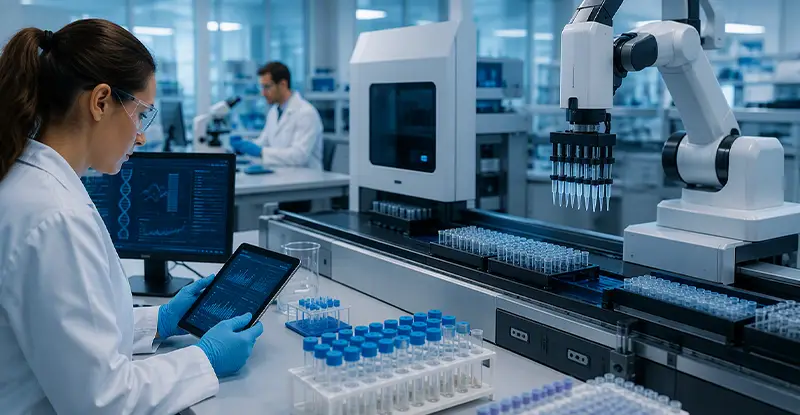 How Laboratory Automation Boosts Productivity and Efficiency
 Best Interactive Lab Platforms for Training in 2026
 How Document Automation Is Revolutionizing Modern Education
 Robotic Process Automation in Education That Works Today
 Automation Tools Transforming Data Management in Education
 AI Algorithms in Intelligent Process Automation (2026 Guide)

