How Lab Automation Can Improve Laboratory Productivity
Published: September 17, 2026
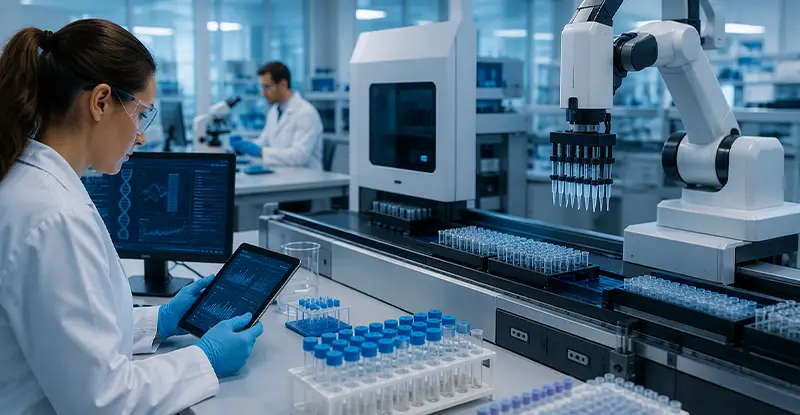
Walk through a busy research laboratory at eight in the morning and the bottleneck is rarely the science. It is the queue. Someone is waiting on a plate reader, someone else is hand labeling tubes, and a third person is copying values from an instrument screen into a spreadsheet because the two systems have never spoken to each other. The work is real, but very little of it requires a doctorate.
That gap between what scientists are trained to do and what they actually spend their hours doing is the productivity problem most labs are trying to solve. Hiring more hands helps for a while, though it also multiplies scheduling conflicts, training time, and the number of people who can transcribe a number incorrectly. Capacity and headcount are not the same thing, and treating them as interchangeable gets expensive fast.
Automation offers a different lever. Instead of adding people to a crowded bench, it removes the repetitive steps that clog the bench in the first place, then hands the recovered hours back to the researchers who can do something useful with them. The effect compounds as sample volumes grow, which is exactly when most labs discover their manual workflow has quietly hit its ceiling.
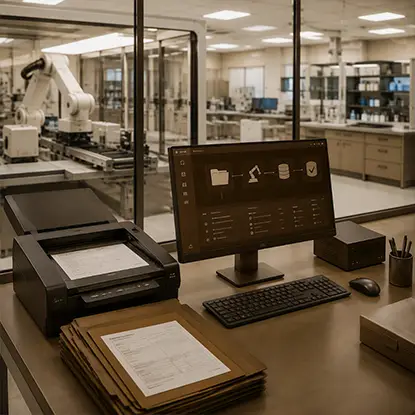
Labs may automate instruments and sample handling while employees still manually capture and transfer information from documents. docAlpha uses AI-powered intelligent document processing to classify, extract, validate, and route business data automatically.
Reduce repetitive administrative work and extend automation across more of the laboratory operation.
Before buying anything, it helps to look honestly at where the day disappears. Pipetting, aliquoting, plate stamping, barcode labeling, reagent prep, instrument booking, data transcription, and the small recurring act of finding out whether a sample was already processed. None of it is glamorous and all of it is necessary. Track it for a week and the pattern tends to surprise people, because the actual experiment turns out to be a thin slice of a very thick sandwich.
Manual handling carries a hidden tax that never shows up on a timesheet. Every transfer is a chance to mislabel, every transcription is a chance to fat-finger a decimal, and every repeat run costs twice, once in reagents and once in calendar time. Standards organizations exist partly because those small errors accumulate into unreliable results, and the Clinical and Laboratory Standards Institute builds consensus guidance around keeping testing consistent across sites and shifts.
The strongest candidates for automation are tasks that are high volume, low judgment, and painfully well defined. Liquid handling leads that list, followed by sample prep, plate replication, labeling, and any step where something moves from point A to point B on a fixed schedule. A well tuned lab automation setup does not try to think. It repeats the same motion at three in the morning exactly as it did at nine, and it does not get bored halfway through plate forty.
Scheduling software matters as much as the hardware, and labs consistently underrate it. When an orchestration layer knows which instruments are free, which need maintenance, and which runs are queued, expensive equipment stops sitting idle between shifts. That is often where the first surprising gain appears, since most labs are not short on instruments so much as short on coordination.
Recommended reading: Discover How Process Automation Improves Life Sciences Operations
Throughput improves for an unglamorous reason: automated systems eliminate the gaps. A technician runs a batch, breaks for lunch, sits through a meeting, and comes back. An automated deck runs the batch and then starts the next one. Overnight and weekend hours that used to be dead time become productive capacity, and turnaround shrinks without a single person staying late.
Consistency is the quieter benefit. When every sample receives the same volume, the same incubation, and the same timing, run to run variability drops, and results become comparable across months rather than merely across one good afternoon. Measurement science depends on that kind of reproducibility, which is why the NIST Material Measurement Laboratory invests so heavily in reference materials and validated methods that let labs trust their own numbers.
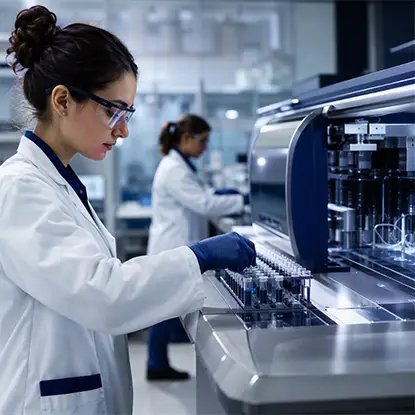
Manual transcription and disconnected information create opportunities for errors even in highly automated laboratory environments. docAlpha captures, extracts, and validates document data before moving it into connected business workflows.
Reduce manual touchpoints and improve the accuracy, consistency, and scalability of document-driven processes.
The point of removing manual work is not to shrink the team. It is to move expensive expertise toward the parts of the job that genuinely require it: designing experiments, interpreting anomalies, troubleshooting a result that refuses to fit, and deciding what to run next. Those activities produce publications and product decisions, and they are the first casualties when a scientist spends six hours a day moving liquid between containers.
Roles shift rather than vanish. Technicians become system operators and method developers, scientists spend more of the week on analysis, and someone on staff inevitably discovers a talent for keeping the robots healthy. The professional community around this shift is substantial, and the Society for Laboratory Automation and Screening alone connects a global membership of roughly 19,000 researchers, engineers, and technology providers working on these exact problems.
Recommended reading: Learn How Intelligent Automation Balances Human Judgment and Machine Efficiency
Automation earns its keep most visibly at scale. A lab running two hundred samples a week can survive on manual process and good habits. At two thousand, that same process collapses, because scheduling conflicts multiply, error rates climb with fatigue, and the only manual remedy is another hire with another training curve. Automated workflows scale on a different axis, since adding capacity often means adding run time or a second deck instead of another salary.
The same logic drives automation across data heavy operations well outside the life sciences, and the parallels are worth studying because the failure modes repeat. Artsyl's overview of how AI automation works in practice makes the point plainly: the technology is only part of the win, while process design, exception handling, and governance decide whether the gains hold up once real volume arrives.
None of this argues for automating everything at once. The labs that get burned tend to start with their most complex assay, discover that edge cases outnumber standard cases, and conclude the whole idea was oversold. Beginning with the dullest, most repeatable, highest volume step is far less exciting and far more likely to work.
It also pays to measure before and after. Cycle time per batch, repeat run rate, instrument utilization, and hours lost to transcription are all countable, and having those numbers turns the next round of investment into a decision rather than an argument between people with different hunches.
The labs pulling ahead are rarely the ones with the biggest teams. They are the ones that stopped spending scarce expertise on repetitive handling, handed that work to systems built for it, and pointed their scientists back at the questions they were hired to answer. That shift is available to almost any lab willing to look honestly at where its hours actually go.
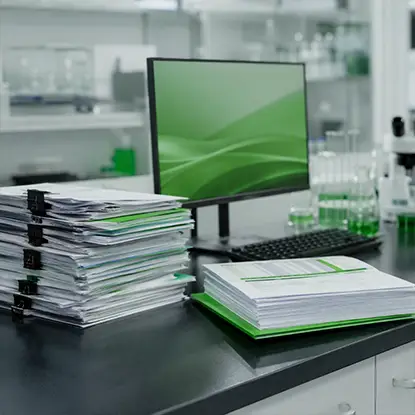
Automation loses efficiency when information must still be manually transferred from documents into downstream systems. docAlpha transforms unstructured content into validated business data for automated workflows.
Reduce transcription effort and create faster, more reliable information flows across laboratory operations.
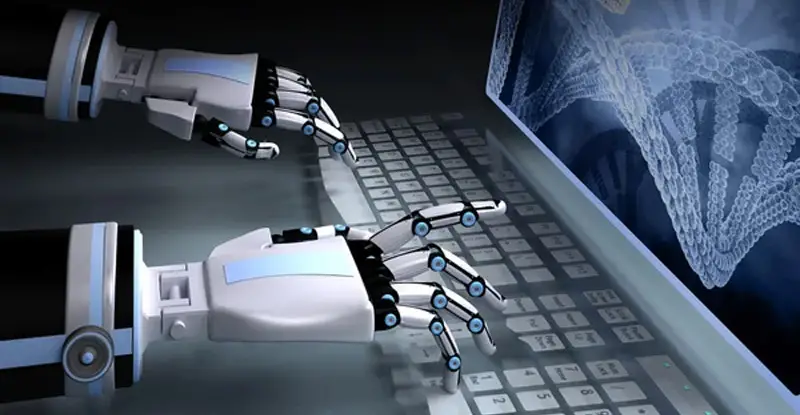 AI Automation: What It Is and How It Works in 2026
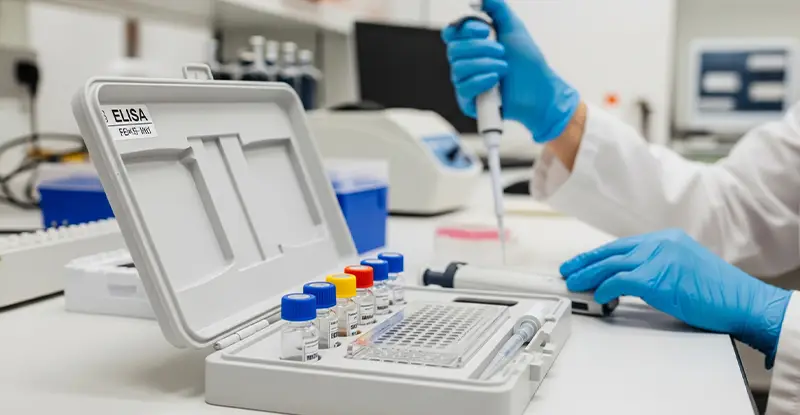 AI Automation for ELISA Lab Workflows and Data Capture
 AI and Data Innovation in Modern Life Science Software
 How to Eliminate Repetitive Work? Hint: Intelligent Automation
 Designing AI Workflows That Support Human Productivity
 Human-AI Collaboration for Better Business Workflows
