Remote Data Entry Jobs:
Why Automation Needs People in 2027

Published: November 05, 2026
Check your application confirmation for instructions, recruiter contact details, or a candidate portal. If the employer provides no timeline, consider sending a concise follow-up after approximately five to seven business days. Mention the job title, your application date, and your continuing interest. Avoid repeatedly messaging automated chatbots, since they may not support application-status inquiries or connect directly with hiring managers.
Yes, some employers offer beginner-friendly positions that focus on accuracy, organization, and basic computer proficiency. Applicants can strengthen their applications by demonstrating spreadsheet skills, careful recordkeeping, and reliable communication. Practice projects and administrative experience can also help. However, competition may be substantial, and some listings require industry knowledge. Always review individual job requirements before applying.
AI is likely to continue reducing the need for certain repetitive data entry tasks, but complete replacement across every industry is not inevitable. Complex documents, inconsistent records, and sensitive information can still require human review. Opportunities may increasingly emphasize data validation, exception handling, and quality assurance. Workers who develop complementary technical and analytical skills will be better prepared for changing responsibilities.
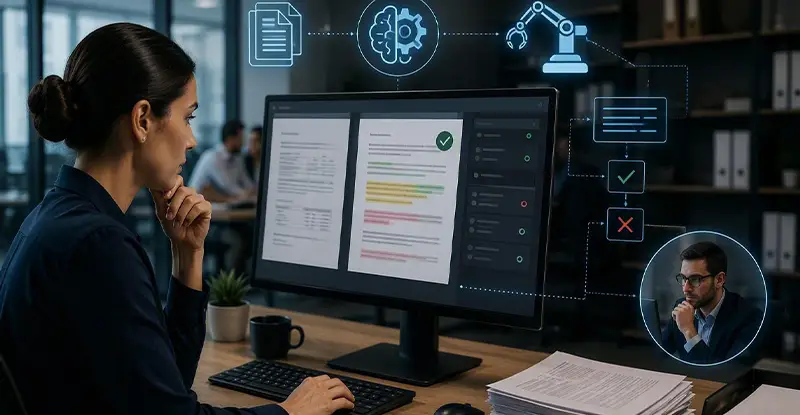
Artificial intelligence can process documents, recognize text, and organize information in seconds. Yet businesses still need people to identify mistakes, resolve unusual cases, and ensure records are accurate. That's why remote data entry jobs can remain relevant in 2027, even as traditional typing tasks become increasingly automated.
The opportunity is changing rather than simply disappearing. Employers may place greater value on candidates who can review AI-generated information, protect sensitive records, and work confidently with digital systems.
If you're exploring new career options, you can browse remote jobs data entry opportunities to understand current job requirements and identify suitable openings. Knowing how automation works, and how AI recruitment tools evaluate applications, can help you stand out.

Traditional data entry spends too much time copying information from invoices, forms, and records, while unusual documents still require careful decisions. docAlpha uses AI-powered classification, data extraction, validation, and exception routing to automate repetitive steps and direct uncertain cases to human reviewers.
Reduce manual typing while keeping people responsible for the records that need attention.
Document automation uses technologies such as optical character recognition (OCR), machine learning, and intelligent document processing to extract and organize information.
These systems can process invoices, applications, customer records, and financial documents without requiring someone to manually type every detail.
However, automation doesn't guarantee accuracy. Problems arise when information is incomplete, inconsistent, handwritten, or poorly formatted.
Consider an invoice containing an incorrect customer identification number. Software might successfully extract the number without recognizing that it belongs to another account.
A human reviewer can investigate the discrepancy before it affects billing or reporting.
Human responsibilities commonly include:
The value of these responsibilities extends beyond typing speed. Businesses need dependable information to make decisions, maintain compliance, and serve customers.
Recommended reading: Discover How Intelligent Automation Balances Human and Machine Work
Automated tools follow programmed workflows and learned patterns. Human workers contribute context, accountability, and judgment when those workflows produce uncertain results.
In healthcare administration, for example, incorrect patient information could create serious operational problems. In financial services, an inaccurate transaction record might affect reporting or reconciliation.
Human oversight helps organizations investigate these issues before they spread across connected systems.
This combination of technology and careful review creates opportunities for workers who understand both accuracy and efficiency.
Entry level remote data entry jobs have traditionally involved transferring information between documents, databases, and spreadsheets.
While these activities still exist, some employers are integrating automation into their workflows.
As 2027 approaches, relevant responsibilities may increasingly include validating extracted data, reviewing automated classifications, checking database records, and managing exceptions.
Potential job titles include data validation assistant, document processing specialist, records coordinator, and data quality associate.
These positions won't all require advanced technical qualifications. However, applicants who understand basic automation concepts may have an advantage over candidates relying entirely on manual typing skills.
Job availability and responsibilities will vary by employer, industry, and the extent of automation already adopted.

Distributed teams may receive documents in different formats and spend hours correcting data copied from scans and PDFs. docAlpha automates document recognition, information extraction, and validation, with human review for documents that do not meet configured checks.
Improve processing consistency and reduce repetitive administrative work across locations.
Successful candidates should develop a combination of technical knowledge and practical workplace skills.
Important capabilities include:
You can build evidence of these skills through practice projects, short courses, volunteer activities, or previous administrative work.
A simple portfolio demonstrating accurate spreadsheet organization and data cleaning may help employers understand your abilities.
Recommended reading: Learn How AI Automation Is Changing Repetitive Business Work
AI recruiting chatbots can support employers by collecting applicant information, asking screening questions, and coordinating interviews.
Depending on the system, a chatbot may ask about work authorization, availability, experience, software knowledge, and salary expectations.
Some conversational tools adapt their questions based on previous answers. Others follow predefined scripts.
An applicant tracking system may separately parse resumes, organize candidate details, or help recruiters compare qualifications against job requirements.
Not every employer uses AI screening, and not every automated system makes hiring decisions independently.
To prepare, answer questions directly, provide accurate information, and describe relevant experience using clear examples.
When explaining your abilities, connect them to the position. For example, rather than simply claiming to be detail-oriented, explain how you reviewed records, corrected inconsistencies, or maintained an organized spreadsheet.

AI can recognize a number on an invoice without knowing whether it belongs to the correct customer or transaction. docAlpha combines automated document extraction with configurable business rules and exception workflows to help reviewers investigate mismatches.
Catch issues earlier and protect the quality of data entering connected business systems.
An effective resume should be easy for automated software to interpret and convincing for a human recruiter to read.
Begin by examining the job description. Identify the software, responsibilities, and qualifications that genuinely match your experience.
Then incorporate relevant language naturally throughout your resume.
For example, if an employer requests spreadsheet management, database updates, and data verification, describe your actual experience performing those tasks.
Use these practical resume strategies:
No resume format guarantees passage through every AI screening system. The objective is to make your qualifications clear, truthful, and accessible.
Recommended reading: Learn Best Practices for Working Alongside Intelligent Process Automation
Document automation is changing how organizations process information, but accurate records still require oversight, accountability, and sound judgment.
For job seekers, the strongest strategy is to develop practical digital skills, understand automated recruitment, and demonstrate how human attention improves data quality.
As businesses adopt increasingly sophisticated tools, remote data entry jobs may shift toward reviewing, validating, and managing information rather than entering it manually.
Candidates who adapt to these changes can position themselves for opportunities in 2027 and beyond.

Automation changes the work, but it does not eliminate the need to verify critical business information. docAlpha handles repetitive document classification and extraction while supporting validation, correction, and human exception review.
Give employees more time to investigate discrepancies and maintain reliable records as document volumes grow.
 AI Automation: What It Is and How It Works in 2026
 AI Algorithms in Intelligent Process Automation (2026 Guide)
 Human-in-the-Loop AI for Intelligent Document Automation
 Reduce Manual Data Entry: 7 Simple Fixes That Save Time
 How Finance Teams Automate Manual Data Entry Tasks
 Human-AI Collaboration for Better Business Workflows

