What Office Communication Systems Should Cover for Hybrid Teams

Published: October 15, 2026
Hybrid teams need communication systems that preserve speed, context, and access whether employees work in an office or elsewhere. Chat handles quick coordination, email records formal updates, and meetings support discussion, yet each channel has limits. A complete system assigns every message a suitable home, protects information, and gives employees a reliable way to find decisions later. It also accounts for time zones, accessibility, and attention.
A practical plan maps each communication need to a channel. It shows where questions, announcements, decisions, and reference material belong. A clear framework for workplace communication systems keeps choices tied to purpose, audience, urgency, and retention. Managers can then check whether messages reach the right people without duplicate work. Documenting those decisions helps hybrid routines stay consistent. A quarterly review can remove channels that no longer match actual work patterns.
Chat should handle short questions, status checks, and coordination that loses value quickly. Email should carry formal notices, policy changes, and messages that require a durable record. A searchable knowledge base should hold procedures, decisions, and reference material rather than scattered links.
Channel labels should describe the work, not the department that created them. A team-wide naming rule makes searches more predictable. It helps new employees quickly find the right place to update something without asking several colleagues for routine guidance.
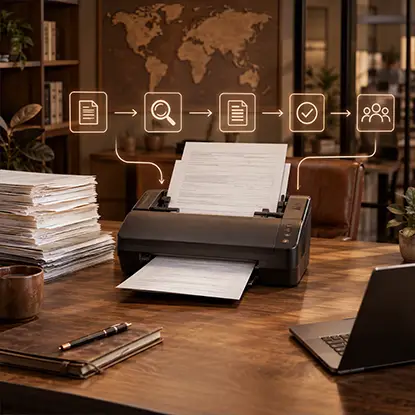
Hybrid teams often rely on emails, shared documents, and manual follow-ups to move business processes forward. docAlpha automates document capture, classification, data extraction, validation, and workflow routing so information reaches the appropriate stage of the process.
Reduce repetitive coordination and help distributed employees work more efficiently without relying on constant manual updates.
Hybrid work loses many informal explanations that once followed meetings or announcements. Every material decision should include the owner, date, scope, and next action in a location employees can revisit. Meeting notes need links to the final decision, while chat threads need a clear closing message when discussion ends.
Employees need equal access to announcements, recordings, documents, and discussion history, regardless of work location. Captions, transcripts, readable documents, and mobile access help people with different schedules, abilities, and connectivity. Access controls should follow job responsibilities, while confidential material should remain limited to approved groups.
Recommended reading: Discover How SharePoint Supports Accessible Document Management
Real-time meetings belong to subjects that need debate, rapid judgment, or shared problem-solving. Routine updates should move into written or recorded formats, so employees can review them without matching a calendar slot. A simple rule helps: schedule meetings for interaction, and publish updates for information.
Search must return the current policy, decision, or project record without forcing employees through several channels. Each knowledge area needs an owner who checks accuracy, removes duplicates, and records meaningful changes. Retention rules should distinguish temporary coordination from records that support compliance, onboarding, or future decisions.
Communication systems should use role-based access, secure authentication, and clear rules for sharing files or recordings. Administrators need logs that show access and distribution without turning routine communication into surveillance. Backup procedures and outage plans should identify where urgent notices move when a primary channel fails.

Hybrid teams work more effectively when responsibilities, approvals, and next steps are clearly defined. docAlpha uses intelligent document processing, validation, intelligent rules, and automated routing to help move information through established business workflows.
Reduce ambiguity around document handling and give employees more time for decisions that require their attention.
Delivery counts show that a message was sent, but they do not show whether employees understood or acted on it. Teams should track completion for required updates, response times for requests, and repeated questions that reveal unclear instructions. Periodic sampling of decisions and documents can expose gaps that dashboard totals miss.
Sensitive changes need language that explains the reason, effect, and action without relying on shorthand. Leaders should record updates when tone or emphasis affects interpretation across time zones. A consistent editorial check should remove ambiguity, define unfamiliar terms, and confirm that the requested action is visible clearly.
Audio can carry pacing and emphasis in updates employees absorb away from screens. It should sit beside written records, with a transcript and links to related decisions. This pairing supports listening while preserving easy searchability and accountability.
Recommended reading: How AI Is Becoming Part of the Front Office for Modern Service Businesses
Governance should set review dates for channel rules, permissions, retention, and emergency communication. A small group can examine failed handoffs, repeated questions, and outdated pages, then assign corrections. That process keeps the system usable as staffing and work patterns change.

When employees work from different locations and schedules, document approvals and manual processing can create unnecessary delays. docAlpha automates document capture, validation, and workflow routing while directing exceptions to employees who need to review them.
Support more consistent business operations without requiring every routine step to depend on immediate employee availability.
A hybrid team does not need one channel for every task. It needs a communication map that assigns purpose, preserves decisions, protects access, and respects different working hours. List recurring messages, record their current locations, identify duplicate or missing ownership, then move each type into a defined channel. Review the map with employees in office and remote roles, and revise it after the first month.
 How AI Front Office Automation Is Transforming Service Businesses
  Preparing for Hybrid Work: How to Facilitate
  6 Digital Tools for Remote Work
  How AI Voice Technology Is Transforming Workplace Communication
  Top 5 Strategies to Enhance Your Business Communication Effectively
  Power Remote Workflows With Cloud-Based File Access
