Guide to Using Pre-Employment Skills Tests for Financial Services Hiring

Published: November 20, 2026
Run a job analysis, build a skills matrix, and combine knowledge tests (Excel, bookkeeping, numerical reasoning) with a realistic work sample. Score each skill separately and confirm results in a structured interview.
Numerical accuracy, Excel and data handling, accounting fundamentals, exception judgment, compliance awareness, critical review of AI-assisted output and communication, weighted by role.
Yes, the task can be shared, but the purpose differs. Hiring tests measure skills needed at entry, while development tests identify practice needs. Explain the purpose before running either.
No. CGMA research found that finance professionals don't need to become systems engineers, computer programmers, data engineers or scientists. Test coding only when the role's tasks require it.
No. A work sample shows performance on job-related tasks. It does not establish regulatory compliance, legal defensibility or the absence of bias, so have HR or legal advisers review your assessment process for your jurisdiction.
An invoice-processing system reads a supplier invoice correctly and recommends posting because it matches the purchase order.
The reviewer approves it without opening the receiving record, which shows the warehouse accepted fewer units than the invoice bills. The payment goes out, and the gap only surfaces weeks later during a supplier reconciliation.
No résumé would have revealed that habit. A well-designed skills test would. This guide covers what to measure, which tests suit which roles, and how to build and score a realistic work sample.
Pre-employment testing for financial services roles is a structured way to see whether candidates can do the work before you hire them. It combines knowledge tests, skills tests and job simulations matched to the role.
To test candidate skills for financial services, follow five steps:
The U.S. Office of Personnel Management (OPM) calls job analysis the foundation for all assessment and selection decisions. OPM also advises that selection should cover only competencies applicants are expected to have on the first day; skills employees will learn on the job should not be selection requirements.

As document entry becomes automated, identifying incorrect or incomplete records grows more important. docAlpha captures information from incoming business documents and routes validation exceptions for review through configured workflows.
Give employees more time to apply analytical judgment instead of manually transcribing every field.
Finance work runs on small details. Tests show whether a candidate catches a duplicate invoice or a mismatched quantity, rather than whether they can describe doing so.
A reviewer who approves without checking source records creates a control gap. Testing that judgment before hiring reduces the chance of payment errors reaching suppliers or auditors.
As more invoice capture, matching and posting becomes automated, people spend more of their time reviewing system output and handling exceptions. That shift makes judgment harder to see in an interview and more important to test.
Standard tests give every candidate the same tasks and scoring, so teams compare applicants on evidence instead of impressions.
When tests reflect the actual job, managers start each new hire with a clear picture of strengths and training needs.
Candidates should calculate variances and spot inconsistencies under time pressure.
Finance teams combine invoice, purchase order and receiving data constantly. Look for traceable formulas and lookups rather than hard-coded numbers. Data handling matters more as AI tools spread: in joint ACCA and CA ANZ research, 93% of finance professionals said they were worried about the integrity and verifiability of AI-generated insights.
Test whether candidates can reconcile a supplier statement to the ledger, list differences and explain them.
This is the skill automation leaves to people. Understanding how invoice exception handling routes PO mismatches and price variances to reviewers shows why candidates must decide when to hold, correct or escalate an invoice under written policy.
Roles in banking, securities and audit need knowledge of the rules that govern them. Test awareness at the level the role requires, and leave licensing to the regulators that issue it.
CIMA's report Finance Transformation: Revisiting the Human Perspective, based on 470 finance and HR leaders in the UK and US, names scepticism, judgement and technical finance skills as essential to avoid overreliance on AI-generated output. In a test, look for a documented reason for accepting or rejecting a system recommendation.
A short written response shows whether candidates can state the issue, the evidence and the next step.
Recommended reading: Learn How AI and Machine Learning Support Better Financial Decisions
Role | Priority skills | Recommended tests |
AP Specialist / Accountant | Accuracy, reconciliation, exception judgment | Bookkeeping test, Excel test, invoice-review work sample |
Financial Analyst | Analysis, data handling, communication | Numerical reasoning, advanced Excel, short analysis write-up |
Bank Teller / Customer-Facing Staff | Accuracy, attention to detail, customer communication | Basic math, attention to detail, situational judgment test |
Finance Manager / Controller | Workflow and control design, judgment | Case exercise on approval limits, structured interview |
Securities Representative | Product and rules knowledge, ethics | Situational judgment test alongside FINRA licensing |
Auditor / Compliance Officer | Control testing, skepticism, documentation | Sample-testing exercise, written findings, ethics scenarios |
Skills tests never replace licensing. A new securities representative must pass FINRA's Securities Industry Essentials (SIE) exam and a role-specific qualification exam, such as the Series 7. Use skills tests to judge how candidates apply knowledge, and let the licensing exams confirm eligibility.
Coding is rarely a requirement. Reserve SQL, scripting or automation configuration for roles whose tasks need them, such as analysts querying exception data.

Strong candidates can reconcile records and explain variances, yet disjointed invoice workflows make that expertise harder to apply. InvoiceAction brings supplier invoice capture, matching, validation, and approval routing into a structured AP process.
Reduce routine administration and give reviewers the context needed to act on exceptions.
Map the workflow the role touches. For an AP role, that path runs from receiving an invoice to extracting fields, checking them against source records, investigating mismatches, obtaining approval and posting.
Mark which steps the system handles and where a person must review evidence. For each human step, record the task, the skill, the evidence of competent work and the accountable role.
Keying speed and judgment are different skills. Pair technical tests (Excel, bookkeeping, numerical reasoning) with tasks that require explaining a decision or writing to a supplier.
OPM describes work sample tests as tasks that mirror the tasks employees perform on the job. For an AP validation role, a 30-minute invoice-review exercise works well. The design below is illustrative, not a validated benchmark.
Use a fully synthetic pack: twelve invoice records in a spreadsheet, a supplier master, purchase orders, receiving records and a one-page approval policy with tolerances, approval limits and exception owners. Seed four problems: a duplicate, a blank PO number, a quantity mismatch and a plausible but incorrect system recommendation.
Make the answer key clear for the mismatch. The purchase order shows 100 units at USD 20 each, totaling USD 2,000. The receiving record shows 90 units accepted.
The invoice bills 100 units for USD 2,000. A two-way match passes because the invoice and PO agree, but the receiving record shows a 10-unit variance worth USD 200. The correct response is to hold or escalate under the policy and document the difference.
Attach a fictional system note to that invoice: "Recommendation: post in full. PO match confirmed." Ask candidates to accept or reject it, citing records from the pack.
Request three outputs: an annotated spreadsheet marking each invoice clear, hold or escalate; an exception log with evidence and next-step owner; and a short email to the supplier whose invoice is held.
Building this in-house gives full control but takes time to create and score. For teams that prefer a ready-made platform, eSkill offers finance-relevant tests, including Microsoft Excel (formulas, pivot tables and macros), Bookkeeping (accounts payable and receivable, bank reconciliations, journal entries and financial reporting), Attention to Detail and a job-based Financial Analyst test. Employers can also upload their own questions and request custom simulations, so an exercise like this one can reflect their own approval policy. Whatever the source, map every test back to your skills matrix.
Rate accounting accuracy, exception judgment, evidence trail and communication on their own scales. An illustrative 0 to 3 scale:
Keep scores separate. A candidate scoring 3 on accuracy and 1 on judgment has a specific gap that an average of 2 would hide.
Before live scoring, have reviewers rate the same two or three sample responses independently and refine the rubric wherever they disagree.
Tell candidates which tools are allowed, whether AI assistance is permitted and how to disclose it. Keep a human reviewer on the reasoning in the exception log and email.
In the United States, the EEOC's fact sheet on employment tests says a selection procedure must be job-related and its results appropriate for the employer's purpose. It also notes that the ADA requires reasonable accommodations, including in how tests are administered. Work with HR on accommodations.
Ask every candidate the same follow-up questions: what they checked first, why they held the invoice and what they would do without the receiving record. Their answers separate a misread instruction from a real gap in control knowledge.
Recommended reading: Discover Why Human Oversight Matters in Automated Invoice Processing
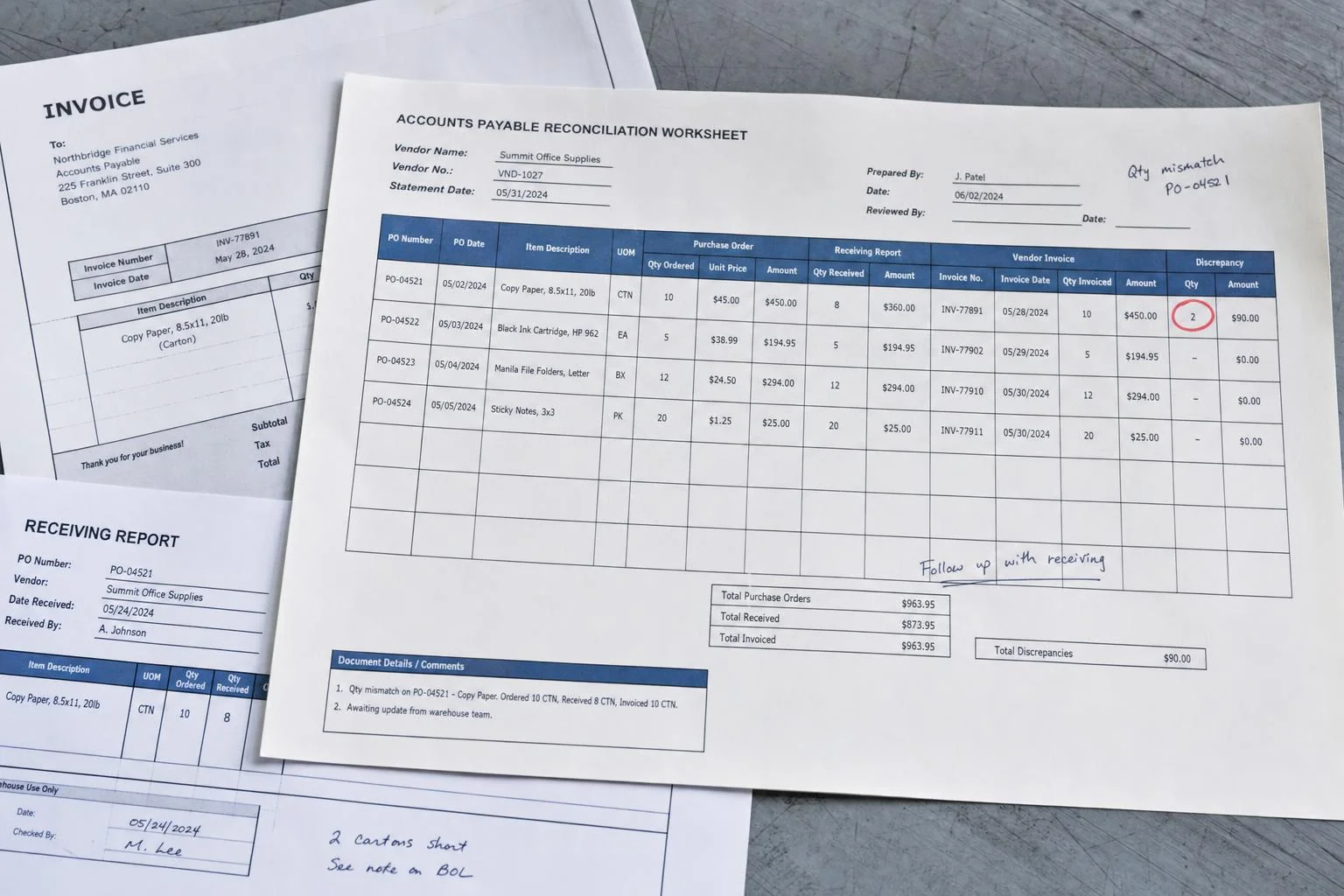
When every reviewer has shown they check source records, fewer invoices reach payment with unresolved variances.
The same exercise works for current employees if you explain beforehand that results guide development. In the first 30 days, run the baseline and agree on one gap per person. From days 31 to 60, practice with coached synthetic exceptions. From days 61 to 90, reassess with an equivalent task and assign a small workflow pilot.
If several people fail at the same step, check the process before adding training. APQC research found that only 7% of organizations report nearly or fully automated procure-to-pay processes, and it ties real gains to pairing automation with mature processes and governance.
Track first-pass validation rate, exception-resolution time and control deviations. Staffing and system changes also affect these, so treat them as trends, not proof.

Hiring assessments test accuracy, reconciliation, and the ability to explain an exception. docAlpha supports those same operational priorities with document classification, data validation, and structured exception handling for business workflows.
Turn strong individual skills into a more consistent document-processing operation.
Financial services roles reward people who check, question and document. Testing those habits directly gives hiring teams evidence interviews cannot. Start with one role, one work sample and one rubric, then expand once reviewers score consistently.
Recommended reading: Learn How Intelligent Automation Is Transforming Financial Processes
 Why Finance Automation Needs Human Oversight Today
 AP Reconciliation: How to Reconcile Accounts Payable
 Human-in-the-Loop AI for Intelligent Document Automation
 Real-Time Data Is Transforming the Role of Finance Teams
 Why Talent Acquisition Needs Smarter Automation
 Payroll Hiring Mistakes: Costs, Risks, and How to Fix

