From Paperwork to Intelligence: How Data Science Is Changing Everyday Automation

Published: October 02, 2026
Businesses create enormous amounts of information through invoices, contracts, forms, receipts, emails, and other documents. The challenge is no longer simply storing those files. Organizations increasingly need to understand what is inside them, move information into the right systems, identify unusual activity, and make decisions without requiring someone to review every page manually. That is where data science is becoming especially useful. Combined with automation, it can turn repetitive document processing into a more intelligent workflow built around accuracy, speed, and better decision-making.
Traditional automation works well when documents follow predictable formats.
A system can be programmed to look for information in a specific location, move a file to a folder, or send an alert when a particular condition is met. Problems appear when documents stop behaving consistently.
Invoices arrive in different layouts. Scanned pages may be blurry. Forms contain missing fields. Suppliers change templates. Emails mix useful information with signatures, disclaimers, and attachments.
Data science helps automation cope with that variation.
Instead of depending entirely on fixed rules, modern systems can recognize patterns, classify documents, extract information, and identify situations that may need human review. That makes automation more adaptable to the messy way business information actually arrives.
The goal is not simply to eliminate data entry. It is to make information usable sooner and with fewer unnecessary manual steps.
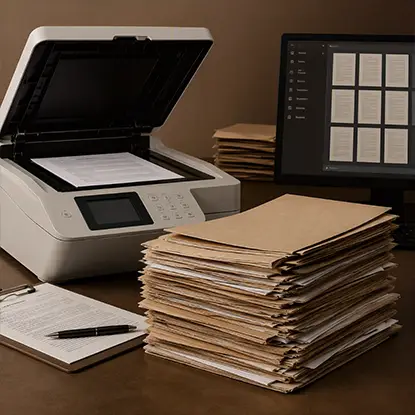
Modern document automation needs to handle changing layouts, incomplete information, scanned documents, and exceptions - not just predictable templates. docAlpha combines intelligent capture, classification, extraction, validation, and workflow automation to process complex business documents.
Make document-driven operations more adaptable without requiring employees to manually handle every variation.
As automation becomes more sophisticated, businesses increasingly need people who understand both analytical methods and their practical limitations.
That requires more than knowing how to create a dashboard.
Professionals may need experience with statistical modeling, data management, machine learning, programming, model evaluation, and the process of turning raw information into useful decisions.
For people looking to build deeper expertise, an online data science master's degree can provide advanced preparation in areas that connect directly with intelligent automation and data-driven business processes.
The value of advanced study is strongest when theory is connected with practical problems.
A useful data science education should help someone understand not only how models work, but also how to evaluate whether they are performing well enough for the environment in which they will be used.
Recommended reading: Discover How Data Analytics Drives Process Automation Success
Machine learning gets plenty of attention, but successful automation usually begins with less glamorous work.
Data needs to be accurate, consistent, and understandable before a model can learn anything useful from it.
Imagine an organization trying to identify duplicate invoices. If vendor names appear in several different formats, invoice numbers contain inconsistent characters, or dates have been entered incorrectly, even a sophisticated model can produce unreliable results.
Data preparation therefore becomes a core skill.
Professionals need to recognize missing values, duplicates, inconsistent labels, unusual records, and other problems that could distort analysis. They also need to understand when two pieces of information that look different actually refer to the same thing.
In document automation, that ability is often more valuable than building the most complicated algorithm available.
Reliable automation begins with reliable information.
Programming knowledge is useful, particularly when working with large datasets or building custom analytical processes. Statistics, machine learning, databases, and visualization also matter.
But technical ability alone rarely solves a business problem.
Strong data professionals need to understand what the organization is actually trying to achieve. A model might identify unusual payment behavior, but someone still has to determine whether that pattern suggests fraud, a supplier change, a seasonal shift, or simply bad data.
The broader range of data science skills and responsibilities reflects this mix of analytical work, computing, problem-solving, and communication.
Document automation especially rewards people who can move between technical and operational thinking.
They need to understand how information enters a workflow, what happens after extraction, where errors create problems, and which decisions should remain with people.
Knowing how to build a model matters. Knowing when that model is useful matters more.

Intelligent automation should handle predictable processing while recognizing when uncertainty or exceptions require human judgment. docAlpha combines automated document processing with validation and human-in-the-loop exception handling.
Reduce repetitive review without removing people from the decisions where their expertise adds value.
Documents are harder to analyze than neatly structured tables because much of their meaning lives in language.
A contract clause, invoice description, customer message, or handwritten note cannot always be interpreted through simple field matching.
Natural language processing can help systems classify text, recognize important terms, identify relationships, and extract meaning from unstructured information. Optical character recognition can convert scanned material into machine-readable text.
Neither process is perfect.
Poor image quality, unusual layouts, handwriting, abbreviations, and industry-specific language can all create errors.
That is why professionals working with document automation need to understand confidence levels and exception handling. When a system is uncertain, it should know when to stop and send the document to a person rather than confidently making the wrong decision.
Good automation is not defined by never requiring human involvement. It is defined by using that involvement where it adds the most value.
Recommended reading: Learn How Human Oversight Improves Automated Document Processing
A system described as 95% accurate may sound impressive.
That number means very little without knowing what was measured.
A document extraction tool might correctly identify company names almost every time while regularly missing totals, dates, or line items. Those errors do not carry the same business consequences.
This is why model evaluation needs to happen at a more detailed level.
Organizations should understand which fields matter most, how often errors occur, what happens when confidence is low, and how mistakes affect downstream processes.
Accuracy also needs continued monitoring.
Document formats change. Business processes evolve. New suppliers appear. A model that performed well when introduced may gradually become less reliable if nobody checks it.
Strong data science therefore includes maintaining systems after deployment, not simply building them and moving on.
Document workflows can contain financial information, personal data, contractual details, and other sensitive material. Adding artificial intelligence creates additional questions about privacy, reliability, accountability, and oversight.
A useful approach to managing AI risks considers how systems are governed, measured, monitored, and used throughout their lifecycle.
That matters when automated decisions have real consequences.
If software flags an invoice as suspicious, rejects a document, or routes a case differently, organizations should understand why the decision occurred and what options exist when the system gets it wrong.
Human oversight remains particularly important for high-impact or unusual cases.
Automation should reduce repetitive work without turning important decisions into an unexplained black box.

Advanced analytics and AI cannot compensate for inaccurate or inconsistent source information. docAlpha captures and validates information from business documents before that data moves into downstream systems and processes.
Create a more reliable data foundation for automation, analytics, and better business decisions.
Document automation looks different across industries.
A finance team cares about payment terms, duplicate invoices, taxes, and approval rules. A healthcare workflow may focus more heavily on privacy, clinical records, and regulatory requirements. Logistics teams deal with shipping documents, quantities, delivery information, and supplier performance.
The same technical model cannot simply be dropped into every environment without context.
Professionals need to understand the workflow surrounding the document.
That means knowing which errors are expensive, which exceptions are normal, which information must be retained, and where a person needs to remain involved.
The best automation usually emerges when technical specialists and operational experts work together rather than treating technology as a replacement for business knowledge.
Recommended reading: Discover How Intelligent Document Processing Turns Business Data Into Action
Organizations can easily become distracted by ambitious AI projects.
A better starting point is usually one repetitive process that creates measurable frustration.
Maybe employees spend hours checking invoice fields. Perhaps document classification slows down customer onboarding. Maybe exception queues are so large that reviewers struggle to prioritize them.
Start with the problem.
Then decide whether data science can realistically improve it.
Useful measures might include processing time, extraction accuracy, number of manual reviews, exception rates, or the cost of correcting errors.
That approach keeps automation connected to actual business value rather than novelty.

Documents contain valuable business information, but extracting that information manually slows down the processes that depend on it. docAlpha uses intelligent document processing to classify documents, extract and validate data, apply intelligent rules, and move information into downstream workflows.
Transform everyday paperwork into structured, actionable data while reducing repetitive manual work.
Document automation is becoming more intelligent, but the purpose has not changed: businesses need information they can trust and act on.
Data science helps bridge the gap between documents and decisions. It can recognize patterns, handle variation, identify unusual activity, and reduce repetitive work. But its value depends on clean data, sensible evaluation, operational knowledge, and human judgment.
For professionals entering this space, the most important lesson is not to chase every new tool.
Learn how information moves. Understand where errors matter. Develop technical skills that help solve those problems, and become comfortable questioning the output when something does not look right.
The future of document automation will involve increasingly capable technology. The people who add the most value will be the ones who know how to make that technology reliable, understandable, and genuinely useful.
 Automated Invoice Processing in 2025–2026: AI Automation with Human Oversight
  How Data Automation and Analytics Improve Business Decision Making
  All About Intelligent Document Processing
  The Importance of Accuracy in Machine Learning: A Comprehensive Guide
  AI Works Better with Clean Data: Tidy Up Your Documents and Images
  Machine Learning Algorithms in Business Process Automation
