Outsourcing Customer Support in 2026: What Growing Businesses Need to Know Before They Sign

Published: August 10, 2026
Customer support used to be a back-office cost center. In 2026, this growth lever gets pulled by a third party. Outsourcing customer support is now buying speed, coverage, and technology that would otherwise take years to build in-house. Signing with the wrong partner can undo all of that in a single quarter. Growing businesses need to understand what's changed in this market, where the real risks sit, and how AI has quietly rewritten the rules before signing a contract.
The math behind customer support outsourcing has always been straightforward on paper. A growing company experiences the gaps in support the fastest. A team that once comfortably handled 200 tickets a day starts drowning at 800. Recruiting, training, and managing an internal team takes months, and a bad quarter of reviews can undo a year of brand-building in weeks. Seasonal spikes, new market launches, and 24/7 coverage requirements lead firms to bring in a partner who already has the infrastructure running.

Replace repetitive data entry with AI-powered document processing using docAlpha, which captures, validates, and routes business documents automatically.
Accelerate operations with intelligent automation, high extraction accuracy, and seamless ERP integration.
Reduce processing costs while enabling teams to focus on higher-value work.
The outsourcing market today looks different than it did even three years ago. According to Grand View Research's 2024 market analysis, the global outsourced customer care services market was valued at over $77 billion in 2024 and is projected to climb past $113 billion by 2030. Deloitte's Global Outsourcing Survey found that most executives plan to maintain or increase their outsourcing investment rather than pull back. What's driving that is industry specialization, tighter compliance frameworks for healthcare and fintech clients, and AI-native delivery models have replaced the generic call-center-for-hire pitch.
Voice and email support are usually first to get outsourced, simply because they're the highest-volume, most repetitive channels. Chat follows next, especially for ecommerce and SaaS businesses that need near-instant first response. Social media support is bundled in too, since it needs the same tone-of-voice consistency as any other channel. The common thread among these channels is that they shape how customers experience the brand, which is exactly why vendor selection matters.
Recommended reading: Outsourcing Invoice Processing: Everything You Need to Know
The scope has widened well past the phone queue. Order tracking, returns processing, complaint management, billing disputes, and account updates are now regularly folded into outsourced contracts, particularly for ecommerce and subscription businesses. This matters because back-office tasks touch the same systems and data as front-line support, so a partner handling both can resolve issues in one pass instead of bouncing a customer between teams.
The cheapest per-hour rate is easy to compare, but a process fit isn't. A vendor excellent at high-volume, scripted retail support may be a poor match for a technical SaaS product where agents need to understand an API or a billing edge case. Before comparing quotes, map how a provider's existing workflows, tools, and specialization line up with your ticket types.
Knowledge transfer, documenting processes, training agents, and running parallel operations before a full handoff takes time. Businesses that budget one or two weeks for this almost always see a dip in quality during the transition. A realistic onboarding window, with a defined ramp-up period and shared quality checks, protects customers from feeling the seams of the switch.
Generic SLA templates get signed more often than they should. A 24-hour first-response target might be fine for a low-touch product but unacceptable where delayed responses drive refund requests. SLAs need to be built around your actual customer expectations and channel mix, not a vendor's boilerplate.

Modernize accounts payable using InvoiceAction to automate invoice capture, coding, approvals, and matching.
Combine AI automation with intelligent workflow management for faster financial operations.
Lower operational costs while creating a scalable AP process that grows with your business.
AI is now the core architecture of outsourced support. Most of that shift runs on contact center as a service (CCaaS) platforms, such as cloud-based systems that handle routing, IVR, and analytics without on-premise infrastructure. That makes it far easier for an outsourcing partner to plug AI into daily operations. In the AI customer support industry, adoption and integration aren't the same thing. Most centers use AI somewhere in their stack, while only a quarter have it fully built into daily operations. That gap is where growing businesses need to ask sharper questions about the vendor’s CCaaS foundation.
Model | How it works | Best fit |
AI-augmented agents | AI suggests responses, summarizes tickets, or surfaces knowledge base articles. A human agent sends the final reply. | Complex, emotionally sensitive, or high-value accounts. |
Fully automated tiers | AI resolves the ticket end-to-end with no human involvement, escalating only on failure. | High-volume, repetitive queries like order status or password resets. |
Most credible providers now run a blended model where AI handles routing and the repetitive first tier, while humans manage anything ambiguous or high-stakes.
The best outsourcing relationships behave less like vendor contracts and more like an extension of the internal CX management team with shared visibility from day one.
A strong partnership rests on a small set of KPIs, including first response time, resolution time, CSAT, and escalation rate. Weekly or biweekly reporting cadences catch quality drift before it shows up in complaints, and a clearly defined escalation path means a difficult case reaches the right person in minutes, not after several transfers. If a provider can't describe their reporting rhythm during the sales process, they likely don't have one worth trusting.
Recommended reading: How Back Office Process Outsourcing Can Transform Business Operations

Eliminate document bottlenecks by using docAlpha to transform invoices, orders, forms, and other business documents into automated workflows.
Leverage AI-driven data extraction, validation, and workflow automation across your organization.
Increase productivity, improve data quality, and scale operations without adding headcount.
Outsourcing customer support in 2026 is a decision about who represents your brand at one of its most important touchpoints. Businesses that get it right treat vendor selection with rigor. Checking process fit, planning a real onboarding period, negotiating SLAs that match their actual customers, and understanding exactly how AI and human agents split the workload are important factors in vendor selection. Get those pieces right before signing, and outsourcing becomes a way to scale support faster without losing the quality that got you here.
 Outsourcing Vs. Automating - A Business Decision
 Best Virtual Assistant Services for Business Growth 2026
 6 Common Pitfalls to Avoid in Customer Service Automation
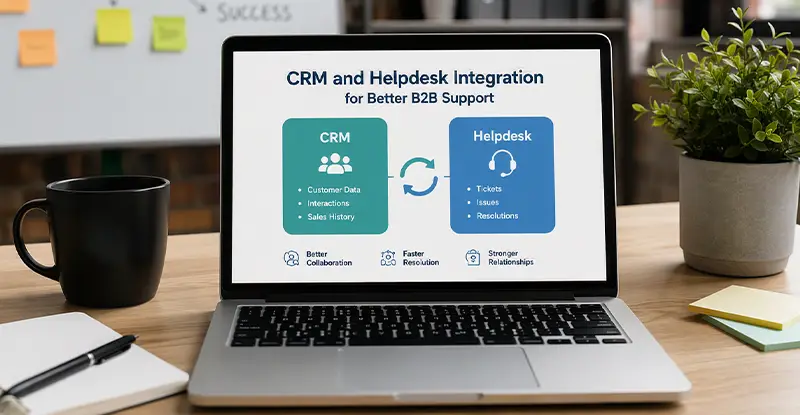 CRM and Helpdesk Integration for Better B2B Support
 Smarter SaaS Support Starts With the Right AI Tools
 The Tech Revolutionizing AI Voice Bots and Customer Interactions
