From Idea to Deployment: How Custom Computer Vision Solutions Get Built
Published: September 29, 2026
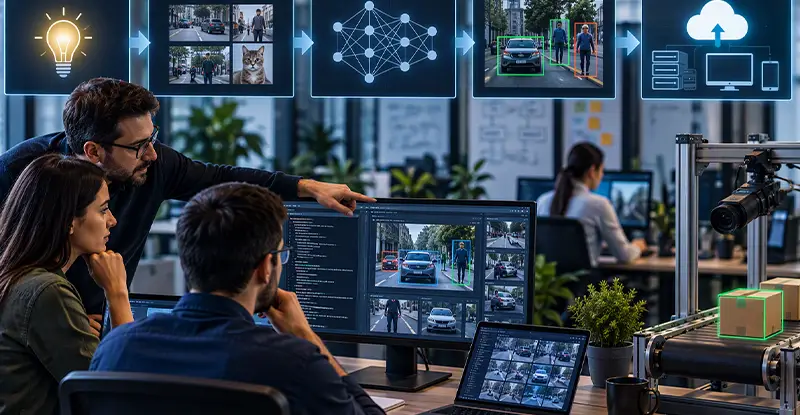
A lot of companies start their computer vision journey the same way: someone sees an impressive demo online, imagines it solving a specific problem on their factory floor or in their app, and assumes the path from idea to working system is short. In reality, computer vision projects follow a distinct lifecycle, and skipping stages is the single biggest reason pilots never make it to production. Understanding that lifecycle - before writing a line of code - is what separates teams that ship from teams that spend a year iterating on a demo.
Off-the-shelf vision APIs can handle generic tasks like recognizing common objects or reading printed text, but most real business problems are not generic. A quality inspection line has its own defect types; a retail shelf has its own product mix; a surgical tool has its own shape and reflectivity. Solving these specific problems usually calls for a model trained on your own data and tuned to your own environment, which is exactly the work a custom computer vision development company specializes in, structuring the process end to end. Off-the-shelf tools rarely reach the accuracy a specialized business process demands.

An AI model creates business value when its output can reliably support what happens next. docAlpha applies intelligent document processing to capture, classify, extract, validate, and route business information into downstream workflows.
Move beyond isolated AI capabilities and put intelligent automation to work in everyday operations.
Before any data is collected, the problem needs to be stated in terms a model can actually be evaluated against. "Detect defects" is not specific enough; "flag surface scratches longer than 2mm with at least 95% recall and no more than 2% false positive rate" is something a team can build toward and test objectively.
This stage typically involves:
Skipping this step leads to a common failure mode: a technically impressive model that nobody can actually use, because it was never aligned with how a human or process will act on its output.
Recommended reading: Learn How to Measure Accuracy in Machine Learning Models
Data is where computer vision projects spend most of their time and budget. Unlike text or tabular data, visual data must reflect the exact conditions the system will face in production - the same lighting, the same camera angle, the same range of object variation.
A few realities teams often underestimate:
Teams that treat data collection as a one-time task rather than an ongoing process tend to see model performance degrade within months of launch, as real-world conditions drift away from what was originally captured.
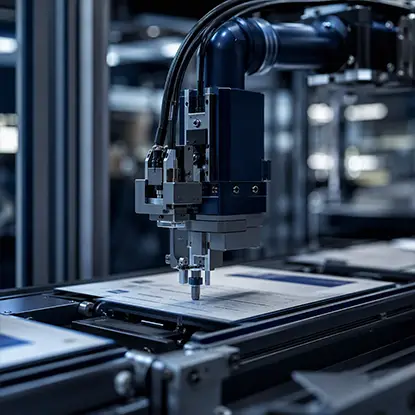
Computer vision projects become operational when model output can trigger an alert, update a system, or initiate another business action. docAlpha brings the same principle to document-driven processes by connecting intelligent data capture and validation with automated workflows.
Turn captured information into business action instead of leaving it trapped at the extraction stage.
With a labeled dataset in hand, the modeling phase can begin. This is often the part people picture when they think of "AI development," but it is usually the fastest stage relative to data work and deployment engineering. Businesses developing systems that interpret images and extract information from visual data can explore InvoZone’s computer vision and OCR solutions to support their specific use cases.
Key considerations during this stage include choosing an architecture suited to the task - object detection, segmentation, classification, or tracking each call for different model families - and deciding how much can be built on pretrained foundations versus trained from scratch. Validation has to go beyond a single accuracy number: teams need to test performance across different lighting conditions, camera positions, and edge cases the model is likely to encounter, and stress-test against the specific failure modes identified back in stage one.
A model that performs well in a Jupyter notebook is not the same as a system running reliably in production. Deployment introduces its own set of engineering problems:
Recommended reading: Discover How Machine Learning Algorithms Power Process Automation
Computer vision systems are not "set and forget." Physical environments change - new product variants get introduced, cameras get replaced, seasons shift outdoor lighting - and models need to be retrained or fine-tuned to keep up.
A sustainable maintenance plan usually includes:
Without this ongoing investment, even a well-built model gradually loses accuracy, and the business ends up back where it started - relying on manual checks to catch what the system misses.
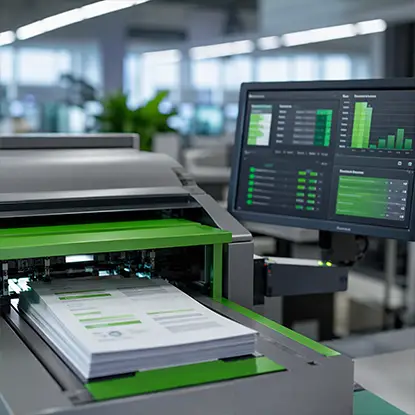
Successful AI initiatives require more than an accurate model - they need validation, integration, exception handling, and a clear path for using the results. docAlpha combines intelligent document processing with validation, intelligent rules, and workflow automation.
Create document-driven processes designed around business outcomes rather than isolated AI functionality.
Custom computer vision development is less about a single clever algorithm and more about a disciplined process: defining the problem precisely, investing seriously in representative data, validating against real-world conditions, engineering for the actual deployment environment, and committing to ongoing maintenance. Businesses that respect each of these stages tend to end up with systems that quietly work in the background for years. Those that rush straight to modeling, skipping the groundwork, are the ones left wondering why their impressive demo never became a reliable production tool.
 The Importance of Accuracy in Machine Learning: A Comprehensive Guide
  Machine Learning Algorithms in Business Process Automation
  Revolutionizing Business: Computer Vision Development Teams
  AI and Visual Inspection Unite for Smarter Workflow Control
  Selecting the Best AI Training Data for Optimal Performance
  AI Proof of Concept: From Testing to Enterprise Deployment
