CRM Isn’t Enough: The Case for Adding a Conversational Messaging Layer to Your Customer Engagement Stack

Published: July 07, 2026
Your CRM proudly tells you how many leads are in the pipeline, but can it whisper “Hey, wanna grab a coffee?” to the hot lead who just abandoned their cart? Probably not. Yet that’s exactly the kind of split‑second, personal nudge that turns a maybe into a yes.
Fewer than 40% of CRM deployments hit end‑user adoption rates above 90%, and the fallout is brutal: 37% of organizations lost revenue directly because of poor CRM data, while a quarter saw annual revenue drop by 20% or more.
The tool isn’t failing because it lacks features, it’s failing because it was built to record history, not to power real‑time conversation. The missing piece is a dedicated conversational messaging layer that transforms stored profiles into instant, high‑open‑rate dialogue.
In the next few minutes, we’ll unpack why CRM alone leaves money on the table, how messaging channels like WhatsApp eclipse email by orders of magnitude, and what it looks like to close the gap with automation and a practical conversational API.

When conversations become orders, OrderAction automatically captures, validates, and processes sales orders directly into your ERP with AI-powered accuracy. Accelerate fulfillment, reduce manual work, and deliver the fast customer experience buyers expect.
We’ve all been sold the dream: a CRM that’s a pristine, single source of customer truth. The reality? That truth is often a mess. Outsales tells us 76% of organizations say less than half of their CRM data is accurate and complete.
To make matters worse, CRM data decays by about 34% every year if nobody’s scrubbing it, silently hollowing out the value of every record.
And the financial sting is anything but silent: a survey by CRM Switch found that 31% of respondents estimated their company loses over 20% of annual revenue purely to bad CRM data.
Even as the industry rushes toward AI‑powered prediction, as explored in The Future of CRM Isn’t Just Digital, It’s Predictive, the foundation of trustworthy, current data remains a real‑time roadblock. An intelligent prediction engine running on dirty data is just a confident liar.
It gets worse when you look at how sales teams actually interact with their CRM. The same Outsales research shows reps spend only about 30% of their week selling; roughly 9% disappears into manually entering customer and sales data.
And knowledge workers burn 13 hours a week just hunting for basic information inside the system, the very tool designed to save them time has become a second job.
No wonder Indigitall frames CRM as fundamentally reactive: it’s brilliant at storing historical relationship data, but it isn’t built to ignite a real‑time, two‑way conversation.
If your best customer just tweeted about a problem, your CRM will record the case later, but it won’t reach out now.
Recommended reading: The Hidden Cost of Disconnected Customer Support: How Integrating Your CRM and Helpdesk Transforms B2B Service Operations
Here’s the thing: CRM is amazing at building customer profiles and segmenting audiences for marketers. You can know everything about a buyer and still be completely mute at the moment they’re ready to act.
Even the most predictive CRM, the kind we mentioned earlier, can’t trigger a “Hey, noticed you’re looking at the premium plan, want me to walk you through it?” in the 90‑second window when intent is hottest.
In short, CRM is the memory; a conversational messaging API is the voice. Without the voice, the memory just sits there.
If you want to talk to customers where they actually live, you need to be on WhatsApp. Aisensy puts the numbers in stark relief: 3.3 billion monthly active users, present in 180+ countries and 60+ languages, and the #1 messaging app in over 60 countries.
The reach alone is jaw‑dropping, but it’s the engagement metrics that make the business case unmissable. WhatsApp Business API messages routinely hit open rates of 95–98%, versus email’s stale 31%, a 3× to 3× advantage.
Another analysis pegs the API open rate at a staggering 98%. And it’s not just opens: 88–95% of messages are read within five minutes of delivery. Customers have voted with their thumbs, too. A Facebook‑commissioned survey reported by Aisensy found 64% of people prefer messaging businesses over calling.
The behavioral data seals the deal: many use those apps to browse or buy products (Chatfuel). The channel doesn’t just grab attention, it moves wallets.
Conversations Generate Documents. AI Automates Them
Customer interactions produce purchase orders, invoices, contracts, and countless other business documents. docAlpha captures, extracts, validates, and routes information automatically using AI. Transform document-heavy workflows into intelligent
business processes.
Book a demo now
The performance gap between WhatsApp and traditional channels isn’t a crack; it’s a canyon. Click‑through rates on WhatsApp campaigns range from 15% to 60%, compared to email’s average 2–5%, a 10–30× multiplier, as Aisensy documents.
Conversion rates are even more extreme: WhatsApp marketing pulls 45–60%, versus 2–5% for email and SMS. That means a campaign that would generate five sales via email can produce sixty on WhatsApp, using the same offer. And 66% of consumers who initiate a WhatsApp conversation with a brand complete a purchase, a figure no cold outreach channel can touch.
Speed is the accelerant: companies using WhatsApp Business through platforms like Wati report a faster customer service response time, which translated into a sales lift and an improvement in overall conversion rates, per Chatfuel.
But that speed sword cuts both ways. The same Chatfuel study found that users will bail on a brand that responds slowly on WhatsApp, and have abandoned a purchase for exactly that reason.
If you’re stepping into the messaging arena, responsiveness isn’t a nice‑to‑have, it’s the price of entry.
Recommended reading: AI Automation: What It Is and How It Works
The latency baked into traditional CRM stacks is a conversion killer. As Evam describes it, brands often engage customers based on yesterday’s data, a relic of batch‑processing infrastructure that can’t keep up with a customer who’s browsing right now. But when you inject real‑time triggers via a messaging layer, the numbers transform.
Interakt found that automated WhatsApp follow‑ups sent within 24 hours of a lead event increased conversion probability by 27%, and cart‑recovery messages fired within 30 minutes recaptured 18–25% of abandoned carts.
Separate research from Gallabox shows that companies responding quickly on WhatsApp see higher conversion rates in sales scenarios. That’s not a marginal improvement; it’s a structural advantage.
Scaling that kind of responsiveness manually would break any team, which is where AI and chatbots earn their keep. WhatsApp chatbots already handle 60–80% of customer inquiries without human intervention, and 91% of all conversational AI interactions in 2025 took place on WhatsApp (Aisensy).
Meanwhile, Gallabox notes chatbots cut response times by up to 35%. Beyond conversation, there’s a broader efficiency lift: businesses that embrace marketing automation see a 14.5% boost in sales productivity.
Your CRM knows the lead is hot; a well‑tuned automated conversation makes sure you don’t let them cool off.
What does adding that layer look like in practice? It’s simpler than you might think. Platforms like Wati plug directly between your CRM and the customer’s messaging app, giving you a shared team inbox, a no‑code chatbot builder, broadcast campaigns, and integrations with the tools you already use.
Wati itself is an AI‑powered customer engagement platform trusted by 16,000+ businesses across 190+ countries, capable of deflecting up to 60% of customer queries via AI.
The proof is in the stories: using Wati’s WhatsApp business API, InvestAI grabbed 30x more responses than traditional emails. These aren’t theoretical gains, they’re direct outcomes of turning stored CRM contacts into instant, two‑way conversations on the channel customers already check hundreds of times a day.
Wati isn’t the only option, but it embodies the missing conversational layer that sits between data and dialogue, making real‑time engagement a simple configuration choice rather than an engineering project.
Winning new business also means processing invoices efficiently. InvoiceAction automates invoice capture, approvals, and ERP posting using AI-powered document processing. Reduce AP workload while improving financial accuracy and visibility.
Adding a conversational layer isn’t a magical fix. The vendor you pick and how ready your operation is matter enormously. For instance, a 2026 review by Flowcart found that some platforms tack on a 20% markup over Meta’s conversation charges and layer per‑agent fees that can surprise you later.
Remember that purchase-abandonment stat from Chatfuel earlier? A messaging layer that responds slowly is worse than no layer at all. None of this means you shouldn’t add one, it means you need a dependable partner, a clear eye on total cost, and a readiness to scale support alongside message volume.
CRM systems are brilliant at capturing intent, but they chronically miss the moment. Data quality decays, adoption lags, and batch‑oriented architectures leave a chasm between what you know about a customer and what you can actually do with that knowledge in real time.
Recommended reading: Intelligent Process Automation - Best Practices
A dedicated conversational messaging API bridges that chasm, delivering the instant, high‑open‑rate engagement that email and portal‑based outreach simply can’t match.
The evidence is stark: open rates near 98% for WhatsApp Business API messaging, click‑through multiples of 10–30x over email, and double‑digit conversion lifts that directly boost revenue.
The customer engagement stack of the future won’t replace CRM; it will surround it with real‑time, AI‑augmented conversational channels that turn stored data into immediate customer action.
The only question left is how quickly you add that layer, before your competitors start answering messages you’re not even getting.
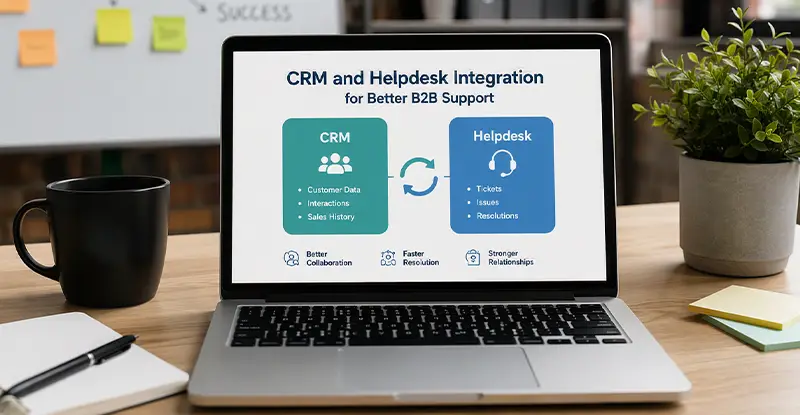 CRM and Helpdesk Integration for Better B2B Support
 Predictive CRM: Next Evolution in Customer Relationship Management
 AI Automation: What It Is and How It Works in 2026
 Smarter SaaS Support Starts With the Right AI Tools
 AI Technology: Artificial Intelligence Technology Explained
