From Video Evidence to Case Files: Automating Legal Document Workflows
Published: July 29, 2026
Video used to be the easy part. A collision happens, someone's dashcam or a nearby storefront camera catches it, and that clip lands in a folder somewhere - unlabeled, untimed, disconnected from the police report sitting three folders over. Turning that raw footage into a case a legal team can actually work with is where things get messy. Document automation is quietly solving that problem, one workflow at a time.

Legal documents shouldn't slow your legal team down. docAlpha uses AI to capture, classify, validate, and route legal documents automatically, reducing manual review and improving accuracy.
AI-powered document automation with intelligent data extraction and workflow control.
Accelerate legal operations while reducing administrative costs and compliance risks.
Well, here's the thing nobody talks about enough - the bottleneck in most crash cases isn't finding video, it's organizing everything around it. A single incident can generate dashcam clips, traffic camera exports, police reports, medical records, insurance correspondence, and witness statements. Other technology that can help prove a car accident, such as vehicle cameras or digital recording systems, can also become part of the evidence that legal teams need to organize and review. All arriving in different formats, at different times, from different people.
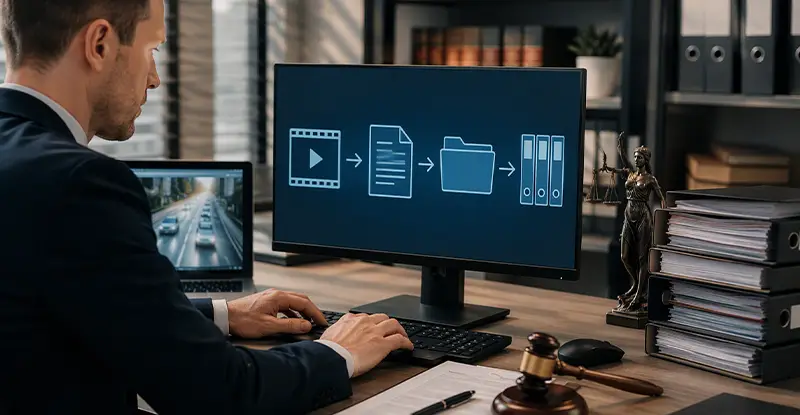
Modern intake workflows tackle this with automated tagging. Software ingests the video file, extracts its metadata (timestamp, GPS coordinates, device signature), and cross-references that against the case number automatically. No paralegal manually typing filenames into a spreadsheet at 9 PM. Optical character recognition pulls text straight off scanned police reports and insurance forms, feeding structured data into a case management system without anyone retyping a single line.
Chain-of-custody logging happens in parallel. Every time a file is accessed, exported, or reviewed, the system timestamps it - building the exact documentation trail courts now expect for digital evidence. Skip that step, and even the clearest video can get challenged on a technicality before anyone even discusses what's in the frame.
This is precisely the stage where legal support becomes essential, not optional. Once video evidence starts feeding into an actual legal case file, the process of formatting, securing, and presenting that documentation properly is what determines whether it holds up and firms working with resources like Landver Law know how to structure that handoff so nothing gets lost or ruled inadmissible later.
A typical automated intake sequence looks like this:
Recommended reading: Document Processing in Legal Industry: Solving the Case of Intelligent Automation
Personal injury and crash cases generate paper. Lots of it. Medical records, repair estimates, correspondence, deposition transcripts - and somewhere in that pile is the one sentence that changes the outcome. Intelligent document processing exists to find it faster than a human skimming for hours ever could.
Natural language processing models trained on legal and medical terminology scan incoming documents and flag specific data points - injury descriptions, dates of treatment, policy limits, prior claims history. Instead of a paralegal highlighting a physical stack of papers, the system surfaces the relevant clauses and numbers within seconds, ranked by relevance to the active case.

Late approvals can impact vendor relationships and financial reporting. InvoiceAction automatically extracts invoice data, validates information, and routes exceptions for faster decision-making.
Automated workflows with AI-driven data validation and matching.
Improve cash flow visibility while minimizing invoice processing delays.
Here's where it gets genuinely useful. Advanced platforms link extracted document data directly to timestamps in the video evidence. A medical report mentioning "impact at approximately 3:47 PM" gets automatically cross-referenced against the frame where the actual collision occurs in the footage. Discrepancies pop up immediately - and discrepancies, frankly, are often where cases get won or lost.
Tools doing this kind of heavy lifting typically include:
Recommended reading: Why Document Automation Is Essential for Modern Law Firms
Technology only works if people actually trust it and legal teams have every reason not to, right away. Handing a jury an AI-written summary that quietly skipped something important? That's a nightmare nobody wants to risk.
So the firms that adopt this well tend to split the labor pretty deliberately. Let the software sort, tag, cross-reference - the grunt work nobody enjoys anyway. Keep actual humans on interpretation and final calls, full stop. This is also where many firms turn to outsourced legal virtual assistants to handle intake follow-ups, document organization, and client communication, while automation takes care of document classification, data extraction, and routing. That division matters. A system flagging "possible discrepancy in reported impact time" is useful. A system deciding what that discrepancy means for the case is a different conversation entirely, one courts aren't ready to hand over to software.
Security concerns run deep too, and rightly so. Then there's security, and this part isn't optional. Medical histories, financial records, deeply personal details - that's what's sitting inside these case files. Any platform touching that data needs encryption both at rest and in transit, tight access controls, audit logs thorough enough to satisfy privacy law and a skeptical judge alike. Skip any of that, and whatever time was saved gets eaten right back up.
So what does it actually look like when it's done right? Weeks of case prep shrink down to days. Attorneys spend less time hunting for the right page in a 400-document file and more time actually building an argument. Makes a real difference in how a firm operates, doesn't it?
Looking ahead, expect deeper integration between video forensics tools and document automation platforms - systems that don't just store the footage and the paperwork side by side, but actively understand how they relate to each other. The technology isn't replacing legal judgment. It's clearing the noise so that judgment has something solid to work with.

Incomplete or inconsistent document data can slow legal matters and increase compliance risks. docAlpha applies AI and business rules to extract, validate, and organize legal information with exceptional accuracy.
Intelligent document processing that delivers reliable, structured legal data.
Reduce rework, improve compliance, and speed case preparation.
 Legal Document Automation in 2026: Faster, Safer Workflows
 How AI Is Reshaping Legal & Compliance Workflows
 AI Legal Document Data Extraction for Faster Workflows
 Generative AI Transforming Legal Drafting Practices
 Process Automation That Elevates Client Experience in Legal
 The AI Revolution in Document Workflow Automation
