OpenAI's Dots Put Always-On AI Agents Into Shared Team Workspaces

Published: September 30, 2026
At DevDay 2026, OpenAI announced two products designed to move AI beyond the prompt-and-response pattern that has defined the category so far. Dots are persistent AI agents that keep working after an employee closes the chat window. ChatGPT Space is the shared workspace where human teammates, ChatGPT, and a user's Dot operate from the same pool of project knowledge. Together, per VentureBeat, they constitute OpenAI's clearest push yet toward AI that holds ongoing responsibility rather than responding to individual requests.
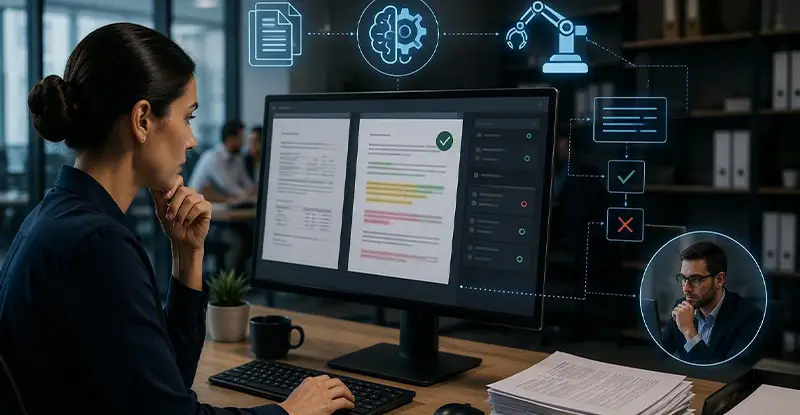
The next phase of enterprise AI is moving beyond individual prompts toward technology that participates continuously in business processes. docAlpha applies intelligent automation to document-driven work by capturing, extracting, validating, and routing business information through downstream workflows.
Move beyond isolated AI interactions and automate the recurring document work that keeps operations moving.
The Activateexp editorial team covers how marketing organizations bridge digital planning and on-the-ground execution, and the ChatGPT Space model raises a direct question for that beat: which workflows does a persistent, memory-carrying agent working from a shared knowledge base most naturally absorb?
OpenAI's own answer points toward marketing teams. A Dot can learn an organization's audience, positioning, and creative standards, then revise launch material automatically when the underlying product changes. That example sits comfortably in the digital planning half of the picture. The more telling test is the physical half.
Marketing operations often extend well beyond content creation. Campaigns can involve schedules, vendors, staffing, location-specific activities, performance data, and constant adjustments across multiple teams. For example, programs designed to reach customers across the country with mobile pop-up tours require ongoing coordination across routes, schedules, field teams, and campaign results. These are precisely the kinds of multi-step workflows where a persistent agent working from shared project knowledge could become useful.
The mechanism behind that persistence is specific. Each Dot runs on OpenAI's GPT-6 Astra model and receives its own cloud computer and browser. Dots are accessible through ChatGPT on mobile and web, with integration into Slack and Microsoft Teams already active; availability through additional messaging apps and as an audio model over the phone is announced as forthcoming.
Connectivity is broad. Dots can reach more than 4,000 applications through OpenAI's plugin ecosystem, and they gradually learn an individual's working preferences and standards over time. The shift this represents is structural. Rather than a user prompting an assistant for a deliverable, the user delegates a category of work. A developer Dot tracks open issues. A marketing Dot monitors audience data and flags when launch copy needs updating. A sales Dot manages pipeline follow-ups. A content Dot maintains brand voice across channels. DevDay 2026 introduced more than 20 products and updates in total, including new high-speed model options, computer use in the Agents API, and event-triggered automations - but Dots, announced during CEO Sam Altman's keynote, represent the most direct claim on continuous workflow ownership.
Recommended reading: Discover How AI Automation Extends Beyond One-Time Tasks
ChatGPT Space is where that workflow ownership becomes organizational rather than individual. The environment provides collaborative Pages, slides, plugins, and spreadsheets, and allows teams to delegate recurring work to automations that gather information and act on schedules or trigger events. A user's Dot, their teammates, and ChatGPT itself all draw from the same project knowledge pool.
Above the individual-Dot tier sits a specialist layer with more formal standing. Specialist Dots receive their own organizational identity, credentials, and access to company systems, and are assigned a defined business responsibility. OpenAI has already run internal experiments with agents working in procurement, invoice processing, email marketing, customer support, and commercial contracting. Focused enterprise pilots are now beginning, with OpenAI engineers working directly alongside customers.
Microsoft is part of the governance story. OpenAI is working with Microsoft to integrate specialist agents into Microsoft Agent 365, giving businesses a path to manage them through security and compliance infrastructure they may already operate. On pricing, the first Dot is included at no additional charge for Pro and Business Premium subscribers. Enterprise, Edu, and Healthcare customers can access the beta when an administrator enables it. OpenAI has not disclosed costs for additional Dots, specialist Dot commercial pricing, or workload capacity tiers.
AI becomes more valuable when it can do more than generate an answer - it needs to work with business information and support what happens next. docAlpha transforms incoming documents into validated data and connects that information with intelligent rules and downstream workflows.
Put intelligent automation to work where documents, decisions, and enterprise systems meet.
Autonomy without oversight is the obvious concern, and OpenAI has built a layered control structure to address it. When a user is not actively working, a Dot can conduct proactive research inside already-connected applications. The tools available for that background activity are read-only: the agent cannot send messages, modify content, or control the user's computer or browser without explicit permission.
Action-taking operates under a separate framework. Custom Rules allow organizations to permit particular actions, require human approval for others, or prohibit specific behaviors entirely. An Activity View lets users inspect what background work has occurred and intervene. An auto-review system checks potentially consequential actions against user instructions and OpenAI's safety requirements before determining whether work can proceed autonomously. Some operations remain reserved for the human user regardless of any rule configuration. Changing passwords is one named example. The reasoning behind that reserved tier reflects a practical reality: mistakes made by an agent with ongoing system access carry consequences that differ in kind from an error in a chatbot response.
Recommended reading: Learn How to Govern Intelligent Process Automation Effectively
OpenAI is not alone in pursuing this category. Meta's Muse, which launched September 8 and runs inside a dedicated Muse Secure VM with its own browser and cross-app capability, had accumulated download figures that multiple analytics firms described as unusually rapid. Sensor Tower estimated 3.4 million downloads by September 24; Apptopia placed the number at 4.3 million; Appfigures estimated roughly 2.3 million. Muse reached the top of both Apple's and Google's U.S. app-store rankings during the initial surge.
On Tuesday, Meta expanded Muse with small-business integrations covering Shopify, QuickBooks, Stripe, and Canva. The Wall Street Journal reported that approximately one-third of Muse users have connected a business-related account, and more than 1,500 businesses have applied for Muse integrations. The category is forming fast. Multiple entrants are building toward the same basic promise of an agent that holds ongoing access, learns context over time, and owns work rather than answers questions.
The competitive question is no longer which AI model produces the best single response. It is which agent a business trusts with continuous access to its operational systems, its data, and the workflows that keep it running.

The value of enterprise AI is shifting from producing individual answers to completing useful work across connected processes. docAlpha combines intelligent document processing, validation, intelligent rules, and workflow automation to turn incoming business information into action.
Focus AI investment on measurable operational improvements rather than isolated capabilities.
 AI Automation: What It Is and How It Works in 2026
 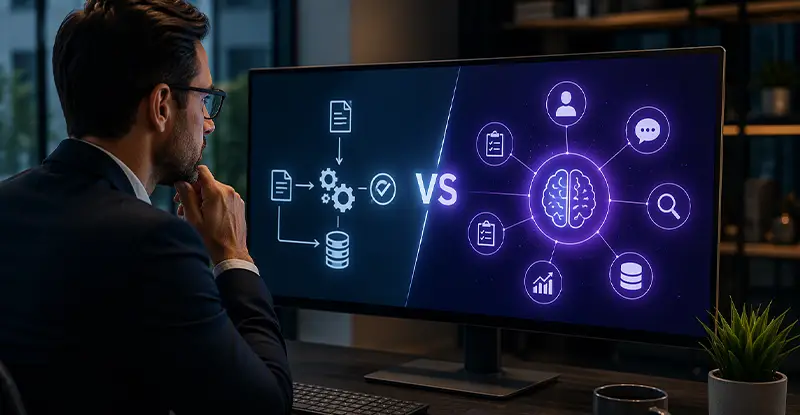 AI Agents vs Traditional Business Automation Solutions
  Human-AI Collaboration for Better Business Workflows
  AI Marketing Automation for Smarter, Faster Campaign Workflows
  Human-in-the-Loop AI for Intelligent Document Automation
  All About Workflow Automation
