Why Businesses Now Compete to Be Recommended by AI Platforms in 2026

Published: November 09, 2026
Across the first seven months of 2026, visitors who reached U.S. retail sites through a link in ChatGPT or Claude went from a rounding error in most analytics reports to one of the highest-converting segments retailers track. The work of getting a brand into those AI answers is younger than almost any other marketing function, and you can date its beginnings to a single month. In May 2023, one agency began offering AI recommendation work as a client service. Six months later, a Princeton-led research team gave the practice its name when they posted "GEO: Generative Engine Optimization" to arXiv.

AI recommendations may bring new customers, but increased demand can also expose slow document-heavy processes. docAlpha uses AI-powered document classification, extraction, and validation to automate the handling of incoming business records across connected workflows.
Scale administrative processing without allowing manual document entry to slow growth.
Through most of 2024 and 2025, the business case depended on projections rather than revenue, and few marketing leaders could point to sales that an AI recommendation had produced. The initial relevant numbers came from Adobe, which tracks more than a trillion visits to U.S. retail sites. In March 2025, its data showed that people arriving from AI tools were still worth less than everyone else, with non-AI visitors generating 128% more revenue per visit. By the holiday season that had reversed, AI referrals had converted 31% better than other traffic. In July of this year, shoppers sent by an AI assistant converted at a 60% higher rate, the 11th straight month they had come out ahead, according to Adobe's July figures.
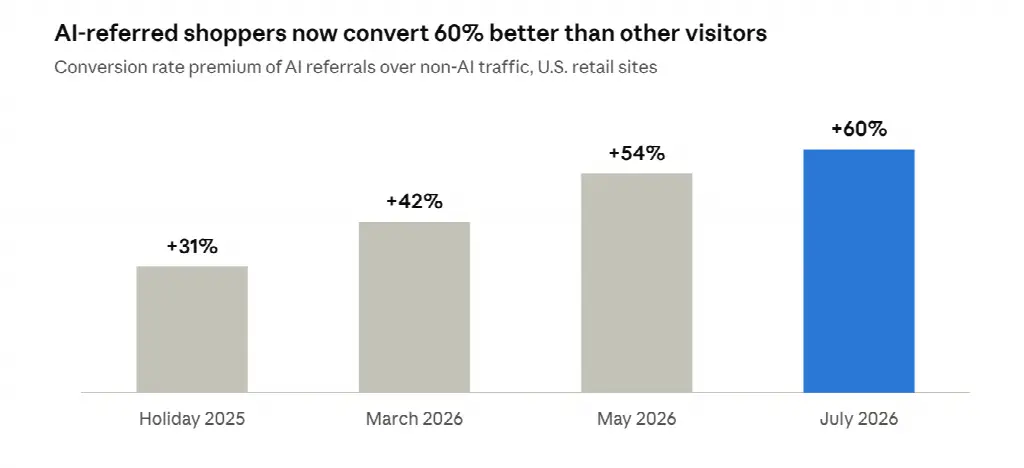
Source: Adobe Analytics, U.S. retail sites (1 trillion+ visits). Holiday 2025 = Nov to Dec 2025; monthly figures as reported by Adobe and Digital Commerce 360, Jan to Aug 2026.
The reason makes sense once you watch how people use these tools. Someone who asks Claude to compare accounting firms in Austin or asks ChatGPT for a quiet dishwasher under $800 has usually done most of their research by the time they click anything. In Alchemer's 2026 survey of 1,002 U.S. shoppers, nearly half had used an AI tool to research a retail purchase in the past year, and roughly one in six had found their most recent purchase through one. Those people arrive ready to buy, and they arrive having already been told who to buy from.
Recommended reading: Learn How AI Automation Is Changing Customer Research and Business Decisions
That second point is what turned a traffic story into a competitive one. A search results page shows ten links and leaves the sorting to the reader. An AI answer usually offers three or four options, sometimes just one, each with a sentence explaining why it fits. A company left off that shortlist has no second page to fall back on.
Early research also suggested the answers could be moved, which explains some of the urgency. The Princeton-led paper reported gains of up to 40% in how prominently a source appeared in generated answers within its test system, and in 2024 three separate academic teams showed that product recommendations from large language models could be steered, in one case with a short string of text added to a product page. The researchers were clear these were lab conditions. Marketers drew their own conclusion anyway: if the recommendation can be influenced, someone will influence it, and it might as well be them.
By January 2026, The Wall Street Journal was reporting that small and midsize businesses were paying serious money for favorable chatbot mentions. Since then the stakes have risen again because AI has started buying as well as recommending. In September, Shopify opened its checkout to browser-based AI agents, which can now fill in the checkout page and submit an order once the buyer approves. Walmart published its own rules for shopping agents in October. Amazon, for now, still blocks outside agents from completing purchases.

AI-assisted discovery and purchasing are changing how demand reaches businesses, while their back offices still process documents from multiple sources. docAlpha uses AI-powered extraction, data validation, and workflow routing to prepare business documents for downstream systems.
Create a more scalable document-processing foundation as commerce channels evolve.
An agent asked to order holiday gift cards for a remote team at about $50 each doesn't stop to get a second opinion from a friend. It compares the options it found and pays. Jim Rowan, who heads AI for Deloitte in the U.S., told Unite.AI last week that agents will favor brands whose products, pricing, and data are machine-readable and easy to verify. Plenty of retailers aren't there yet. When Adobe checked a broad set of U.S. retail homepages this summer, it found that 39% of their content couldn't be read by language models at all.
The holiday season starting this month is the first in which agents can complete purchases at Shopify stores and, through Meta's Muse assistant, at more than a million businesses that accept Stripe's Link. Most of the companies that turn up in those transactions started working on it a year or more ago. For an owner who has never asked ChatGPT to recommend a business in their own category and read who comes back, this week would be a good time to try.
Recommended reading: Discover How AI-Powered Data Management Makes Business Information Easier to Verify
 AI Automation: What It Is and How It Works in 2026
 AI Search Optimization: Why Visibility Now Depends on AI
 Top AI Visibility and Agent Analytics Platforms Compared
 AI Transforming SEO: Redefining Strategies for Digital Success
 How IT Teams Can Choose the Best Google SERP API
 AI’s Role in Shaping the Future of Digital Marketing

