How Automated Order Processing Helps Waterjet Cutting Manufacturers Fulfill Custom Orders Faster
Published: July 23, 2026
Every custom order is a little different. One customer sends a neat PDF. The next fires off a rushed email with a drawing attached. Another drops in a spreadsheet with fifty line items. Sound familiar?
For a waterjet cutting shop, this is the daily reality. Custom work is the bread and butter, but every order has to be read, understood, and typed into a system before a single part gets cut. So what happens when all that typing becomes the slowest part of the job? That is exactly where automated order processing changes the game.
Custom orders rarely arrive in one tidy format. They show up from every direction, in whatever style the customer happens to prefer. No two clients seem to send things quite the same way.
A typical shop might receive:
Each file holds the same basic information: what to cut, from which material, how many, and by when. The trouble is that a person has to dig it all out of every format and enter it by hand, one order at a time.
Recommended reading: Intelligent Document Processing for Manufacturing Firms
Manual order entry looks simple, but it quietly eats up hours. Someone has to open each file, read it, and retype the details into an ERP or production system. The catch is that a customer's layout almost never matches your system's fields, so every order becomes a small translation job.
Then that work usually gets double-checked against the original. On a busy day, the same details might be copied across two or three different screens. Each extra step is another chance for a small slip.
That slow, repetitive work causes real problems:
And those mistakes add up fast. Research shows that manual data entry typically produces errors in around 1 to 4 percent of entries, according to a peer-reviewed study on data accuracy. On a large order, that can mean the wrong material, the wrong quantity, or a missed deadline. Every error means rework, and rework means delays.
Recommended reading: Eliminating Manual Data Entry in Enterprise Operations
Automated order processing uses AI to do the reading for you. It scans an incoming order, pulls out the important details, and drops them straight into your system. Part numbers, quantities, materials, and dates all get captured without anyone retyping a thing.
It handles the messy variety too. Whether the order is a clean PDF, a spreadsheet, or a long forwarded email chain, the system reads it and lines the details up against your product catalog. It can also check its own work, flagging anything odd like a missing field or an unusual quantity, so problems get caught before they ever reach production.
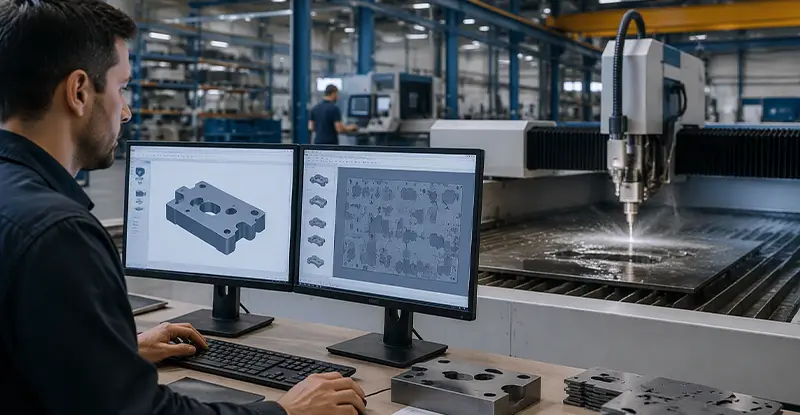
This matters because the order data is what eventually drives the shop floor. A water jet cutter can only make what the order actually says, so the cleaner and faster that information arrives, the sooner cutting can begin.
OMAX, a Hypertherm Company, builds machines that many custom shops rely on to turn those orders into finished parts.
The result is a smoother handoff from inbox to cutting table. A job that once needed an hour of data entry can be ready in minutes, with far fewer mistakes along the way.
Recommended reading: AI Order Management: The Complete 2026 Guide to Intelligent Order Processing
When order data flows automatically, the benefits ripple across the whole business. Small time savings on every order turn into real capacity over a month. Three gains stand out.
Better production planning comes first. When orders land in your system right away, schedulers can see the full workload and slot jobs in sooner. There is no hidden pile of unentered emails quietly throwing off the plan.
Faster fulfillment follows naturally. Jobs are no longer stuck waiting for someone to type them up, so parts move to cutting and out the door more quickly.
Happier customers are the real prize. Accurate orders and on-time delivery build trust. In custom manufacturing, that kind of reliability is what wins repeat business.
Here is what shops tend to gain, at a glance:
Together, these improvements create a smoother workflow, stronger customer relationships, and a more efficient operation from order to delivery.
Recommended reading: 12 Benefits of Sales Order Automation
Waterjet shops live and die by custom work. But the real bottleneck is often not the cutting itself. It is everything that has to happen before the machine even starts.
Automated order processing clears that bottleneck. It takes the slow, error-prone typing out of the picture and gets clean, accurate orders to the shop floor faster. For any manufacturer juggling a steady flood of custom orders, that is a simple change with a very big payoff.
 AI Order Management: The Complete 2026 Guide to Intelligent Order Processing
 Sales and Purchase Orders Processing with Artificial Intelligence
 ERP Sales Order Automation for Streamlined Manufacturing
 Reduce Manufacturing Rework With Smart Automation
 Driving Innovation with Automation in High-Tech Industries
 Reduce Manufacturing Delays with Document Automation
