What Enterprise Reputation Management Firms Must Do as AI Buyers Become a B2B Reality
Published: May 22, 2026
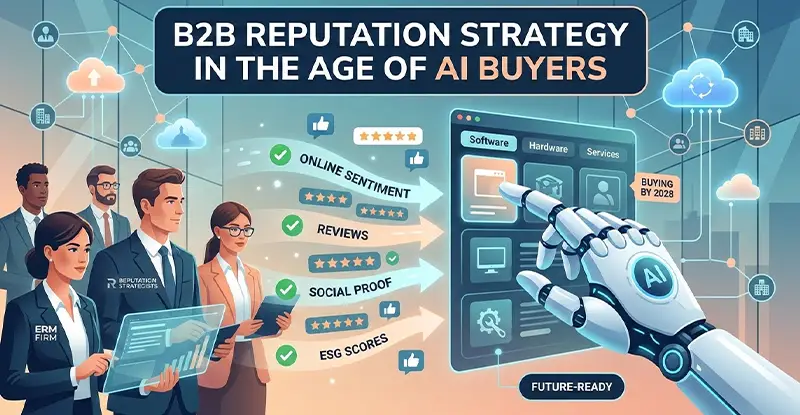
AI agents are moving into the purchasing seat. By 2028, autonomous systems will evaluate vendors through data signals rather than human intuition, and every enterprise reputation management firm needs a plan for what that means. The shift is already underway. The question is whether your firm is building for the audience that will decide who gets shortlisted.
An AI procurement agent does not read your about page the way a human buyer does. It processes structured signals: reviews, compliance records, financial filings, and employee sentiment data. It runs these inputs against weighted criteria and produces a score. The whole process takes seconds.
The four major AI buyer agents currently operating in B2B markets each pull from different source types. Salesforce Einstein evaluates 47 trust signals in roughly 2 seconds, prioritizing review platforms and employee forums. IBM Watson Procurement analyzes 39 signals in 4 seconds, drawing more heavily from compliance databases and financial filings. SAP Ariba AI checks 52 signals in 3 seconds, incorporating supplier ratings and sustainability metrics. Oracle Procurement Cloud AI uses 44 signals in about 5 seconds, pulling from contract histories and risk assessments.
A vendor that looks strong to a human buyer can score poorly with these agents if the underlying data is outdated, inconsistent, or simply not in a machine-readable format.

docAlpha helps businesses organize, process, and validate business documents using AI-based automation designed for modern B2B environments and digital workflows. Improve operational visibility while supporting faster, more consistent business decision-making.
Enterprise reputation management teams now break down AI monitoring into three functional categories. AI agent queries account for 65% of total monitoring volume. Autonomous decision scoring makes up 25%. Trust signal evaluation covers the remaining 10%. Each category requires different data sources and different analysis methods.
Standard sentiment analysis was built for human-generated content. It cannot keep pace with the volume or speed of AI-driven query patterns.
Real-time AI monitoring platforms can detect reputation threats from autonomous agents within 14 seconds. Traditional social listening tools take an average of 4.2 hours to achieve comparable threat identification. That gap is not a minor inconvenience. When AI agents are making shortlisting decisions, a 4-hour response window is effectively no response at all.
CMO James at TechCorp tracked a 340% increase in reputation incidents caused by AI agents in 2026. His team found that the agents were misinterpreting old product reviews and employee comments. The volume alone overwhelmed standard monitoring workflows.
Recommended reading: Discover What Makes a B2B Business Model Successful
AI-generated crises now account for 34% of enterprise reputation incidents. Average response time requirements have dropped from 4 hours to 23 minutes for machine-mediated threats. Three threat vectors deserve specific attention.
AI agent query pattern detection. Google's 2027 penalty algorithm flags reputation sites that appear artificial. Deploying predictive anomaly detection systems that catch unusual query behavior before penalties trigger is the standard mitigation approach.
Trust signal manipulation. One vendor lost $2.3 million when artificial signals entered their AI reputation scoring evaluation. Signal verification layers that validate incoming data from external sources are the fix.
Algorithm bias in scoring. The NIST AI Risk Framework 2027 provides guidance here. Quarterly bias audits that examine fairness and compliance issues in reputation models are now part of baseline governance for serious firms.
A manufacturing firm recovered from an AI-amplified crisis in 43 minutes by activating dedicated response protocols. They isolated the misinformation source and issued verified statements across all stakeholder channels before the damage spread.

InvoiceAction and OrderAction help organizations process invoices and orders with greater speed, accuracy, and workflow visibility across ERP systems. Support better business operations and stronger customer experiences through intelligent automation.
Human-focused reputation campaigns take 60 to 90 days to produce a measurable impact. Content optimized for AI-agent evaluation achieves vendor shortlisting within 48 hours using structured trust data. Both audiences need to be served simultaneously, which means building a content conversion process.
The standard approach runs six to eight weeks:
Enterprise content optimized this way generates 3.8 times higher vendor selection rates when structured data includes 23 specific trust metrics in JSON-LD format. That figure comes from how AI procurement systems identify reliable partners. The data has to be parseable before it can be persuasive.
Recommended reading: Discover How AI Automation Is Transforming Modern Business Operations
Three structured data implementations produce the clearest results.
JSON-LD Trust Object. This helps AI agents parse vendor security certifications and trust metrics. Medium setup difficulty, strong foundation for AI trust scoring.
Schema.org Organization markup. This provides credibility signals such as employee count and founding date. Easy to set up and provides AI algorithms with basic context about a vendor's history.
Custom Reputation API endpoints. These provide real-time scoring through live NPS feeds. Advanced setup, but they support AI risk assessment by delivering current performance data rather than static snapshots.
Companies implementing full structured reputation data saw AI agent selection rates increase from 12% to 47% within six months, according to Forrester's 2027 B2B AI Procurement Study. That is the business case for infrastructure investment. It is not theoretical.
A basic JSON-LD trust signal looks like this:
{
"@context": "https://schema.org",
"@type": "Organization",
"name": "VendorName",
"securityCertification": "ISO27001"
}
Leading firms now track 19 AI-specific KPIs. Three anchor the measurement framework.
AI agent engagement rate targets 34%. Trust signal visibility score targets 78%. Machine decision inclusion rate targets 52%.
The full KPI set covers AI agent query volume (tracked daily via Google Search Console), trust signal ranking position (tracked weekly via Ahrefs), AI decision inclusion rate (tracked monthly via proprietary tracking), reputation API response time (tracked in real time), bias detection score (tracked quarterly via Fairlearn), and regulatory compliance score (tracked annually via internal audit).
AI agent query volume deserves particular attention because it measures something traditional traffic metrics do not. It tracks queries submitted by autonomous systems rather than human visitors. It shows how AI algorithms gather information about a brand during procurement scenarios. Unlike page visits or bounce rates, it provides a signal about the future sales pipeline through automated channels.

docAlpha enables organizations to automate document-driven processes with AI-based extraction, workflow automation, and intelligent validation tools. Create stronger operational consistency while supporting scalable B2B growth and digital transformation initiatives.
EU AI Act compliance now requires reputation firms to document 67 algorithmic decision factors. Non-compliance penalties reach EUR 35 million or 7% of global revenue, whichever is higher.
Traditional governance structures operate on 30-day human review cycles, with annual costs of $50,000 to $100,000. AI-automated governance runs continuously, with annual costs ranging from $180,000 to $350,000 for comprehensive implementations. Both models have their place depending on client size and risk exposure, but the compliance requirements make governance a non-optional budget line.
Firms like NetReputation, which operate in this space, have begun treating regulatory documentation as a core deliverable rather than a back-office function. That reframe matters when clients ask how their reputation scores hold up to an audit.
Recommended reading: Discover Why Businesses Use Document Management Systems
Firms that achieve cross-functional reputation alignment report 2.8 times faster crisis resolution and 41% higher client retention through integrated AI governance protocols. The operational model that produces those results involves three structural components.
First, AI reputation steering committees with C-suite representation across Legal, IT, Marketing, and Sales. These groups review AI trust scoring outputs and coordinate responses to emerging reputation risks.
Second, shared reputation KPI dashboards built in Tableau or Power BI. Real-time data sharing across departments enables early detection of trends in AI-generated evaluation processes before they affect positioning.
Third, cross-departmental threat response protocols with a 24-hour escalation matrix. When AI algorithms flag potential reputational issues, the response is activated without delay.
Monthly governance reviews in 45-minute sessions keep teams aligned on AI ethics developments and bias mitigation strategies. Unified, cloud-based reputation data repositories with role-based access controls store the trust metrics and explainability factors that AI agents evaluate during procurement.
Modernize Order Processing for Faster B2B Operations
OrderAction helps businesses automate sales order processing, validation, and document workflows across ERP and B2B environments. Reduce delays, improve data consistency, and support more reliable customer and partner interactions.
Book a demo now
Reputation firms investing $180,000 to $450,000 in AI infrastructure now project a 3.4 times ROI by 2028 through expanded service offerings and reduced manual monitoring costs.
The capability gap assessment is where this starts. Evaluate current team competencies across seven technical areas: AI algorithms understanding, generative AI content evaluation, predictive analytics for crisis prevention, sentiment analysis at scale, data analytics infrastructure, AI ethics frameworks, and AI compliance protocols. Build a matrix showing current proficiency versus what B2B AI procurement environments actually require.
From there, the platform selection and deployment process runs for three to four months once a vendor is chosen. Budget between $45,000 and $120,000 for initial setup, customization for B2B reputation signals, and staff training.
The firms that build this infrastructure before AI-driven procurement becomes the standard operating model will hold a structural advantage. Those who wait will spend 2028 catching up.
 B2B Outreach Strategies That Improve Sales Conversions
 Building Business Trust Through Clear Communication
 AI Search Optimization: Why Visibility Now Depends on AI
 AI Automation: What It Is and How It Works in 2026
 What Truly Builds Lasting Trust With Your Clients
 ABM Success in Intelligent Process Automation Markets
