How AI and Automation Are Transforming Warehouse and Operations Management
Published: July 16, 2026
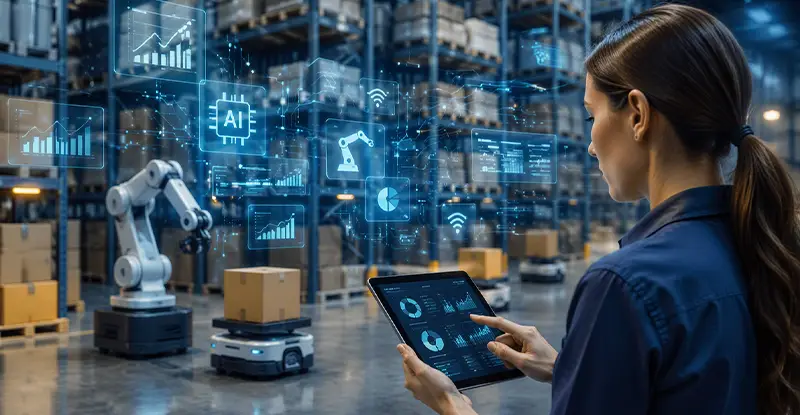
Walk into a modern warehouse today and it looks nothing like it did a decade ago. Robots move through aisles. Software tracks every item in real time. Orders ship faster than ever. And behind all of it, artificial intelligence is making decisions that used to take human managers hours to work through.
These technologies are not just improving speed - they are reshaping accuracy, reducing operational costs, and minimizing human error across the entire supply chain. As automation continues to evolve, warehouses are becoming more efficient, scalable, and data-driven than ever before.
What exactly is changing, and why does it matter for the businesses running these operations?
The shift toward automated, AI-driven warehousing is not a gradual trend. It's a rapid transformation driven by hard economic pressure.
According to Grand View Research, the global warehouse automation market was valued at USD 19.2 billion in 2023 and is projected to reach USD 59.5 billion by 2030, growing at a compound annual growth rate of 18.7%. The primary drivers are e-commerce growth, persistent labor shortages, and the demand for faster, more accurate order fulfillment.
Over 90% of warehouses are expected to use or plan to adopt Warehouse Management Systems by 2027. That's a remarkable shift in how quickly this technology is moving from competitive advantage to industry standard.
Recommended reading: Automation in Warehouse Management: Enhancing Efficiency
It's easy to talk about AI in abstract terms. In warehouse and operations contexts, it does very specific things that directly affect performance.
Demand forecasting: AI analyzes sales history, seasonal patterns, and supply chain signals to predict what inventory will be needed and when. This reduces both stockouts and excess stock, which have significant cost implications.
Route optimization: Inside a facility, AI determines the most efficient picking paths for workers or robots, cutting down the time and distance involved in fulfilling each order.
Predictive maintenance: Rather than waiting for equipment to break down, AI-powered systems monitor machinery performance and flag when maintenance is needed before a failure occurs. Unplanned downtime in warehouse operations is extremely costly.
Real-time inventory visibility: AI, combined with IoT sensors and RFID tracking, gives operations managers an accurate, up-to-the-minute picture of stock levels, locations, and movement across the facility.
Anomaly detection: AI identifies patterns that suggest errors, inefficiencies, or potential fraud, such as unusual order volumes, discrepancies between counted and recorded inventory, or repeated fulfillment mistakes.
Recommended reading: How IoT and AI Are Revolutionizing Inventory Tracking Systems
Hardware like robots and conveyors gets a lot of attention, but the software layer is where AI-driven warehousing really comes into its own. A well-implemented software platform integrates all the moving parts, from receiving through storage to shipping, and makes the data generated by those processes actionable.
That's the core function of warehouse management software, giving operations managers a centralized view of their warehouse, built on real-time data, with tools to optimize every part of the process from inbound receiving to last-mile handoff.
Deposco builds cloud-based fulfillment solutions that bring together inventory management, order management, and warehouse execution in a single platform, helping businesses scale their operations without a proportional increase in headcount or errors.
Recommended reading: Inventory Management: Harnessing the Power of Automated Workflows
One of the most common concerns about warehouse automation is job displacement. The reality is more nuanced. Automation does reduce the need for purely repetitive, high-volume manual tasks. But it also creates demand for workers who can operate, maintain, and troubleshoot automated systems. The nature of warehouse work is changing more than the volume of it.
What tends to happen in well-automated facilities is that workers shift from physically exhausting, injury-prone tasks, heavy lifting, repetitive picking, to more supervisory, problem-solving, and quality-assurance roles. Warehouses that have adopted automation have reported a 25% reduction in workplace injuries, according to industry data, which is a meaningful benefit beyond pure efficiency.
Recommended reading: How AI Is Reshaping Workplaces and Employee Productivity
For businesses investing in warehouse automation and AI, the priorities tend to cluster around a few key areas:
These aren't abstract goals. They're measurable outcomes that smart warehouse technology directly addresses.
Recommended reading: AI Order Management: The Complete 2026 Guide to Intelligent Order Processing
Not every business needs the same level of automation. A company processing 500 orders a day has different needs from one processing 50,000. The right approach is one that scales appropriately and integrates well with existing systems rather than requiring a complete overhaul.
The businesses that get the most out of warehouse technology are the ones that start with a clear view of their current operational pain points, where errors happen, where time is wasted, where costs are highest, and choose solutions that address those specifically.
Recommended reading: How Data Analytics Drives Process Automation to Success
AI and automation are not replacing warehouse operations. They are making them faster, more accurate, and more resilient. The warehouses that embrace these tools thoughtfully are the ones building a durable operational advantage, while those waiting for the technology to mature may find themselves playing catch-up in a market that is moving quickly.
The transformation is well underway. The question for most businesses now is not whether to automate, but how.
 Intelligent Automation for Modern Warehouse Operations
 Automation in Warehouse Management: Enhancing Efficiency
 Warehouse Automation with Digital Transformation Strategies
 Smarter Warehousing with Document Automation Tools
 Inventory Management: Harnessing the Power of Automated Workflows
 How IoT and AI Are Revolutionizing Inventory Tracking Systems
