How Intelligent Automation Is Transforming Modern Warehouse Operations
Published: July 14, 2026
According to the U.S. Bureau of Labor Statistics, the warehousing and storage industry has seen a 6.6 percent increase in labor productivity in 2024. It’s a vivid reflection of the enhanced adoption of high-end technologies to make the warehouses operate more intelligently.
Businesses are under pressure to turn orders around faster, reduce errors, and cut operating costs. Conventional manual processes frequently aren't agile enough to meet contemporary supply chain requirements.
Intelligent automation is enabling businesses to address these issues with the integration of software, AI, and robotics. Read on for the key impacts intelligent automation is having on today's warehouse facilities.
Effective warehouse management relies on having correct information about inventory. Intelligent automation assists in monitoring the levels of stocks in real time via integrated systems, sensors, and automated scanning tools.
It minimizes errors associated with misplaced products and discrepancies in inventory. Different warehouse teams now have increased visibility of stock movement in different storage areas.
Warehousing managers are able to base purchasing and replenishment decisions on accurate information. Improved inventory accuracy also leads to increased customer satisfaction. There is an increased likelihood that the right product will be available at the right time.
Recommended reading: How IoT and AI Are Revolutionizing Inventory Tracking Systems
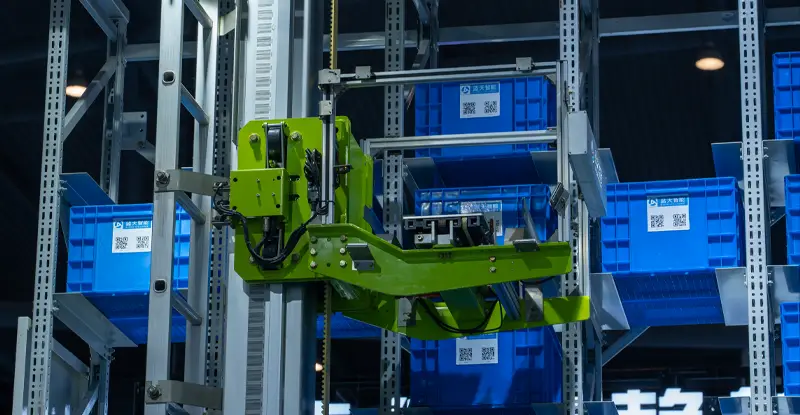
Moving materials around the warehouse, from storage areas through to packing stations and shippers, is one of the most labor-intensive activities in any warehouse. Autonomous mobile robots are used to move products around the warehouse more efficiently.
A growing number of businesses are investing in robotic warehouse automation. The systems also help in shortening the travel time of the warehouse employees, thereby improving productivity.
Robots can follow the optimized routes and make adjustments to the routes according to the changing conditions of the warehouse. It enables companies to move products efficiently and also minimize the job strain for employees. Key benefits of autonomous robotic systems include:
Recommended reading: Warehouse Automation with Digital Transformation Strategies
Order fulfillment involves a variety of activities, from picking to packing and ultimately dispatching. These activities are integrated by intelligent automation with software, as long as the synchronization of the workflow is well established.
The automated systems can choose the most time-sensitive orders based on shipping deadline, inventory condition. You can also set it to focus on the individual customer needs.
Staff would be freed from repetitive service and processing jobs, and put more effort into human decision-making procedures. The shorter-order processing can lead to back-to-back delivery and enhance the customer relationship.
Recommended reading: AI Order Management: The Complete 2026 Guide to Intelligent Order Processing
Manual data entry and manual processing can cause human errors. Minor errors can affect the inventory stock, and delivery. The issues are resolved by Intelligent automation, which automatically captures and processes operational data.
AI detects abnormalities and can notify managers before bigger problems occur. Automated comparisons verify that the products ordered actually shipped, the quantities ordered are correct, and the details match. In this way, the operation is more consistent and reliable.
Recommended reading: Eliminating Manual Data Entry in Enterprise Operations
When warehouse employees become stuck doing monotonous tasks such as counting objects in inventory every day, their productivity can be stagnated. While automation cannot involve complex tasks, it is of great help in executing straightforward tasks.
It includes routing orders, tracking information, and system reporting. Having a two-way communication device allows employees to be provided with digital information containing instructions for performing operational tasks.
Providing information and instructions more quickly helps to save time and enables tasks to be completed more quickly. So in many cases, companies can expand production without changing the available labor.
Recommended reading: How AI Is Reshaping Workplaces and Employee Productivity
Today's warehouses produce a high volume of operational data on a daily basis. Data is gathered and evaluated by intelligent automation, which then provides meaningful insight into operations.
Operational managers can watch performance metrics and look for ways to optimize performance. Technology-driven tools can enable downward forecasting.
It assists in demand prediction, providing recommendations for inventory requirements, and illustrating where processes could be bottlenecked. Businesses can operate more efficiently and effectively after planning and resource allocation by using this data.
Real-time data will allow the warehouse management to be agile to conditions. Good teams will have built-in flexibility for staffing, slotting, and business priorities to be aligned as needed.
Recommended reading: How Data Analytics Drives Process Automation to Success
Numerous warehouses operate with siloed setups, meaning that inventory, transit, procurement, and customer service operate independently. Intelligent automation amalgamates the various silos by centering operations in a cohesive setting so data can pass more freely.
Connected systems enable better management of the whole supply chain. Consumer teams are able to adapt faster to the continuously evolving needs of the customer, inventory, and transportation. Greater integration leads to fewer communication barriers.
Furthermore, a connected warehouse ecosystem allows for continuing long-term business growth. Additional rising operational volumes and inventory levels are smoothly absorbed by an integrated system built for evolution and scalability.
Recommended reading: What a Digital Supply Chain Revolution Looks Like
Today, warehouses are able to perform various tasks faster and more accurately. From inventory management to handling the transfer of materials by automated assisted technologies to order fulfillment, warehouses are automated, thereby improving the overall performance.
Automation is no longer reserved for large enterprises. Small businesses can develop a strategy that benefits all aspects of productivity, and planning to support future growth. If you haven’t automated your warehouse, then now is the time to do it with intelligent automation.
 Automation in Warehouse Management: Enhancing Efficiency
 Warehouse Automation with Digital Transformation Strategies
 Smarter Warehousing with Document Automation Tools
 Inventory Management: Harnessing the Power of Automated Workflows
 How IoT and AI Are Revolutionizing Inventory Tracking Systems
 AI Order Management: The Complete 2026 Guide to Intelligent Order Processing
