How Workflow Automation Helps Global Brands Manage Exhibition Projects Across Multiple Countries

Published: October 09, 2026
An international exhibition program generates a lot of paperwork. Behind every stand built in Frankfurt, Dubai, or Las Vegas there are dozens of documents: design briefs, technical specifications, contractor quotes, purchase orders, venue submissions, invoices, customs paperwork, and shipping records. When a company exhibits in several countries a year, these documents multiply across languages, currencies, time zones, and vendors.
Most consistency problems in global exhibition programs are not caused by poor design or weak contractors. They come from fragmented workflows: specifications sent by email, approvals given in chat threads, and invoices matched against purchase orders by hand. Workflow and document automation give marketing, procurement, and finance teams a shared, controlled process that works the same way in every market.

International exhibition programs generate invoices from contractors, freight providers, venues, and other suppliers in different formats and currencies. InvoiceAction automates invoice capture, data extraction, validation, purchase order matching, and exception processing.
Reduce manual reconciliation and help finance teams maintain better control over exhibition-related expenses.
A single international stand project typically involves the brand's marketing team, a design agency, one or more local contractors, logistics providers, the venue organizer, and the company's finance department. Each party creates and edits documents, and each handoff is a point where information can be lost or changed.
Typical failure points include:
Each problem looks minor on its own. Across ten or fifteen shows a year, they add up to budget overruns, missed deadlines, and stands that look different from one country to the next.
Recommended reading: Discover How Document Management Systems Create a Single Source of Truth
The foundation of a consistent global program is one controlled repository for every project document. Instead of emailing files, all participants work from the same set of approved materials, with access defined by role.
A centralized document workflow typically holds:
Version control matters most here. When a specification changes, the system records who changed it, when, and why, and automatically notifies every contractor working from the previous version. This prevents the most common cause of inconsistency: different teams building from different documents.
Global brands need control over what is built under their name, but local teams need fast decisions to meet venue deadlines. Automated approval workflows resolve this tension by routing each document to the right reviewer based on predefined rules.
For example, a change to stand graphics can go straight to the brand team, a budget variance above a set threshold can go to finance, and a structural change can require sign-off from both the design lead and the local contractor. Each approval is timestamped and attached to the document, creating an audit trail that shows exactly how the final stand was agreed.
This approach also makes local adaptation manageable. Stands rarely need to be identical - venue dimensions, visitor flow, and organizer rules differ from show to show. What matters is that every deviation from the global standard goes through a defined approval step rather than being decided informally on site.

Managing exhibitions across countries often means dealing with different document formats, vendors, languages, and approval requirements. docAlpha transforms incoming business documents into structured, validated data and applies intelligent rules to support downstream workflows.
Standardize repetitive document processing and reduce administrative work across international projects.
Working with many independent contractors across countries is one of the main sources of inconsistency in exhibition programs. Every vendor has its own quote format, contract terms, and documentation habits.
Workflow automation helps standardize this from the start. Vendor onboarding can collect insurance certificates, company registration documents, safety credentials, and signed framework agreements in one structured process, with automatic reminders when documents expire. Quotes can be requested through a standard template so they can be compared line by line.
Many brands go a step further and reduce the number of parties involved altogether, coordinating international projects through one partner or a vetted network of booth builders that works to a shared documentation standard. Fewer handoffs mean fewer document formats, fewer conflicting specifications, and a much simpler approval chain.
Recommended reading: Learn How to Streamline Vendor Onboarding and Document Collection
Finance teams often feel the effects of exhibition complexity long after the show ends. Invoices from builders, freight forwarders, venue services, and AV suppliers arrive in different formats, languages, and currencies, and each one must be matched to the original purchase order and the scope actually delivered.
Document processing and accounts payable automation reduce this workload significantly. Incoming invoices can be captured and their data extracted automatically, then matched against purchase orders and goods-receipt or completion records. Discrepancies, such as additional services billed on site or quantities that differ from the order, are flagged for review instead of being discovered during month-end close.
For companies running exhibitions in several countries, this also produces something hard to get from spreadsheets: reliable cost data per show, per market, and per vendor, which makes budgeting for the next season far more accurate.
Stand components, graphics, and AV equipment often travel between countries, and every shipment generates its own documentation. When packing lists, shipping documents, and customs paperwork are linked to the same project record as the specifications and purchase orders, teams can confirm that what was shipped matches what was ordered and approved.
Automated status updates and deadline reminders, such as cut-off dates for advance warehouse delivery or venue material submissions, help local teams stay on schedule without relying on manual tracking.
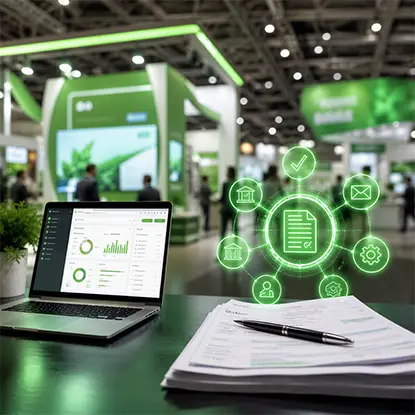
Managing multiple exhibitions requires accurate coordination between purchase orders, supplier invoices, and delivered services. InvoiceAction automates invoice processing with intelligent data capture, matching, approval workflows, and exception handling.
Reduce manual handoffs between procurement and finance while improving the efficiency of exhibition-related AP operations.
A well-run international program does not depend on one person remembering every detail. It runs on a repeatable process:
The result is consistency that holds across borders: stands that reflect the same brand standards, budgets that are easier to control, and teams that spend less time chasing documents and more time preparing for the event itself. For companies that treat exhibitions as a long-term market entry channel, digital workflows are what turn a series of separate projects into a coherent global program.
Recommended reading: Discover How Business Process Automation Connects Teams, Documents, and Workflows
 All About Workflow Automation
  Document Automation for Logistics and Supply Chain Management
  Smarter PO Workflow Automation for Purchasing Teams
  Three-Way Match in Invoice Processing
  Manufacturing ERPs Improve Delivery Accuracy for Trade Show Vendors
  Maintaining a Supplier Directory for Success
