5 Ways Route Mapping Reduces Fuel Costs and Boosts Fleet Efficiency
Published: June 23, 2026
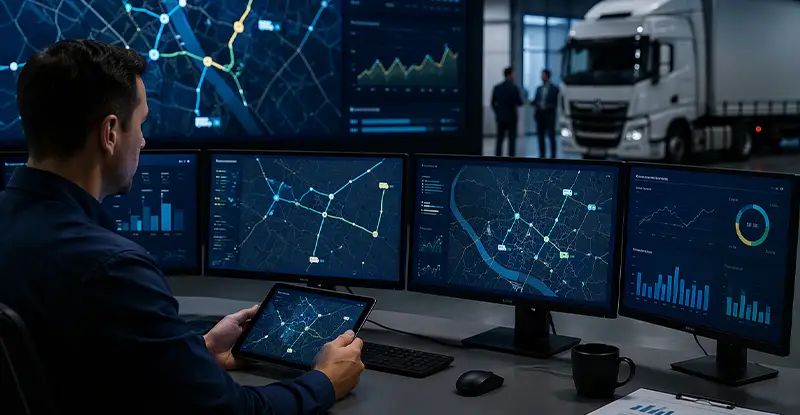
Fuel is your highest controllable cost. Your fleet is your most underutilized asset. Between the route plan built last night and the actual miles drivers covered today, a significant amount of money disappeared from operations without anyone noticing.
That gap, between what your fleet should have driven and what it actually drove, is not a driver problem or a traffic problem. It is a routing problem. Route mapping done right closes that gap systematically, shift after shift, across every vehicle in your network.
For logistics leaders watching fuel spend climb and fleet utilization flatten, the answer is not more drivers or more vehicles. Let's explore exactly where smarter route mapping changes the equation.
Disconnected delivery documents and manual data entry create delays that impact fleet performance. With docAlpha, organizations can automate the capture and validation of bills of lading, delivery confirmations, route reports, and shipping documents using AI-powered process automation. Cloud-based intelligent document processing with high accuracy and ERP connectivity. Improve operational visibility and reduce administrative costs across the logistics network.
Excess miles a vehicle drives result from routing decisions that were not optimized. Underloaded trucks leaving the depot reflect capacity decisions that were never questioned. Drivers taking restricted roads or waiting at unplanned stops absorb the costs of routes built without full visibility of constraints.
Fleet inefficiency does not originate in execution. It originates in planning. Route mapping software that accounts for every operational variable before a single vehicle departs eliminates the structural inefficiencies that manual planning and basic GPS tools consistently miss.
Recommended reading: How Document Automation Improves Logistics Compliance
Most fleets are not underperforming because of driver behavior or market conditions. They are underperforming because the routing decisions made before departure are leaving measurable fuel savings and utilization gains on the table every single shift.
The single largest source of excess fuel spend in fleet operations is poor stop sequencing. Routes that are built by proximity or dispatcher familiarity rather than by constraint-aware optimization consistently drive more miles than an AI-optimized sequence would require.
Route mapping software powered by AI solves for vehicle capacity, time window compliance, driver shift limits, and live traffic conditions simultaneously in a single planning pass.
The output is a sequence that minimizes total miles driven without sacrificing stop quality or delivery window compliance. Every mile eliminated at the planning stage is a fuel cost that never reaches the monthly expense report.
A driver who encounters a weight-restricted bridge, a low-clearance tunnel, or a road closure mid-route does not just lose time. The vehicle idles, burns fuel, and forces a manual re-route that adds miles the original plan never accounted for.
Route mapping software that factors road restrictions, including tunnel clearances, bridge weight limits, and real-time closures into route generation, eliminates such issues before drivers leave depots.
Routes are built around physical road constraints from the start, producing accurate ETAs and removing the fuel waste that unplanned detours consistently generate across high-volume fleets.
Optimize Transportation Spending Through AI Automation
Manual invoice processing limits financial visibility and delays cost control. InvoiceAction automates the capture, validation, and approval of freight invoices, fuel invoices, carrier bills, and transportation expenses.Cloud-based AP automation with intelligent validation and approval workflows. Improve accuracy and gain tighter control over logistics-related spending.
Book a demo now
Underloaded vehicles are a fuel cost problem that most fleet operations underestimate. When routes are built without accurate load optimization, vehicles depart below capacity, and additional routes are required to cover the same stop volume.
Each additional vehicle on the road adds fuel spend, driver hours, and vehicle wear that smarter loading would have eliminated. Route mapping with integrated capacity optimization builds routes that maximize vehicle utilization before departure, factoring weight, volume, and pallet constraints into the sequence during planning.
Covering the same stop volume with fewer vehicles is one of the fastest paths to a measurable reduction in fleet fuel spend.
A traffic incident, a driver delay, or a late order injection mid-shift does not just affect one stop. It creates a sequencing problem across every remaining stop on the route. Fleets without dynamic route mapping absorb disruptions through manual dispatcher rebuilding, which creates suboptimal sequences under time pressure.
As a result, additional miles are consistently added that the original optimized plan would not have required. Route mapping software with real-time re-sequencing recalculates the optimal sequence for remaining stops automatically when conditions change.
Drivers receive updated instructions instantly. The route stays as close to fuel-optimal as live conditions allow, rather than degrading from the first disruption onward.
Recommended reading: Leveraging OCR for Document Automation in Logistics Accounting
Fleet operations that do not measure the gap between planned miles and actual miles driven cannot identify the specific routing decisions driving excess fuel spend. Without that measurement, the same inefficiencies repeat across every shift without generating the data needed to eliminate them.
Route mapping software with built-in planned versus actual analytics surfaces mile variance, stop timing deviation, and vehicle utilization data at the route and driver level automatically.
Every completed shift generates performance data that improves the accuracy of the next planning cycle. Fuel efficiency gains compound over time rather than plateauing at whatever level manual planning happened to achieve.
Manual handling of transportation records often creates delays and errors. docAlpha automates the processing of manifests, proof of delivery documents, invoices, and carrier paperwork to streamline supply chain operations. AI-powered capture and workflow automation with cloud scalability. Reduce processing time while improving data quality and operational efficiency.
Before shortlisting any route mapping platform, logistics leaders should validate these capabilities:
Eliminate Delays Before Vehicles Leave the Warehouse
Every routing decision depends on timely and accurate order information. OrderAction automates order processing to ensure transportation teams receive complete and validated data. AI-driven workflow automation with real-time ERP connectivity. Boost fleet productivity and improve on-time delivery performance.
Book a demo now
Each shift your fleet runs without optimized route mapping converts excess miles, underloaded vehicles, and avoidable detours into fuel spend that compounds monthly. Operations closing that gap are not relying on fuel negotiations or adding vehicles to manage growing volumes across increasingly complex delivery networks.
Instead, they eliminate routing inefficiencies that generate excess miles, improving fleet utilization and cost control directly at the planning stage itself. With technology partners, fleet operations gain AI-based route mapping that continuously optimizes route efficiency across every shift.
Additionally, they benefit from real-time re-sequencing and fleet performance analytics built for enterprise delivery complexity. The fuel your fleet burns above optimal is not a market condition but a routing decision that optimized route mapping software reverses immediately.
Recommended reading: Optimizing Accounting in Logistics and Transportation: Streamlining Processes with Automation
 Simplifying Accounting Operations in Logistics: Leveraging OCR for Document Automation
 Optimizing Accounting in Logistics and Transportation: Streamlining Processes with Automation
 AI in Logistics: Smarter Operations and Faster Delivery
 Document Automation for Logistics and Supply Chain Management
 Smarter Document Workflows for Logistics & Manufacturing
 Bill of Lading Automation: Perfect Your Logistics Workflows
