Why QA Automation Services Are Becoming Essential for Faster Software Releases

Published: September 28, 2026
Software teams are constantly racing to release faster. New features should get to the users as soon as possible, updates should be made to meet evolving expectations and production problems must be identified before they impact the customers. Meanwhile, applications are getting increasingly complex with
The repetitive work can take up a lot of time as the frequency of releases goes up, and it will be more difficult to keep test coverage consistent.
That's where QA automation services can come into play. The repetitive, high-volume, and predictable nature of testing scenarios can be automated, resulting in more consistent and scalable testing and freeing up more time for QA professionals to focus on testing requirements that involve human judgment.

QA teams automate repetitive, high-volume testing so specialists can focus on work that requires judgment. docAlpha brings the same principle to document-driven operations by automating document capture, classification, data extraction, validation, and workflow processing.
Reduce repetitive administrative work and give employees more time for exceptions, decisions, and higher-value activities.
Traditional testing fails to keep up with modern release cycles. Manual testing is still a significant aspect of software quality.
Challenge | Impact |
Frequent releases | More changes to validate |
Large regression suites | Repetitive testing takes more time |
Multiple browsers & devices | More combinations to test |
Changing APIs & workflows | Existing functionality can break |
Manual repetitive checks | Less time for exploratory testing |
✓ Automates repetitive checks
✓ Speeds up regression testing
✓ Catches issues after code changes
✓ Supports multiple browsers, devices, and environments
✓ Gives testers more time for exploratory testing
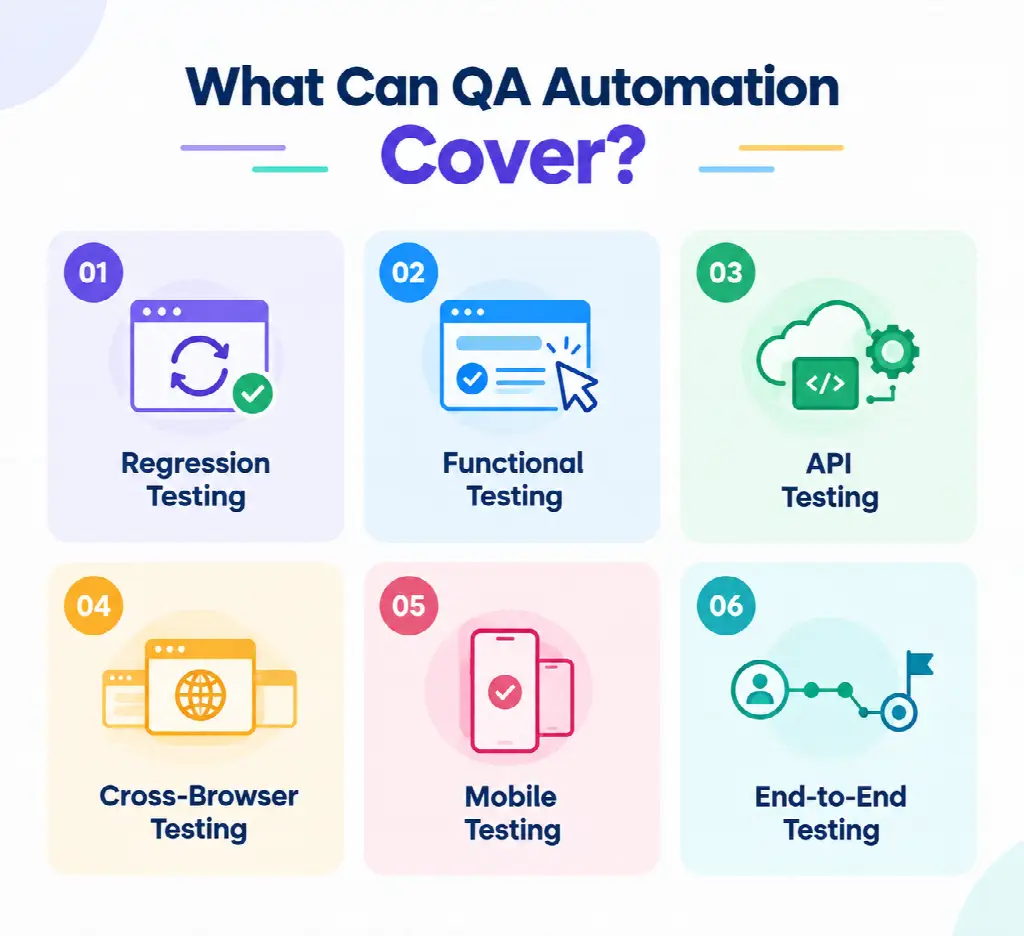
What QA Automation Services Actually Help Businesses Automate
QA automation can cover different parts of the software lifecycle depending on an organization's application, technology stack, and testing requirements.
Recommended reading: Discover How AI Technologies Are Reshaping Business Process Automation
Automation becomes particularly valuable when it is connected to the software delivery process.
Instead of waiting for a QA team to manually begin regression testing after a build is completed, automated tests can be triggered when code is committed, a build is generated, or a deployment takes place. The results can then provide developers with faster feedback about whether important functionality is still working.
Tools such as
can be used to support these workflows. The specific platform is less important than how the automation strategy fits into the team's existing development process.
The objective is to identify defects earlier, validate releases more efficiently, and reduce the likelihood of known issues being reintroduced into the application.
Companies do not need to automate every test case from day one. In fact, trying to automate everything immediately can create unnecessary maintenance work.
A better approach is to start with scenarios that are:

Faster software releases depend on automating predictable work instead of asking skilled employees to repeat the same tasks manually. docAlpha applies intelligent automation to document-intensive business processes, transforming incoming documents into validated, actionable data.
Create greater operational efficiency while keeping people focused on work that requires expertise and judgment.
The right automation strategy can impact not only the speed of software testing, but also the consistency.
Reduce the time spent rerunning repetitive regression tests.
Run the same test scenarios consistently across releases.
Test more scenarios across browsers, devices, and environments.
Integrate automation into CI/CD to identify issues sooner.
Shift testers away from repetitive checks and toward:
One such example is Kualitatem, which claims that its automation methodology can achieve up to a 70% reduction in regression effort and offer quicker release cycles.
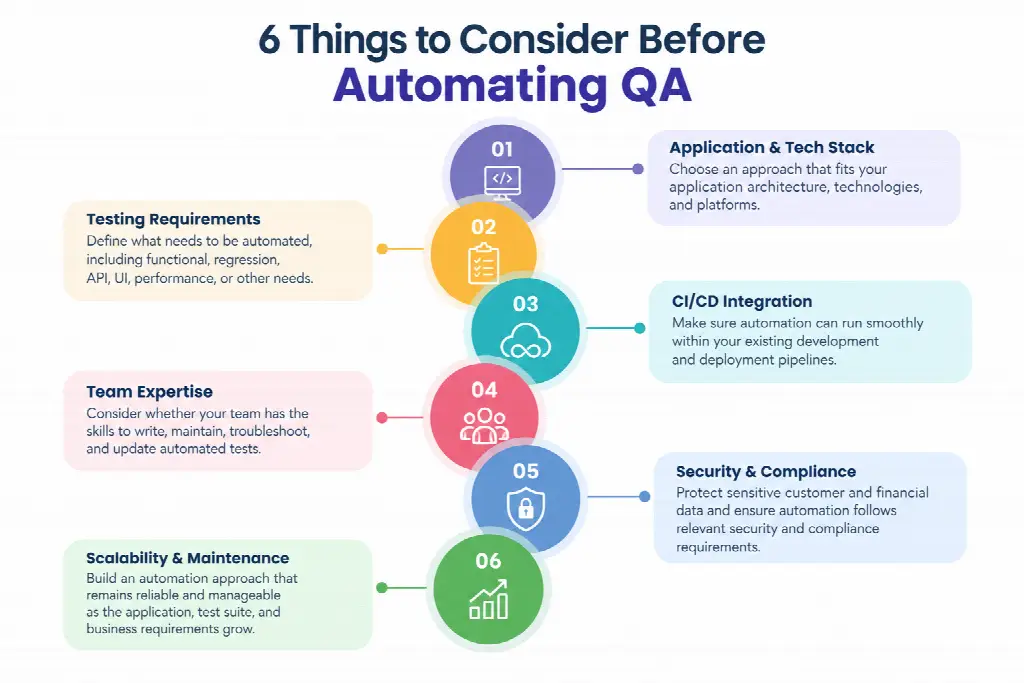
Selecting the Appropriate Approach for QA Automation
Automation should not be built on a tool; it should be built on the application.
Before developing an automation framework, organizations should consider their application architecture, technology stack, existing QA processes and testing requirements.
Recommended reading: Learn How Intelligent Process Automation Makes Business Workflows More Efficient
Certain patterns can indicate that an organization is ready to consider external QA automation support.
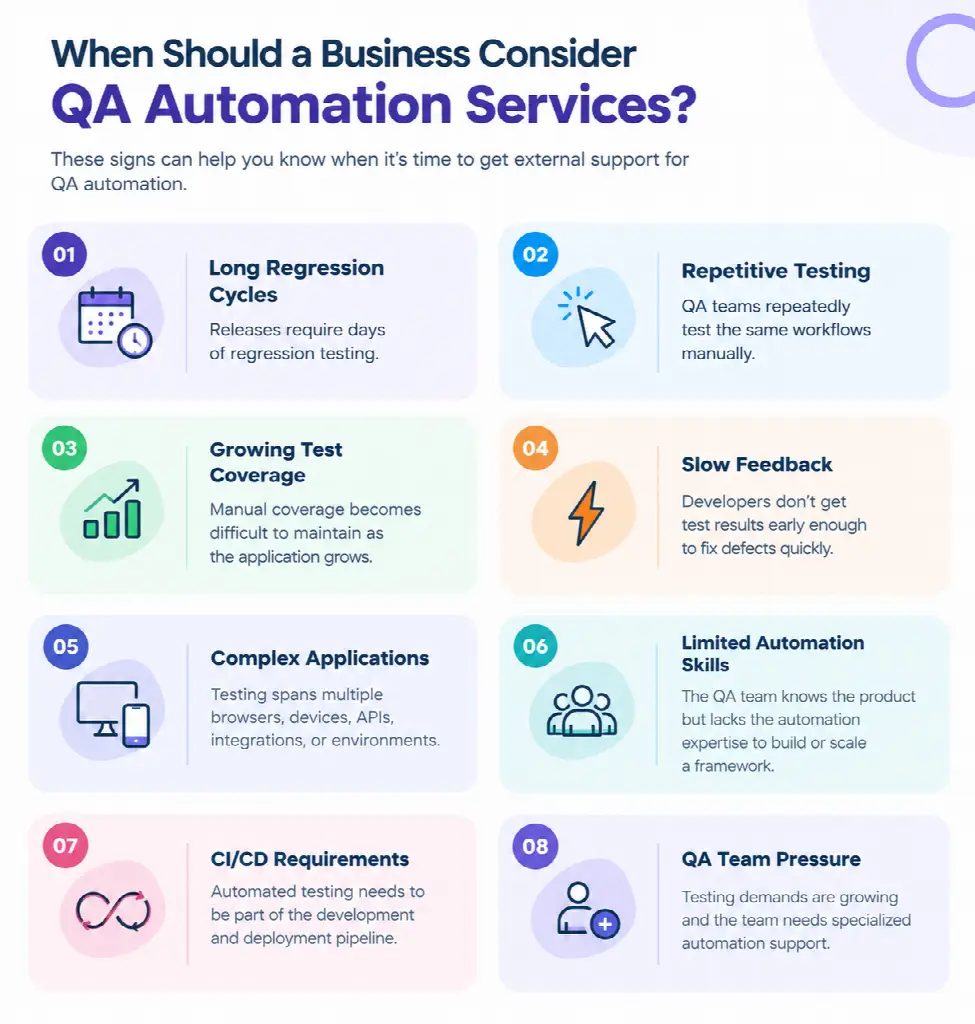
As testing requirements become more complex, some organizations choose to work with specialized QA automation services to design automation frameworks, integrate testing into CI/CD pipelines, and expand coverage without putting additional pressure on internal QA teams.

Effective automation starts by identifying processes that are repetitive, stable, high-volume, and costly to perform manually. docAlpha helps organizations apply that strategy to document-driven workflows through intelligent capture, data extraction, validation, and automation.
Focus employee time where human judgment creates the greatest value.
A successful automation program usually starts with assessment rather than immediately writing test scripts.
The first step is to assess the existing testing process and identify where automation can provide the greatest value. Teams can then prioritize test cases, define the automation scope, and select tools and frameworks that fit their technology environment.
Assessment → Planning → Tool Selection → Framework Development → Test Automation → CI/CD Integration → Monitoring → Maintenance
Maintenance deserves particular attention. Automated tests are software themselves. When application functionality, interfaces, APIs, or environments change, automated tests may also need to be updated.
Recommended reading: Discover the Difference Between AI Agents and Traditional Business Automation
As software development becomes more intelligent and more complex, so does QA automation.
✓ AI-Powered Test Generation
✓ Intelligent Test Prioritization
✓ Self-Healing Tests
✓ Low-Code & No-Code Testing
✓ Human-Led QA Strategy
These technologies can be utilized when requirements are clearly defined and the use of testing is sound to help teams scale their testing.

Automation does not have to replace people to create significant value. docAlpha automates routine document processing while supporting validation and exception workflows where human attention is required.
Let automation handle predictable work while employees focus on complex decisions and exceptions.
QA automation is providing testing teams with a better way to split up the load.
The repetitive, predictable and high-volume checks can be automated; testers can work on exploratory testing, complex scenarios, usability and quality decisions, which need human judgment.
 AI Technologies Powering Smarter Business Automation Today
  Best Automation Tools for Error-Free Code Delivery
  Key Features of Cloud Cross-Browser Testing Platforms
  How Code-Based Testing Ensures Optimum Quality Software Development
  Ensure business safety with software security testing services
  AI Agents vs Traditional Business Automation Solutions
