Beyond the Production Line: How Automation Is Transforming Manufacturing Operations

Published: September 18, 2026
Most conversations about manufacturing efficiency start and end on the plant floor. Faster cycle times, tighter tolerances, less downtime. That focus makes sense, since the production line is where raw material becomes revenue. But it also means a lot of manufacturers are optimizing one part of the operation while leaving the rest running the way it did a decade ago.
The reality is that a plant floor running at peak efficiency can still be bottlenecked by what happens around it. A purchase order that sits in someone's inbox for two days. An invoice that gets keyed in by hand and occasionally keyed in wrong. A production schedule that isn't actually talking to the inventory system. None of that shows up on a line efficiency report, but all of it eats into the same margin the line improvements were supposed to protect.
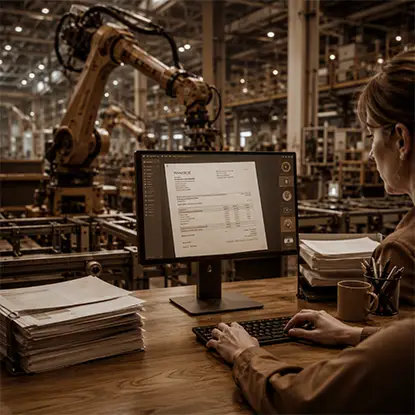
Production may run automatically while supplier invoices are still keyed, matched, and routed by hand. InvoiceAction uses AI-powered capture, validation, matching, and workflow automation to streamline invoice processing.
Reduce manual AP work, improve data accuracy, and extend manufacturing efficiency beyond the production floor.
Production-side automation is the easiest place to see the payoff, because the numbers are so direct. Take a materials handling process that relies on industrial air systems for construction materials manufacturing, where a rotating drum system needed a way to blow off residual moisture and debris between processing stages. The manufacturer had been running a compressed air setup rated near 200 horsepower to get the job done. Switching to a purpose-built, high-velocity air delivery system dropped the horsepower requirement to a fraction of that while holding the pressure needed for the application, cutting energy draw and simplifying maintenance in the same move.
That kind of result is common wherever a manufacturer automates a task that used to depend on brute force or manual adjustment. The equipment gets smarter, the energy bill drops, and the labor tied up babysitting the process gets freed up for something that actually needs a person's judgment. It is a clear, measurable win. But it is also just one piece of the operation.
Recommended reading: Discover How AP Automation Extends Manufacturing Efficiency Beyond the Production Floor
Walk into the office side of most manufacturing companies and you will find the same inefficiencies that used to define the plant floor twenty years ago. Purchase orders routed by email and re-entered by hand. Invoices matched against packing slips manually, line by line. Customer orders retyped from a web form into an ERP system because the two were never connected in the first place.
These are not small tasks. Order processing, purchasing, invoice processing, and general data entry consume a real share of headcount at most manufacturers, and they are exactly the kind of high-volume, rules-based work that automation handles well. Optical character recognition and workflow automation tools can pull data off a scanned invoice, match it against a purchase order, flag discrepancies, and route exceptions to a human, without anyone spending an afternoon on it.
The gains here are less visible than a horsepower reduction on the floor, but they compound. Faster invoice turnaround improves vendor terms. Fewer data entry errors mean fewer disputes and rework. Staff who used to spend their day on repetitive entry get reassigned to work that requires actual decision making.
Production planning depends on accurate order information, but manual PO entry can delay or distort the demand signals reaching the ERP. OrderAction automates customer PO capture and validation for downstream sales order workflows.
Accelerate order processing and give production, inventory, and fulfillment teams reliable information sooner.
The real value shows up when floor automation and back office automation start talking to each other through a connected ERP system. A production line that reports real-time output can automatically trigger a purchase order for raw material before a shortage becomes a shutdown. An automated invoice match can flag that a vendor shipped fewer units than the production schedule assumed, before that gap shows up as a missed order. None of this requires replacing existing equipment or systems. It requires connecting them.
Manufacturers who treat automation as a floor-only initiative tend to hit a ceiling. The equipment runs better, but the business around it still moves at the speed of manual processes. The ones who extend automation into purchasing, order processing, and ERP-connected workflows tend to see efficiency gains that keep compounding well after the initial equipment upgrade has paid for itself.
Production efficiency and operational efficiency used to be treated as separate conversations. For manufacturers serious about margin, they are increasingly the same conversation.
Recommended reading: Learn How ERP-Connected Order Processing Improves Manufacturing Efficiency
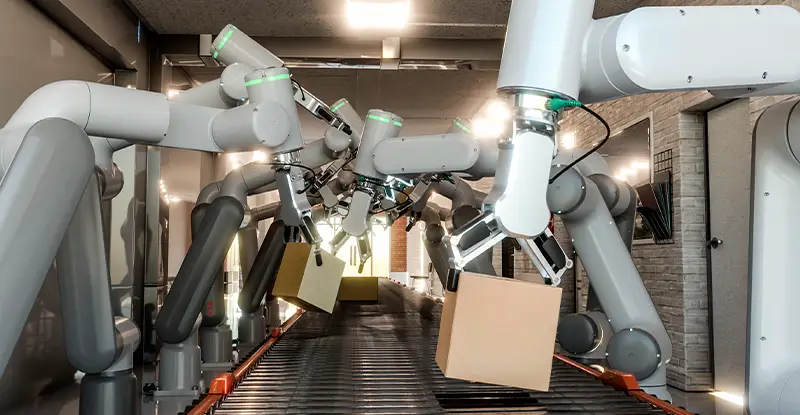 How Intelligent Automation Powers Smart Manufacturing
 ERP Sales Order Automation for Streamlined Manufacturing
 Intelligent Document Processing for Manufacturing Firms
 Intelligent Data Capture for Manufacturing
 Reduce Manufacturing Delays with Document Automation
 AI vs RPA in Manufacturing: Choosing the Right Automation
