How Hospital Inventory Management Improves Healthcare Claims Accuracy
Published: August 11, 2026
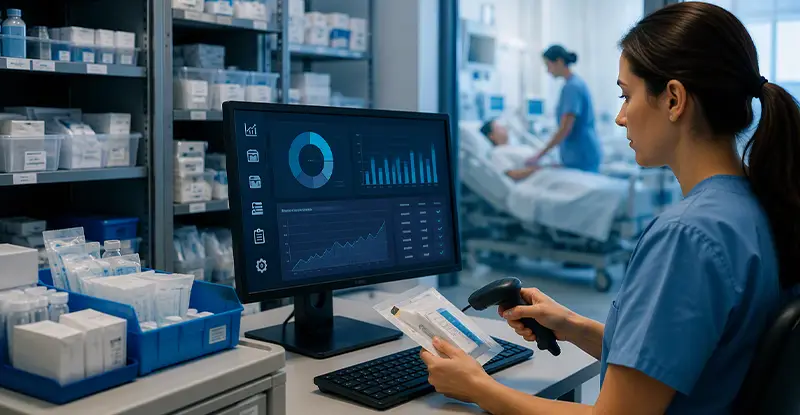
Ask any charge nurse where the nearest infusion pump is, and you'll probably get a shrug instead of an answer. Ask a billing department why a claim got denied, and the answer is often just as murky. These two problems look unrelated on the surface, but they share the same root cause: hospitals that can't reliably track their equipment usually can't reliably document it either. Strong hospital inventory management isn't just a facilities issue anymore. It's becoming one of the more overlooked levers for improving healthcare claims accuracy.

Manual medical claims processing increases administrative costs and delays reimbursement. ClaimAction automates healthcare claims capture, validation, and submission using AI-powered intelligent process automation.
Process more claims with greater accuracy while improving revenue cycle performance.
A missing wheelchair sounds like a minor inconvenience until you multiply it across a 400-bed facility running three shifts a day. Staff members routinely spend fifteen to thirty minutes per search, and those minutes add up to entire full-time positions worth of wasted labor over a year. But the cost doesn't stop at labor. When equipment usage isn't tracked accurately, the documentation that supports a claim often isn't either. Infusion pumps, monitors, and other billable equipment generate charges tied to when and how they were used. If nobody can confirm which device was actually deployed for a given patient encounter, that gap tends to show up later as a coding error, a missing charge, or a denial that takes weeks to untangle.
Hospitals have historically responded to equipment loss by simply buying more to compensate. That approach treats the symptom rather than the cause, and it doesn't touch the documentation problem at all. A facility might own three times as many pumps as it needs on any given day, and still generate claims with incomplete usage records because nothing was tracking the equipment in the first place.
Recommended reading: How to Streamline Medical Claims with Intelligent Automation
Real-time tracking systems solve the "where is it" problem, but the more valuable shift happens when that location data starts feeding into billing and claims workflows automatically. Most tracking systems rely on a mix of technologies depending on the precision required. Wi-Fi-based tracking can place an asset within a general zone, which works fine for large, stationary items. For smaller or frequently moved equipment, many facilities have turned to RFID Tags for Hospital Inventory Management, which offer a more granular and cost-effective way to tag individual items and monitor their movement through the building.
Sensors placed at doorways, hallway junctions, and equipment rooms pick up signals as tagged items pass by, logging timestamps and locations to a central system. That same data trail, when connected to billing software, can automatically confirm which device was used, for how long, and in which department.

Incomplete or inaccurate medical documentation slows healthcare claims processing and increases denials. docAlpha uses AI-powered intelligent process automation to capture, validate, and route healthcare documents with exceptional accuracy.
Improve data quality, accelerate workflows, and create a stronger foundation for successful claims management.
Instead of a coder manually piecing together usage from incomplete notes, an integrated system supplies a verified record. This is where hospital inventory management stops being a back-of-house logistics tool and starts functioning as the front end of healthcare claims automation. Some systems go further, using Bluetooth low energy beacons for near-continuous position updates, which suits equipment that moves constantly, like portable ultrasound units or vital signs monitors. The more granular the tracking, the more precisely that usage data can be matched against a billing code when the claim is generated.
Not every piece of equipment carries the same billing weight, and facilities generally prioritize tracking based on cost, mobility, and how often the item shows up on a claim:
The higher-value or higher-urgency items tend to get the most sophisticated tracking first, largely because the financial and documentation stakes are greater when something goes untracked. A pump that can't be located during an audit isn't just an operational headache. It's a claim that may not hold up under review.
Recommended reading: Improving Medical Claims Processing Through Technology
Getting from a tracking system to a genuinely more accurate claims process takes more than installing tags and sensors. Billing and clinical teams need to trust the data enough to actually use it, and that trust is built the same way frontline adoption is built anywhere in a hospital: by involving staff early and proving the system works during real shifts rather than in a demo. Facilities that see the strongest results tend to loop billing staff into planning conversations alongside clinical and IT teams, so the tracking data is structured in a way that claims systems can actually use.
It also helps to designate a team responsible for monitoring tag health and reconciling tracking data against billing records on a regular basis. A tracking system with unreliable tags doesn't just create operational blind spots. It quietly reintroduces the same documentation gaps that led to denied claims in the first place.

Healthcare providers need faster, more reliable claims workflows. ClaimAction automates medical claims processing by capturing, validating, and routing claims data with minimal manual intervention.
Shorten reimbursement cycles while improving operational efficiency and compliance.
Hospital administrators used to view asset tracking as a nice-to-have upgrade reserved for well-funded systems. That view is fading, not just because equipment visibility improves day-to-day operations, but because it's increasingly tied to revenue integrity. Every piece of equipment that can be accurately tracked is one less variable standing between a patient encounter and a clean, defensible claim. As more hospitals connect their inventory systems to their billing workflows, equipment visibility is becoming less about convenience and more about protecting the accuracy of the claims that keep a hospital financially healthy.
 Streamlining Medical Claims Processing: How Technology is Shaping the Industry
 AI Automation for Faster and Cleaner Claims Processing
 How IoT and AI Are Revolutionizing Inventory Tracking Systems
 Efficient Claims Workflow: CMS 1500 OCR Data Capture and Automation in Healthcare Processing
 AI in Medical Billing: Transforming Accuracy and Efficiency
 Inventory Management: Harnessing the Power of Automated Workflows
