5 Hidden Costs of DIY Workflows in Operations

Published: August 11, 2026
How much does a "free" workflow really cost? It's a question most operations managers dodge until the spreadsheet cracks show up in a board meeting.
The early days feel clever: a shared doc here, a form there, maybe a zap someone wired up after dinner. Then one quarter you realize half your team’s energy is going into feeding the system instead of serving customers. That’s when the real price tag appears.
DIY workflows usually start as survival tactics, not strategy. You’re under pressure, budgets are tight, and the tools you already have feel “good enough” if you just bend them a little.
Over time, that bending turns into twisting.
Rules get fuzzy. Ownership gets murky. And the system that once felt scrappy and empowering starts charging interest in the form of rework, stress, and delay.
With that in mind, here are the five hidden costs that quietly affect operations.

Temporary fixes eventually become permanent bottlenecks. docAlpha replaces disconnected document processes with intelligent automation that grows alongside your business.
Increase operational efficiency while reducing maintenance costs and manual intervention.
You see it in the small rituals that eat the day.
Copying numbers between tabs. Manually updating status columns. Rebuilding the same report every Friday because automation “would take longer right now.”
Asana’s Anatomy of Work report found that knowledge workers lose about 60% of their time to “work about work”, chasing updates, searching, duplicating effort. DIY workflows have a knack for amplifying that, turning sharp operators into human integrations.
It looks like productivity on the surface. Underneath, it’s drift.
Recommended reading: How AP Workflow Automation Transforms Accounts Payable
One wrong filter. One extra zero.
The University of Hawaii’s research on spreadsheet risk showed that around 88% of real‑world spreadsheets contain non‑trivial errors. That’s not a rounding issue; that’s broken formulas, mislinked cells, logic that quietly went sideways.
In operations, that can mean:
You can almost hear the air leave the room when someone realizes the “trusted” sheet has been wrong for three months.
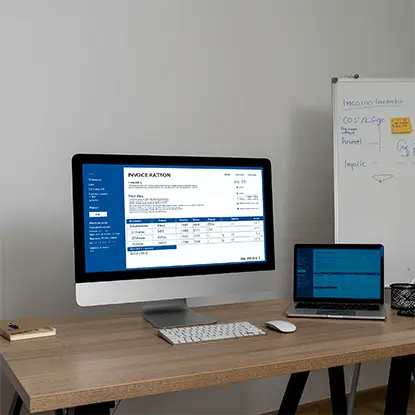
Manual invoice routing creates delays, errors, and unnecessary workload. InvoiceAction intelligently automates invoice processing from receipt through ERP posting.
Increase processing accuracy while lowering operational costs and approval cycle times.
Your website platform is a good example of how this happens. Wix can be a practical choice for getting a professional website online fast, especially if you don't have technical experience.
But if your company outgrows its platform and needs greater flexibility, advanced functionality, or long-term scaling, it's worth taking time to choose the best Wix alternative for your business.
Theo points out that businesses should compare factors like scalability, built-in SEO capabilities, customization, and ongoing maintenance, not simply the upfront setup, since those differences can affect operational efficiency long after launch.
It's a lesson that extends well beyond website platforms. Every temporary workaround eventually needs monitoring, updating, or fixing, and those responsibilities rarely disappear. Instead, they become recurring tasks that slowly consume the workday without anyone noticing.
Growth exposes every fragile link in your operational chain. A workflow handling ten orders a week will absolutely choke on a hundred.
The Project Management Institute points out that poor communication and bad requirements doom almost half of all failed projects. Your makeshift systems simply lack the structural integrity to scale alongside your ambition. They crack under the weight of real volume.
Recommended reading: Workflows in Accounting Processes
People rarely complain about the word “operations.” They complain about feeling like walking duct tape. Gallup’s research on burnout shows that when employees feel blocked by poor tools or chaotic processes, their engagement drops sharply.
In practice, that looks like:
Maybe it’s just human nature: when the process feels heavier than the work, people either disengage or leave.

DIY workflows slow decisions and create unnecessary delays. docAlpha automatically extracts, validates, and routes business documents into your ERP and business applications.
Accelerate operations with greater visibility, consistency, and automation across every workflow.
The real cost of a DIY workflow isn't found in a line item on your budget. It’s hidden in the exhausted sighs of your team and the slow-motion errors that keep you up at night.
While "free" tools offer a tempting start, the long-term price of maintenance and missed opportunities is staggering. Transitioning to a structured, scalable system isn't just an expense, it’s how you buy back your time and your team’s sanity.
Sometimes, the most expensive way to do something is to try to do it for free.
 AP Workflow Automation
 Reduce Manual Data Entry: 7 Simple Fixes That Save Time
 How Document Automation Lowers Operational Costs Effectively
 Why Manual Payroll and AP Cost More Than You Think
 Automate Operations To Scale Faster And Save Hours Each Week
 Outsourcing Vs. Automating - A Business Decision
