Why Strong Digital Foundations Matter More Than Ever For Modern Businesses
Published: January 22, 2026
Ideas are great, but to be able to function, your business needs systems. If those systems are weak, everything built on top of them feels harder than it should.
The easiest way to see this? Updates taking too long, teams working around tools instead of with them, or growth creating complexity instead of momentum.
One thing fixes this: strong digital foundations.
They give your business a base that supports daily work, future plans, and real customer needs. It all starts with choices like quality website development, how your tools connect, how data moves, and how people access what they need to do their jobs well.
If you still don’t realize how important this topic is, check the numbers - about 90% of organizations were going through some form of digital transformation in 2024, according to McKinsey & Company.
Keep reading to learn more.

Strengthen your operations with AI-driven document intelligence in docAlpha. Build a scalable automation layer that supports long-term business growth.
Don’t start improving anything just yet. First, think about what you’re building ON.
Digital foundations are the core systems that support how your business works online and behind the scenes. They’re not just chasing tools or trends, but stability, access, and consistency.
When the foundations are solid, your team can spend less time fixing issues and more time moving work forward. Changes don’t feel scary but manageable, and growth feels planned, not rushed.
Strong digital foundations usually come down to a few essentials:
Each segment is important, but the real value comes from how they work together.
When systems are aligned, information moves where it’s needed, when it’s needed, without friction.
Recommended reading: How Digital Asset Management Unlocks Productivity, Security & ROI
Strong digital foundations show their importance in daily tasks, not in strategy decks. You feel the obvious difference in how quickly work moves and how often small issues turn into big delays.
When systems are reliable, your team focuses on results instead of workarounds. This is where cloud services and shared platforms often come into play.
Around 27% of businesses report better performance or higher profits after adopting cloud and as-a-service tools, according to KPMG.
The gain usually comes from smoother access, fewer blockers, and faster decisions.
Strengthen Digital Foundations Through AP Automation
AI-powered InvoiceAction transforms invoices into clean, usable data. Support smarter cash flow decisions and scalable financial operations.
Book a demo now
In other, simpler words, solid foundations support everyday work in these ways:
All of these points share one thing - functionality. And that is the point. When your systems support the way people actually work, progress feels steady and predictable rather than forced.
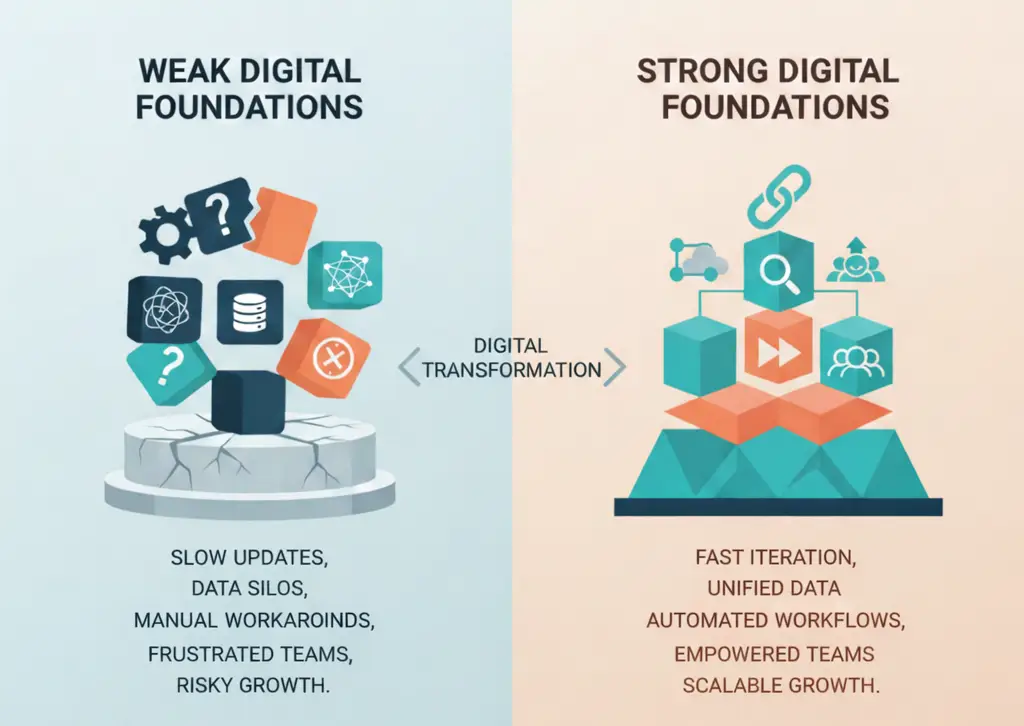
When digital foundations are ignored, problems don’t show up all at once. They surface in small, frustrating ways that slow everything down - a simple update takes hours, reports don’t match across tools, and teams double-check work because they don’t trust the data.
Over time, these issues add real cost. When information is incomplete or hard to access, decisions get delayed. When teams fix things manually, they might break again a week later.
And then, growth starts to feel risky because every change might trigger another issue somewhere else.
Data is often where the impact becomes most visible. The same KPMG report notes that about 29% of businesses saw at least an 11% boost in performance or profits after investing in data and analytics.
That tells you what is lost when data systems are scattered or outdated. Without a clear foundation, insights stay locked away, and opportunities pass unnoticed.

Leverage intelligent process automation with docAlpha to modernize your core operations. Enable faster decisions and stronger resilience across your organization.
This all might sound overwhelming, like you have to replace everything. But that’s probably not the case.
Before anything, know what you already have and how it supports your goals. You should look at your systems as a connected setup, not as separate tools owned by different teams.
Then, review how information moves through your business. Where does data live? Who can access it? How often does work get duplicated because systems don’t sync? As organizations rely on more cloud platforms and third-party service providers, understanding DPA explained can help clarify how responsibilities for processing and protecting personal data are shared across systems and vendors.
The answers will give you a good starting point for a checklist.
Your next move should be strengthening the priorities, like systems tied to revenue, customer experience, and team collaboration. Set clear ownership, keep documentation up to date, and agree on how changes get made.
So, if you want room to move, strong digital foundations give it. They allow you to adapt without constant rebuilds and grow without added complexity.
And when your base is solid, every single improvement builds on something you can trust.
Recommended reading: Revolutionizing Digital Management with IPA
 Digital Transformation in Accounts Payable & Accounts Receivable
 Cloud-Based ERP Solutions: Definition, Benefits, Costs
 Business Process Automation: Examples, Tips, Technologies
 How Data Analytics Drives Process Automation to Success
 Revolutionizing Digital Management with IPA
 Process Automation in AP
