Device Procurement Automation Tools Comparison: 9 Best AI Platforms for 2026

Published: October 02, 2026
A new hire in Nairobi starts tomorrow, yet her MacBook is still stuck in a reseller’s portal. Sourcing, kitting, shipping, and eventually retrieving that laptop across borders can drain hours and budget. This device procurement automation tools comparison reviews nine platforms that shrink those chores into a single, zero-touch workflow - so you click once and move on. We ranked each product for geographic coverage, AI depth, lifecycle reach, and pricing transparency using public docs and reviews captured on September 28, 2026. No vendor paid for inclusion; any vendor-reported metric is clearly flagged.
“Automation” should mean a closed loop, not just a prettier catalog. In this article, a platform earns the label only when its workflow starts the moment someone requests equipment and ends when that same device is redeployed, resold, or recycled.
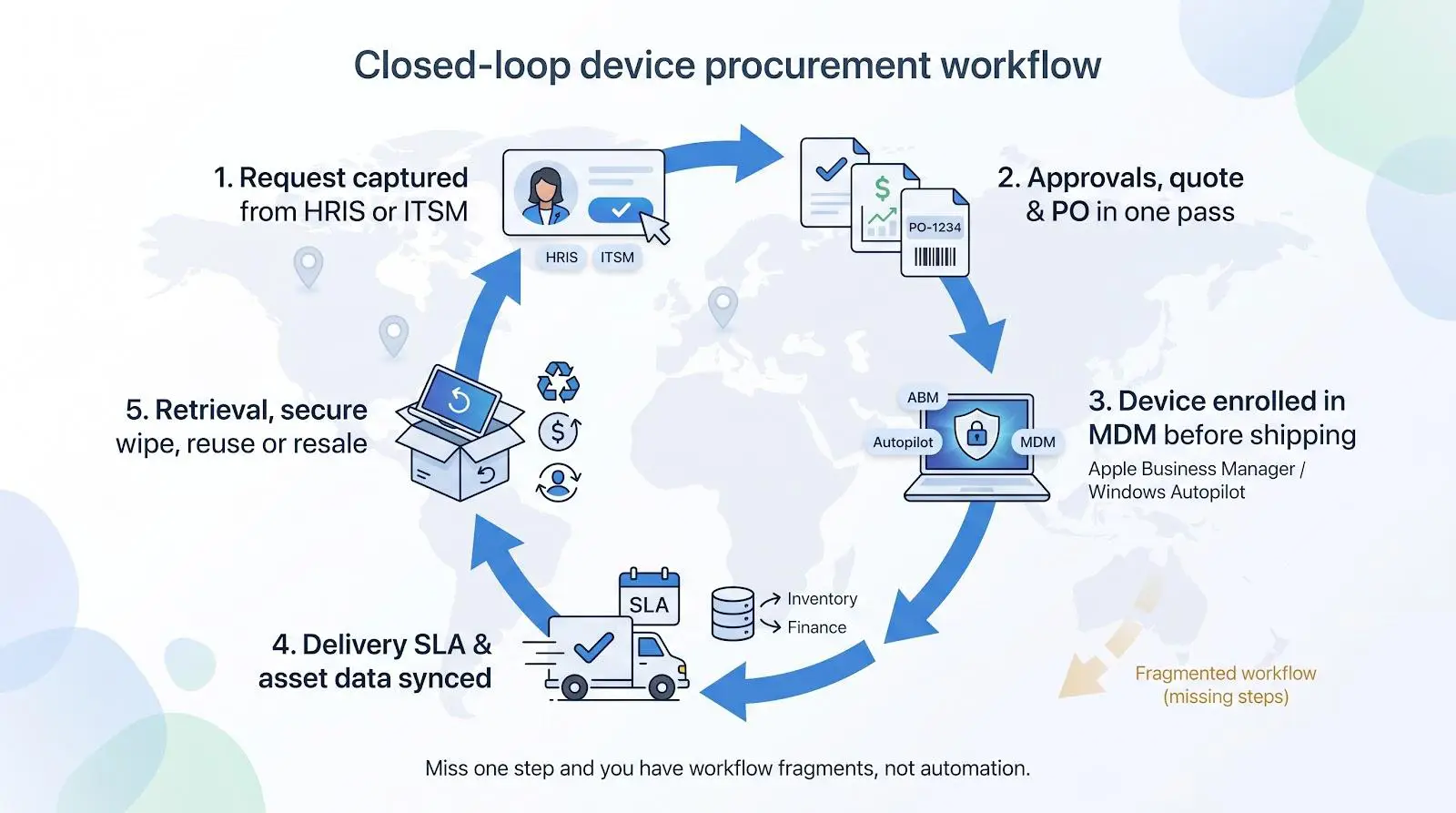
Miss even one of those beats and you have workflow fragments, not automation.
In short, AI must execute tasks, not just narrate status. With that yardstick in place, the platform scores make a lot more sense.

Device procurement automation can streamline purchasing, approvals, delivery, and asset tracking, but finance still needs to process the invoices generated along the way. InvoiceAction automates invoice capture, validation, matching, intelligent rules, approvals, and exception processing.
Extend automation beyond device ordering and reduce manual work across the financial side of the procurement lifecycle.
Below is the weighted league table. We scored each platform on the seven criteria defined earlier, then normalised everything to a ten-point scale so you can spot front-runners at a glance.
Platform | Weighted score | AI depth | Country reach* | Zero-touch ready | Pricing transparency |
allwhere | 8.2 | Moderate | “Global regions”‡ | Yes | High |
GroWrk | 8.9 | High | 150+ | Yes | Medium |
Workwize | 8.8 | High | 130+ | Yes | Low |
Primo | 8.1 | Very high | 60+ | Yes | Low |
Deel IT | 8.1 | Moderate | 130+ | Yes | Low |
Firstbase | 7.8 | Moderate | 150+ | Yes | Low |
Rippling IT | 7.7 | High | Core markets‡ | Partial | Low |
ZenAdmin | 7.7 | Moderate | Multi-country‡ | Yes | Low |
Rayda | 7.5 | Low | 170+ | Yes | Low |
*Country reach reflects public claims as of September 28, 2026; local-sourcing depth varies by model.
†Review metrics come from product-specific G2 or Capterra pages captured the same day; vendor-reported numbers are labelled as such.
‡Provider does not publish a precise country count; see “How we scored” for details.
GroWrk edges into first place on sheer geographic coverage, an AI operating layer, and its published seven-day deployment claim. Workwize lands a close second, trading a slightly lower AI score for deeper end-to-end lifecycle automation.
allwhere follows in third.
According to its 2026 SLA dashboard, the platform completes 96 percent of deliveries on time and retrieves 91 percent of devices on the first attempt.
It also ships with more than 150 native HRIS and MDM integrations and runs a pay-as-you-go, service-led model that pairs software with managed couriers and depots-letting lean IT teams trim both hours and capex without committing to a long-term subscription.
Scores drop more sharply after the top three, yet every remaining platform owns a clear niche. Primo tops the AI-native race, Rayda excels in hard-to-serve geographies, and Rippling links device actions directly to employee data.
Use the table as a quick reality check. If the numbers line up with your priorities, you’re set. If not, the next section shows where quantitative scores end and real-world context begins.
Recommended reading: Discover How Business Process Automation Connects People, Data, and Workflows
Every vendor went through the same seven-point fitness test. The table shows each criterion and its weight; details follow.
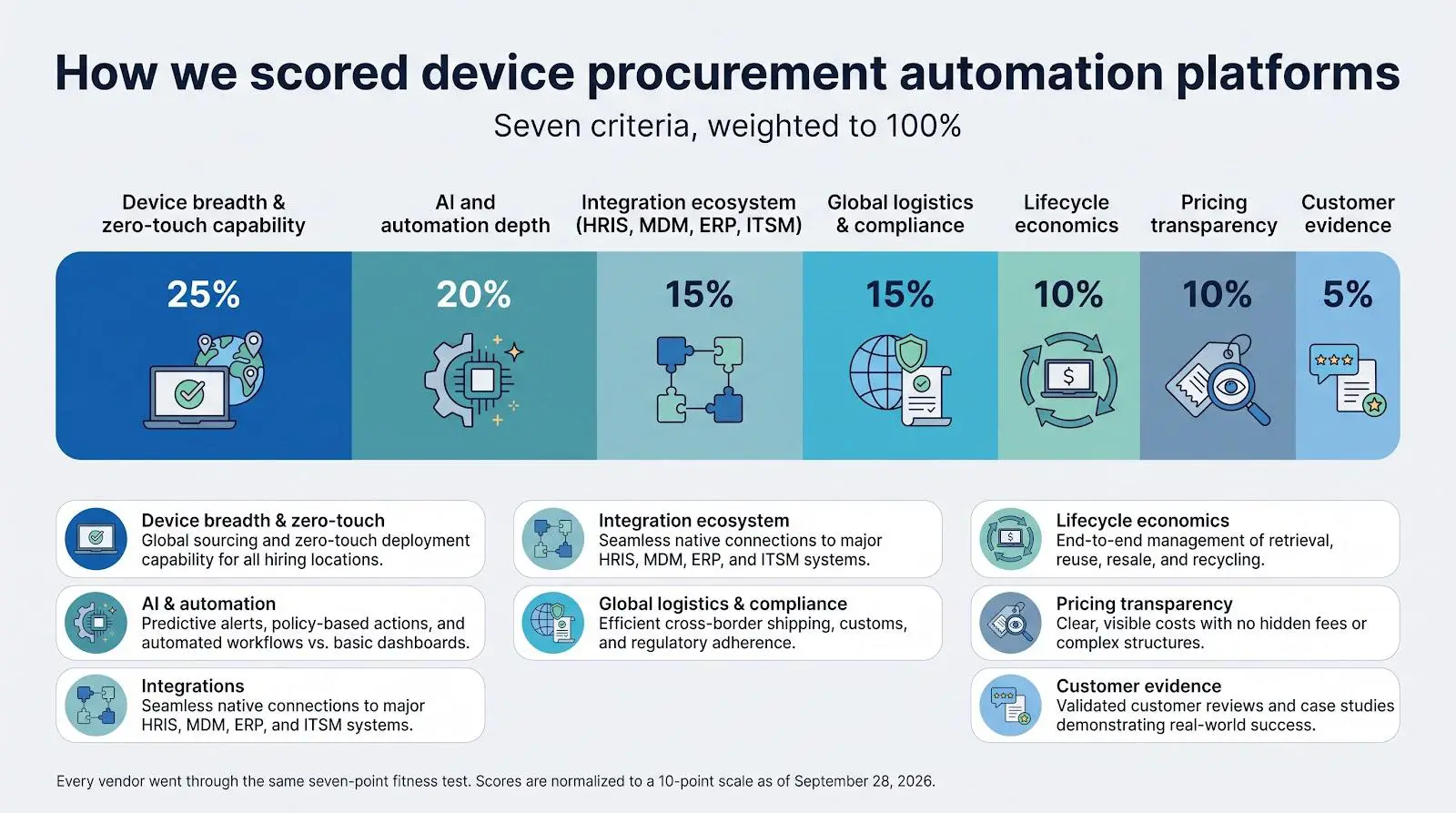
Device breadth (25%)
The platform must source, configure, and deliver the right device, zero-touch, in most of the countries where you hire. A slick UI means little if the laptop sits in customs.
AI and automation (20%)
Predictive stock alerts, policy-driven approvals, and agent-level actions score highest; dashboards alone do not.
Integrations (15%)
Native hooks into HRIS, MDM, identity, ERP, and ITSM trim swivel-chair work and keep data in sync.
Global logistics & compliance (15%)
Local sourcing, warranty routes, tax handling, and importer-of-record support turn worldwide promises into worldwide execution.
Lifecycle economics (10%)
Retrieval, reuse, resale, and recycling decide whether IT spend compounds or comes back to you.
Pricing transparency (10%)
Public fees, clear mark-ups, and no surprise minimums spare you endless back-and-forth with sales.
Customer evidence (5%)
Only product-specific reviews count; parent-suite testimonials stay on the bench.
Eligibility note. We exclude any vendor that automates fewer than four of the five core workflow steps defined earlier, so pure MDM tools, broad procurement suites, and traditional resellers never make the list.
All scores are desk research as of September 28, 2026. Re-check country coverage, pricing, or review counts before you sign an order form.
A year ago, “AI-powered” often meant a chatbot that summarised device status. Today, top platforms get real work done. Type “Order three 16-inch MacBooks for Toronto, need approval by noon” and the agent builds the quote, routes sign-off, places the order, and enrols the serial numbers in MDM - no second click needed.
That shift saves more than keystrokes. Agents surface low-stock alerts before finance feels the hit, block configurations that violate security policy, and schedule retrieval the moment HR marks a departure. You step in only for true edge cases.
Guardrails still matter. Most teams keep spend approvals and disposal choices behind a manual checkpoint; everything in between - duplicate data entry, courier chasing, “just checking” chats - fades away.
Real-world examples are already live. Workwize exposes its workflow actions through a plug-and-play Microsoft Copilot interface, so any LLM can trigger a shipment or pickup. GroWrk markets an “AI operating layer” that lets you pull procurement tasks into your own assistant. Primo goes further, building its entire UI around natural-language commands and autonomous IT agents.
With three major players shipping agentic features in 2026, waiting on the sidelines now feels like the risky move, especially for teams overloaded by joiner-mover-leaver tasks.

Device procurement generates more than orders, it also creates quotes, invoices, shipping records, certificates, and other documents that contain information needed across IT and finance. docAlpha captures, classifies, extracts, and validates document data for downstream workflows.
Reduce manual document handling while keeping procurement information moving across connected business processes.
Zero-touch works only when every system hears about a new hire the moment People Ops clicks approve. Because the HRIS owns that signal, leading device platforms now listen there first and trigger the rest downstream.
Here’s the play: the recruiter flips a candidate to hired. Within seconds the platform checks role, country, and start date, chooses the right kit, raises a purchase order, and schedules delivery to arrive two days before day one. No side-channel emails, no duplicate data entry, no frantic courier calls. Off-boarding mirrors the same flow: terminate the record and the system revokes access, prints a return label, starts the retrieval clock, and logs a wipe certificate once the device returns.
Most shortlisted vendors already follow this pattern. allwhere syncs HRIS events to automate procurement and retrieval flows. Workwize connects to more than 82 HRIS tools so a new-hire record instantly spins up a hardware order. ZenAdmin triggers device purchasing and SaaS provisioning the moment a profile appears in BambooHR or Workday. Deel IT and Rippling push the same signal through their broader people-ops suites.
If a vendor still needs manual CSV uploads, it is not ready for hands-off device logistics, no matter how slick the UI looks.
Buying laptops in a low-tax hub and shipping them across borders once worked; today the model buckles under import duties, lithium-battery paperwork, and week-long customs delays. Forward-looking teams now ask a simpler question: can we buy the device inside the employee’s country? Local stock brings local warranty, predictable VAT, a courier who speaks the language, and, in many markets, delivery measured in days instead of the 20- to 60-day windows common to cross-border routes.
Vendors are already shifting. GroWrk sources through certified resellers in more than 150 countries and publishes country guides that spell out local compliance rules. Rayda focuses on hard-to-serve regions, maintaining supplier networks across APAC, LATAM, and Africa to hit 4- to 8-day delivery SLAs in over 170 countries. Workwize and allwhere mix in-country sourcing with regional warehouses, letting you hold buffer stock for same-day or next-day ship-outs.
Local sourcing raises due-diligence stakes. Ask each vendor for a country matrix that shows who acts as importer of record, where warranty repairs land, and which taxes appear on the invoice. Stress-test the answers with three notoriously tricky markets: Brazil, India, and Nigeria. Then compare landed cost, lead time, and warranty path. Clear, prompt replies signal real local capability, while vagueness often means a rebadged cross-border shipment.
The takeaway: if a platform cannot document local fulfilment in the countries where you hire today, no amount of AI polish will make customs disappear tomorrow.
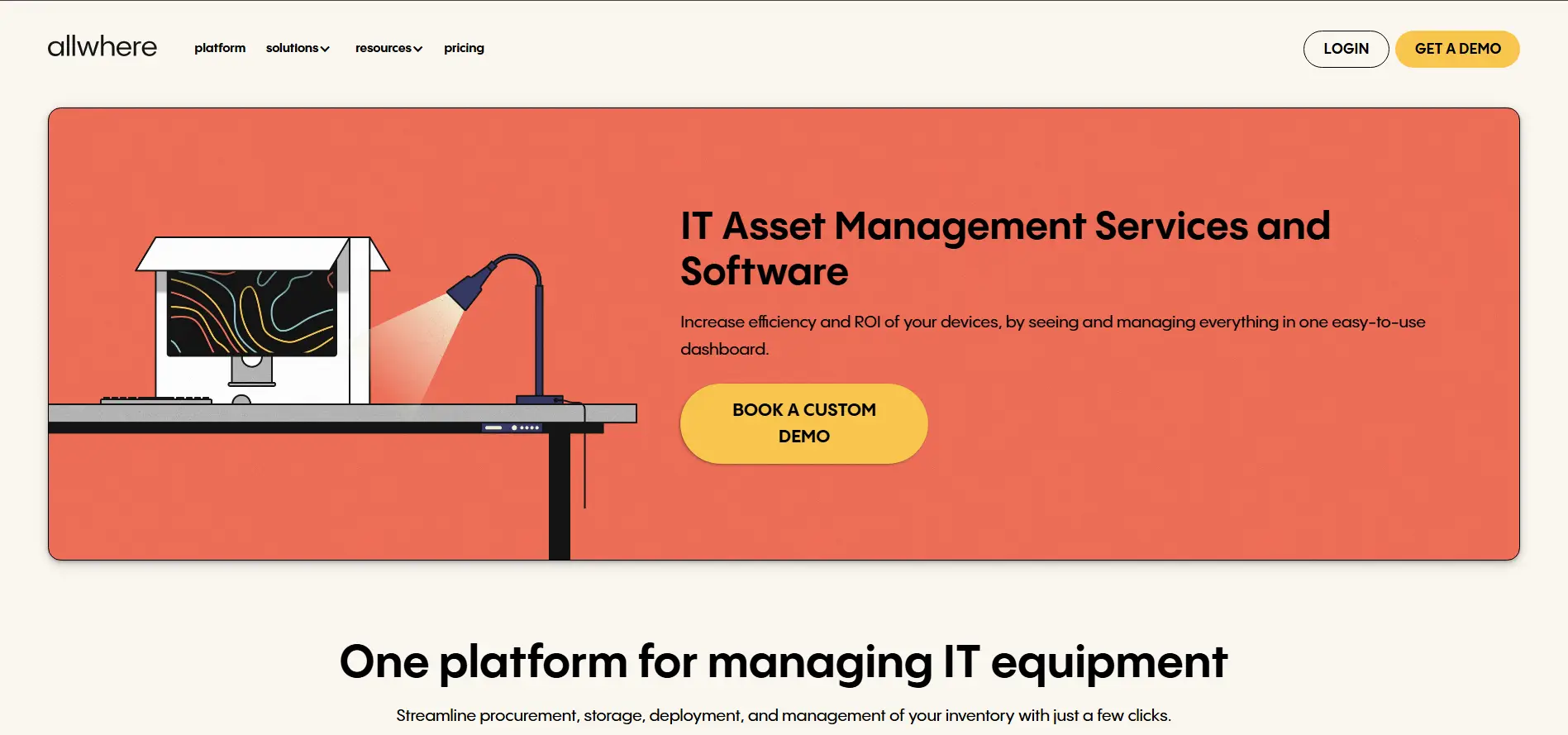
allwhere positions itself as an operations partner first and software vendor second, and the performance metrics showcased on Allwhere's device procurement platform back that claim: a 96 percent on-time delivery rate and a 91 percent on-time retrieval success rate for employee devices, according to its 2026 SLA dashboard. The company reports a 96 percent on-time delivery rate and a 91 percent on-time retrieval success rate for employee devices, based on 2026 internal SLA data. Instead of asking your team to juggle portals and couriers, allwhere lifts the logistics load:
Where it trails. Public AI capabilities stop at rule-based workflows; there is no generative or agentic layer yet. Country coverage appears as “global regions,” but a precise list is not published, so request a matrix if you hire in emerging markets.
Ideal fit. Distributed teams with limited IT bandwidth that want a hands-off logistics partner plus a single dashboard. Because there is no subscription in the way, you can pilot one country and measure SLA performance before expanding.
Learn more about their unified IT asset management services and software.
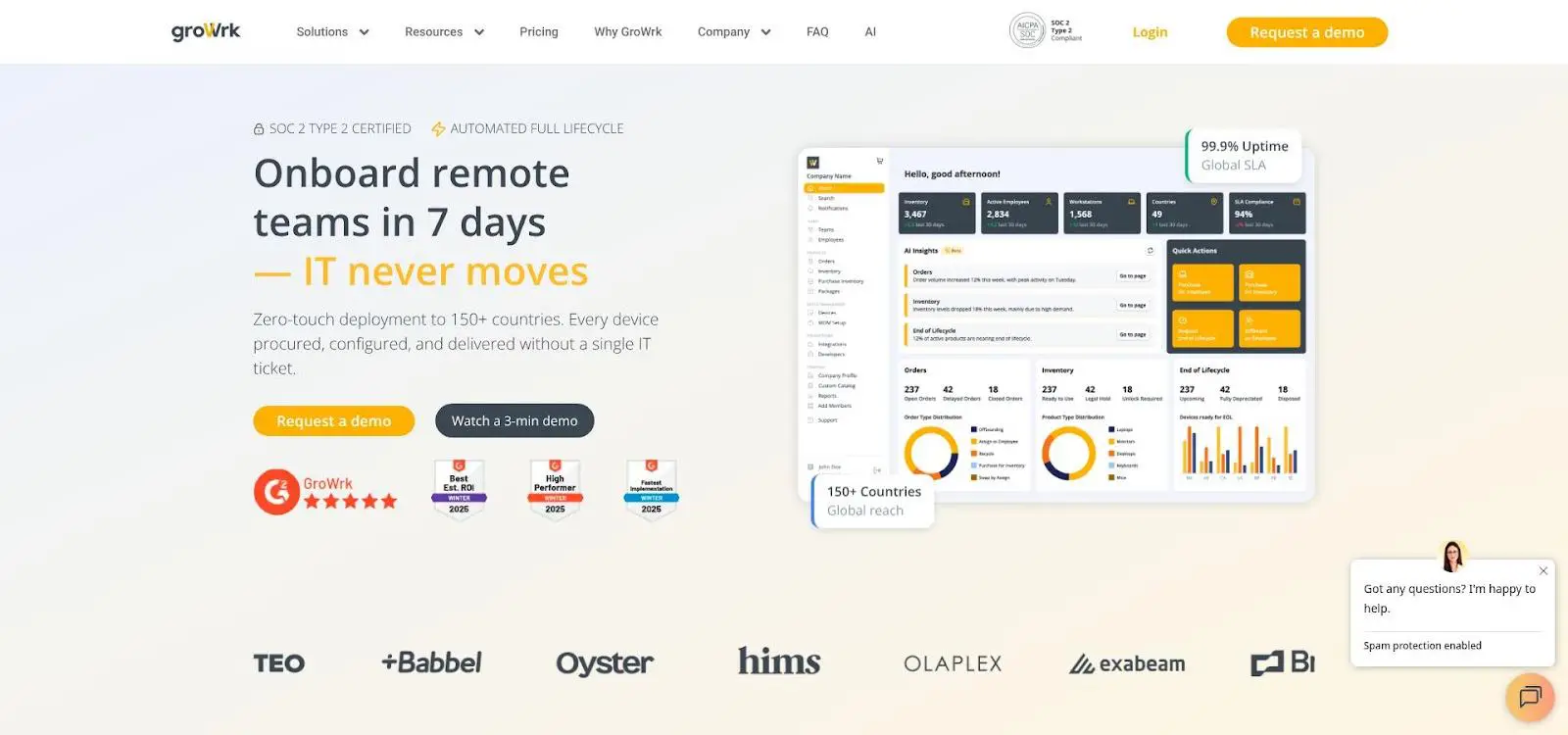
If your hiring map stretches from São Paulo to Seoul, GroWrk stands out. The platform sources, configures, and delivers hardware through certified resellers in 150 plus countries, then overlays that network with an AI operating layer built to shrink the hours between request and delivery.
How it works
Proof in the numbers
The company reports device deployment in seven days or less and offers more than 40 ecosystem integrations for global roll-outs, fast by any hardware standard.
Pros
Cons
Ideal fit
Mid-market firms on three or more continents that want AI to remove manual touches, not just report on them, without juggling multiple regional vendors.

Modern device procurement connects HR, IT, logistics, asset management, and finance, but invoices can still create manual work at the end of an otherwise automated process. InvoiceAction automates invoice processing and connects validated transaction data with downstream AP and ERP workflows.
Create a more complete automation strategy from equipment request through financial processing.
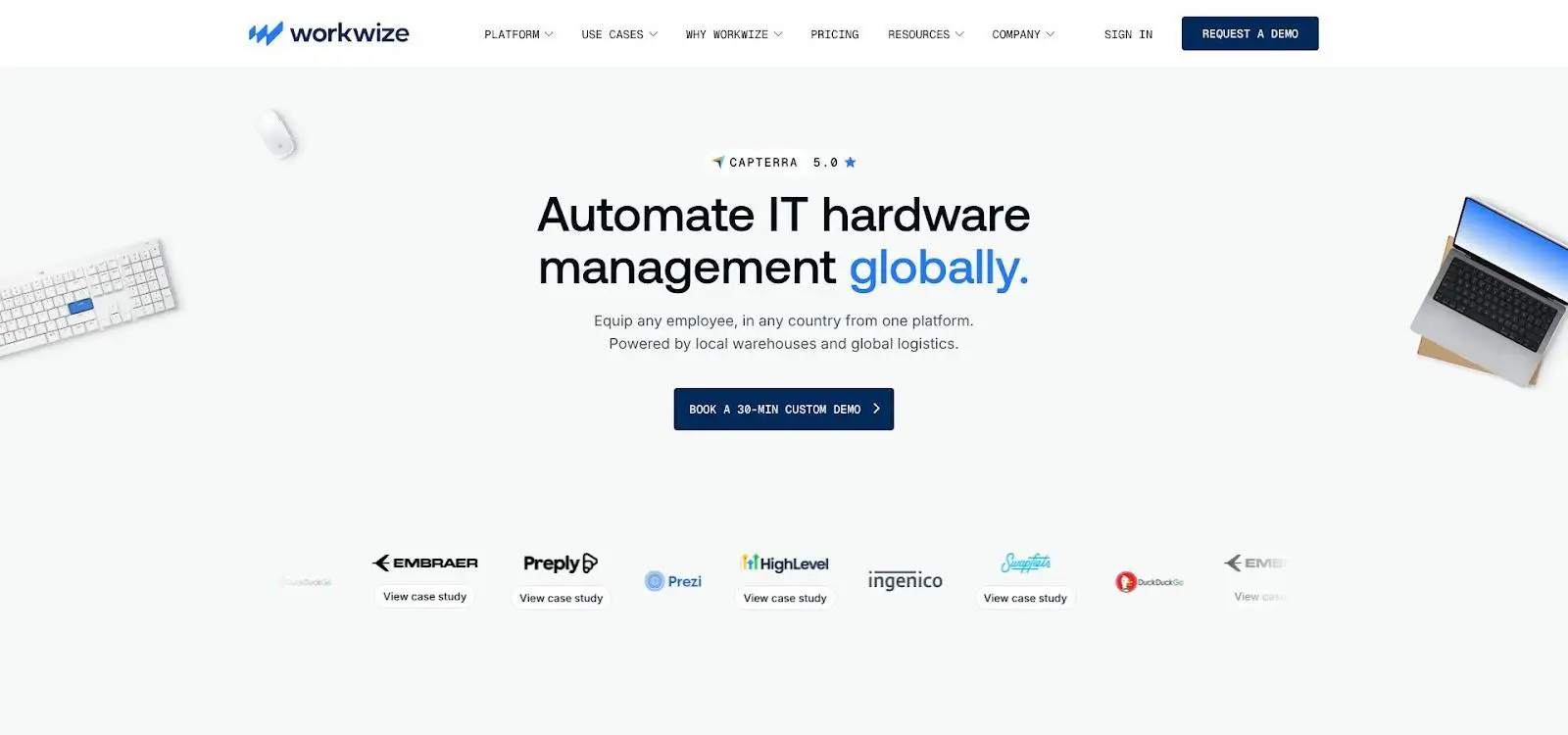
Workwize treats the device lifecycle as one uninterrupted loop: procurement, deployment, repair, replacement, storage, resale, and certified disposal, all triggered by HRIS or MDM events.
Why it stands out
Pricing
Tiered (Basic, Professional, Enterprise) and quote-based. Confirm the latest rate card; some 2025 blog posts still show outdated per-user figures.
Watch-outs
Community feedback notes occasional mark-ups on high-spec Macs and mixed experiences during LATAM peak seasons. Ask for landed-cost samples in your top three markets before committing.
Ideal fit
Mid-market or enterprise teams drowning in manual lifecycle work, such as lost loaners, missing wipe proofs, or assets stranded in home offices. Workwize swaps a platform subscription for hours of reclaimed IT time and a cleaner audit trail.
Recommended reading: Learn How Digital Asset Management Improves Productivity, Security, and ROI
If your people team already runs onboarding, contracts, and global payroll inside Deel, the IT module feels like a natural extension. The same employee record that prints a contract now triggers a role-based hardware order, checks local availability, and routes approvals without leaving the Deel console.
What you get
Trade-offs
Pricing is bundled into existing Deel seats, so standalone buyers pay a convenience premium. Once devices, payroll, and identity share one database, swapping out only the hardware layer later becomes a surgical project. Plan for long-term commitment, not casual dating.
Ideal fit
Companies already sending Deel paychecks in multiple currencies and wanting hardware to follow the same click path. Verify that your must-have countries appear on Deel’s supported list, and get the bundled quote in writing before finance signs off.
Primo starts where many tools stop: an AI agent sits on top of procurement, MDM, SaaS management, and lifecycle data. Type “Ship a developer kit to our new hire in Oslo next Tuesday” and the agent assembles a quote, checks stock in its network of more than sixty countries, routes Slack approvals, enrols the MacBook in Jamf, and schedules DHL pickup in one chat window.
Why it works for small teams
Limitations
Coverage is thinner beyond Tier-one markets, so verify local sourcing and warranty routes for Jakarta, Johannesburg, or similar cities. Independent SLA data is still scarce, so pilot before a full roll-out.
Ideal fit
Tech scale-ups with lean IT crews that prize speed, clean APIs, and chat-driven procurement. Try it on the next five hires and count how many Slack threads disappear.

The article emphasizes that AI can automate routine actions while budget exceptions and other consequential decisions remain behind human approval. docAlpha applies the same principle to document processing, automating routine work while supporting human review where exceptions require attention.
Scale automation without removing human judgment from the decisions where it matters.
Firstbase built its reputation on the hardest part of the lifecycle: getting devices back, wiping them, and putting them to work again. The company runs virtual IT closets on four continents, so a returned laptop is wiped, graded, photographed, and redeployed or resold, often within days. Customers report recapturing more than 175 thousand dollars in device reuse value during a single workforce reduction through this closed-loop model.
What sets it apart
Trade-offs
Implementation is heavier than lighter-weight rivals; expect structured onboarding and warehouse-slot allocation before the first device ships. Pricing hides behind custom statements of work and multi-year commitments, which may deter scrappy scale-ups.
Ideal fit
Enterprises that care less about chat-based flair and more about squeezing every possible dollar and carbon gram out of the fleet lifecycle.
Rippling’s super-power is its single employee graph: the same table that runs payroll tax, benefits, and SSO policies also drives laptop assignment, MDM rules, and off-boarding retrieval. Create a role in HR and a device order fires. Change a department and access groups update in one sweep. Terminate the record and Rippling locks the account, schedules pickup, and revokes SaaS seats, often before the farewell Slack thread ends.
The company widened its scope in August 2026, launching Rippling Procurement, an AI layer that drafts purchase orders for hardware or SaaS in plain language. Early users praise the prompt “Buy a graphics laptop for the new designer in Berlin”; the system returns landed cost in euros along with an approval card.
Coverage and pricing
Physical logistics focus on the United States, United Kingdom, Canada, and Australia; other regions rely on carrier partners. Pricing starts at eight dollars per employee per month for the core HR platform, with the IT module requiring a custom quote on top.
Pros
Cons
Ideal fit
Teams already deep into Rippling HR that want hardware, identity, and access changes to move as one, especially if most employees sit inside Rippling’s strongest logistics markets.
Recommended reading: Discover How Procurement Software Simplifies Purchasing and Spend Management
ZenAdmin wears many hats: device procurement, SaaS and identity governance, and help-desk automation. That breadth turns it into a remote IT department you can rent instead of build.
What the platform does
Pricing and cautions
Everything is bespoke. Team size, countries, and module mix drive the quote, and reviewers stress the value of a written SLA in the statement of work. Run a ten-hire, three-offboard pilot first; measure ticket closure and retrieval speed before handing over the keys.
Ideal fit
Distributed SMBs or mid-market firms that treat IT as an operating expense, not a staffing plan. If you need procurement plus first-line support without hiring a fleet of sysadmins, ZenAdmin deserves a coffee chat.
If your hiring roadmap dots Lagos, Nairobi, Manila, and Bogotá, Rayda deserves close inspection. The platform claims device procurement, deployment, and retrieval in more than one hundred seventy countries, emphasising in-country sourcing across APAC, LATAM, and Africa to hit delivery windows of four to eight days where cross-border rivals quote thirty to sixty days.
Why it matters
Caveats
Public AI features are limited, and independent reviews remain thin. Ask Rayda to quote three tricky markets, outline importer-of-record liability, and print SLA clocks in the contract; crisp answers suggest true coverage, while vague ones often point to cross-border drop-ship.
Ideal fit
Companies expanding into fast-growth regions that value operational reality over a glossy interface; often the difference between a day-one laptop and a two-week scramble.

The goal of device procurement automation is to eliminate unnecessary manual touches across the lifecycle. InvoiceAction brings the same principle to AP by automating invoice capture, validation, matching, approvals, and exception workflows.
Reduce the manual handoffs between procurement and finance and keep transaction processing moving.
Buying a laptop is only one beat; a clean orchestration needs four systems working together:
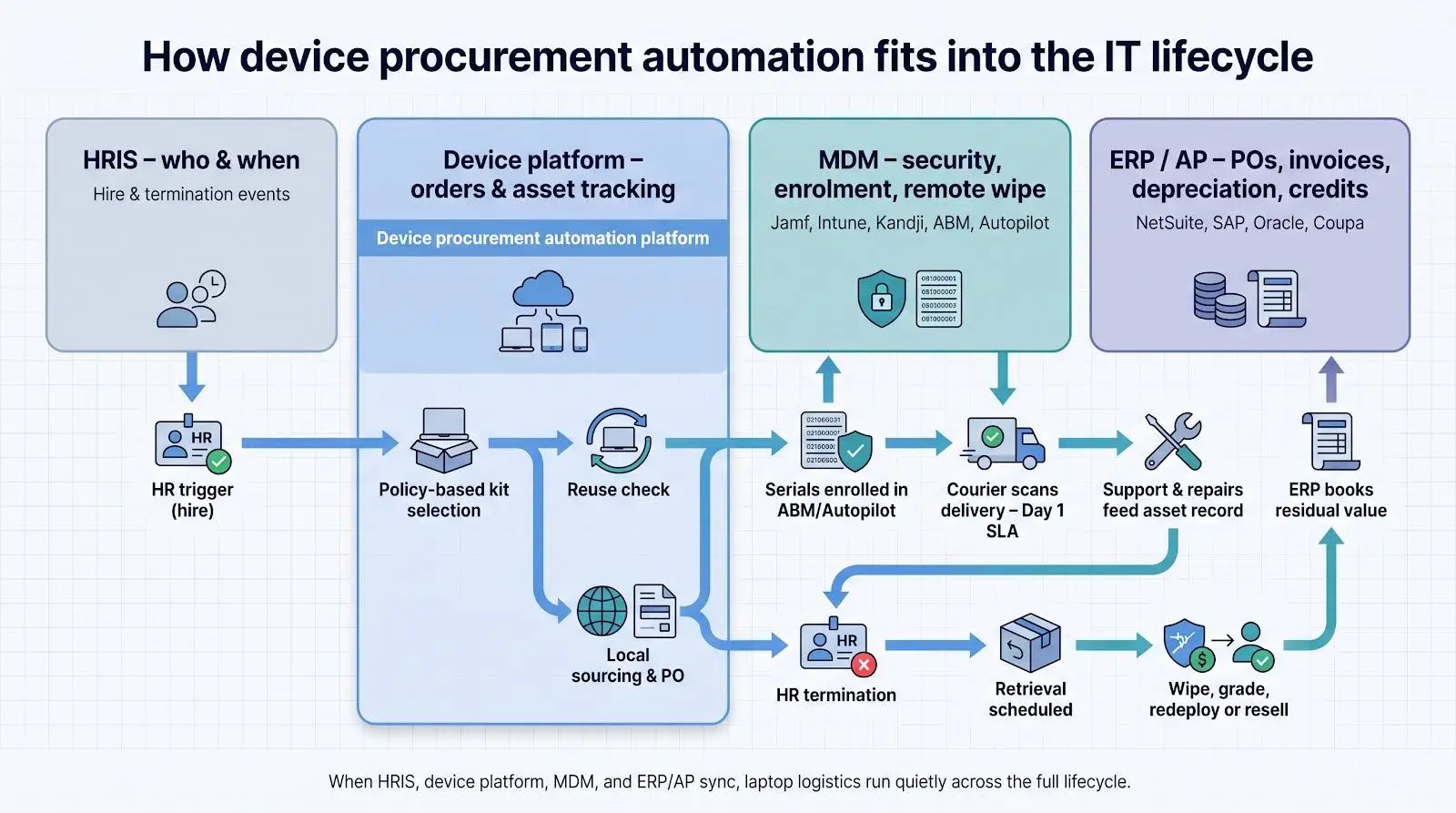
When these layers sync, the workflow looks like this:
HR trigger → policy-based kit selection → reuse check → local sourcing and purchase order → serials enrolled in ABM or Autopilot → courier scans delivery, closing the day-one SLA → support and repairs feed the asset record → HR marks termination → retrieval scheduled → warehouse wipes, grades, redeploys or resells → ERP books residual value.
AI adds value at the green-light moments such as stock forecasts, quote generation, and retrieval nudges, while human approval should stay on budget exceptions and disposal paths.
Most tools cover the full loop, yet each excels in a different lane: GroWrk for global sourcing, Workwize for cradle-to-grave automation, allwhere for service overlays, and Rippling for data convergence. Map ownership of every record - asset ID, purchase order, wipe certificate - before implementation so invoices, audits, and security checks land where they should.
Finish that homework now, and the automation you buy will stay quiet when an employee moves from Madrid to Miami, instead of squealing at the first hand-off.
The best tool for you depends less on buzzwords and more on where your people sit, how you run the device lifecycle today, and which gaps hurt most. Use this five-step screen to find the fit.
List every country where an employee lives or could live this year. Mark them green (core), yellow (growth), or red (historically hard). Ask each vendor for landed-cost quotes and delivery ETAs for one green, one yellow, and one red market. True in-country operators turn quotes in hours and name courier and warranty partners; cross-border shippers take days and dodge importer-of-record questions. Treat geography as a go or no-go gate.
Chart each touchpoint - purchase, zero-touch enrolment, support, mid-life repair, retrieval, resale. Note who owns it today. If retrieval is the black hole, weight that column heavily. Compare your map to each vendor’s native modules: Workwize and Firstbase run depot storage and resale; Primo does not. Filling gaps later costs more than choosing the right all-in-one now.
Specialists (GroWrk, allwhere, Workwize, Firstbase) go deep on devices and logistics. Suites (Rippling, Deel IT, ZenAdmin) fold hardware into a broader people-ops console. Specialists win on lifecycle KPIs; suites win on data context and single invoices. Pick the friction you prefer: one more vendor versus hardware being a secondary focus.
Hand finalists the same spreadsheet and fill every row - device markup, platform fee, per-shipment cost, storage beyond a set number of days, retrieval and failed-attempt fees, currency spreads, ITAD charges, minimum commitments, price-hold window. Ask for SLA-breach credits; confident vendors tie money to on-time delivery and retrieval.
Great demos can hide risky defaults. Confirm where the agent’s data lives, which actions auto-execute, how prompts and results are logged, and how you scope spend by cost centre. Run an edge-case demo - order a discontinued model or ship to a sanctioned region - and watch the approval chain catch or miss the error.
Work through these five steps and glossy slide decks turn into hard numbers, clear SLAs, and firm ownership lines - exactly what you need before the contract ink dries.
Recommended reading: Learn How to Validate Automation Software With a Proof of Concept
Excel scorecards only go so far; the real test is a live walk-through using your own numbers and edge cases. Block ninety minutes per finalist and treat the demo like a mini-pilot:
Capture the session with video, screenshots, and timestamps, then drop the raw data - quotes, SLA timers, click counts - into the pricing model you built earlier. The side-by-side view reveals which marketing claims survive contact with your workflow.
A contract means nothing until the first laptops land on desks. Before a global rollout, run a tight pilot that mirrors daily chaos and measures every minute and dollar saved.
Metric | Target | How to capture |
Quote-to-order turnaround (hours) | fewer than four | Timestamp emails or API calls |
On-time day-one delivery (percent) | ninety-five or higher | Courier scan versus start date |
Zero-touch enrollment success (percent) | one hundred | MDM enrollment logs |
IT minutes per order | thirty percent below baseline | Timesheets or screen recordings |
Landed-cost variance vs. quote | plus or minus two percent | Purchase order versus invoice |
First-attempt retrieval rate (percent) | ninety or higher | Courier proof of pickup |
Devices redeployed vs. new (count) | maximize | Asset register |
Invoice exceptions (count) | zero | AP workflow |
Residual value recovered (dollars) | track | Resale report |
Even small wins add up: saving thirty minutes per order across five hundred annual hires equals one full-time headcount. Recovering two hundred dollars per recycled laptop funds the next refresh cycle. Measure first, expand second, and buy on proof, not promise.
Device procurement automation is no longer a nice-to-have; it is a competitive requirement for globally distributed teams. By aligning geography, lifecycle needs, platform depth, and robust AI guardrails, organisations can reclaim time, reduce spend, and deliver day-one productivity for every employee - no matter where they log in.
 Procurement Software for Smarter Spend Management
  SaaS Applications: The Backbone of Digital Era
  Invoice Automation: What Is It and What Are the Benefits?
  Top Features of a Modern B2B Procurement Platform
  Smarter PO Workflow Automation for Purchasing Teams
  Effortless Digital Asset Management for Modern Teams
