8 Best Loyalty Platforms for Banks and Fintechs in 2026

Published: October 16, 2026
These are some of the frequent loyalty questions that other banking and fintech leaders are asking.
If you mainly want merchant-funded cardholder rewards with minimal platform work, Kard is worth considering. If you expect higher transaction volumes and want a broader loyalty system, SessionM gives you more room to build around points, tiers, campaigns, offers, and customer data.
FIS runs its ScoreCard-branded program for financial institutions. Capillary Technologies has a strong financial services track record, clients include Santander and TD Bank. Comarch works with Bancolombia and Nedbank. Kobie has also worked with major financial institutions, particularly in North America.
Through bank-funded points, merchant-funded offers, or partner funding in coalitions. Debit programs lean on merchant funding.
A loyalty platform like SessionM runs your own points, tiers and redemption. Networks such as Kard and Cardlytics bring merchant-funded offers and are paid on performance. Many banks use both.
Yes, if it accepts events from core banking and digital channels. Full platforms such as Epsilon and Capillary Technologies can; card-linked networks generally only see card transactions.
Choosing a loyalty platform for your bank or fintech can get complicated quickly. You need to reward more than card spending, connect customer activity across products and channels, and still keep your data and compliance requirements in check.
The problem is that most loyalty platforms can do some of this well, but they are built for different types of financial institutions.
So, which one fits your setup?
In this article, we will look at eight loyalty platforms for banks and fintechs in 2026, what each does best, what you can expect to pay, and what to watch for before you choose.

Loyalty platforms help banks and fintechs strengthen customer engagement, but operational efficiency also depends on how financial documents and business information are processed. docAlpha automates document capture, classification, data extraction, validation, and downstream workflows.
Reduce repetitive administrative work and extend intelligent automation into document-intensive financial operations.
We looked for platforms that banks, credit unions, and fintechs can use to run or extend a rewards program today. We compared them on what they can reward, how rewards are funded, how quickly they react, how they handle customer data, and how well they support multiple markets and partners. The order is not a ranking: each entry explains the type of program the platform fits best. Details come from each vendor's public materials as of October 2026.
Two categories are outside the scope of this list: card-linked offer networks built for large banks, such as Cardlytics, and specialist bank and credit union loyalty providers, such as ampliFI. Kard is included as an example of an offers network built for fintech issuers.
Recommended reading: Discover How AI Is Transforming Financial Institutions
Platform | Best for | Pricing model |
SessionM | Card issuers and fintechs running high-frequency, offer-led programs | Enterprise license, quoted |
FIS Loyalty Engagement Solutions | Community banks and credit unions already on FIS | Modular, quoted |
Capillary Technologies | Financial groups running loyalty across brands or countries | License, or license plus revenue share |
Epsilon PeopleCloud Loyalty | Banks tying loyalty into a wider data and media stack | Enterprise license, quoted |
Kobie Alchemy Loyalty Cloud | Large US card portfolios wanting strategy plus technology | Enterprise license, quoted |
Comarch Loyalty Marketing Platform | Retail banks and insurers with multi-partner reward ecosystems | Quoted, modular |
Loyalty Juggernaut (GRAVTY) | Multinational banks and coalitions with strict privacy needs | Enterprise license, quoted |
Kard | Neobanks adding merchant-funded rewards fast | Pay-per-performance, merchant-funded |
Let’s get to the list.
Best for: Card issuers, payment fintechs, and co-brand programs where customers transact often and the platform must respond in the moment.
SessionM is now part of Capillary Technologies since it was acquired from Mastercard in 2026. The platform is built around real-time customer profiles, points and tiers, campaigns, rewards, and offers.
Its customer profiles update in real time and can trigger campaigns and offers the moment a customer acts. It also supports paid loyalty, where customers pay for extra benefits or higher earn rates.
For a bank or fintech, that could mean rewarding a first deposit or another high-value action as it happens, rather than after an overnight batch update.
SessionM was named a Strong Performer in The Forrester Wave™: Loyalty Platforms, Q4 2025 report. The platform was recognized for its real-time data engine, omnichannel personalization, and financial ecosystem integration.
Key capabilities:
Pricing model: Enterprise license, quoted.
Watch out for: SessionM's public case studies are concentrated in restaurant, retail, fuel, and airline loyalty. Ask for financial services references and find out how data residency and audit controls would work for your regulator.

Banks and fintechs rely on accurate information moving between applications, departments, and business processes. docAlpha transforms incoming business documents into structured, validated data and applies intelligent rules to support automated downstream workflows.
Reduce manual data entry and help financial institutions create more connected, efficient operations.
Best for: Community banks, credit unions, and other financial institutions already working with FIS.
FIS connects loyalty to card transactions, payments, and digital channels. You can use it for card-linked rewards, merchant-funded offers, points, cash back, and relationship-based rewards. Packages range from an offers-only option designed for starter cards and debit programs to a white-labeled premium program, and FIS also offers a complete ScoreCard-branded loyalty platform.
Key capabilities:
Pricing model: Modular, quoted.
Watch out for: The strongest integration benefits come when you already use FIS. Compare the setup carefully if your payments and core banking systems sit elsewhere.
Best for: Financial groups managing loyalty across multiple brands, countries, currencies, or partner ecosystems.
Capillary Technologies, which also owns SessionM, sells its loyalty program software as Loyalty+, with customer data built into the platform. Its banking clients include Santander and TD Bank, as mentioned on its site.
Loyalty+ uses that data to build segments and trigger personalized engagement, with activity-based rules, points, coupons, and tiers.
Its AI layer, aiRA by Capillary, is an AI agent for on-demand insights and analytics that lets loyalty teams ask questions in plain language and turn the answers into campaigns in minutes. Nothing goes live without human approval, and every AI action is logged, which matters in regulated environments.
Capillary Technologies was named a Leader in The Forrester Wave™: Loyalty Platforms, Q4 2025 report and scored the highest among all 11 vendors evaluated in the report in both the current offering and the strategy categories. Receiving a full score in 22 of 27 criteria, driven by its AI-powered personalization engine (aiRA).
Key capabilities:
Pricing model: Enterprise license, quoted.
Watch out for: If you already run a customer data platform, decide which system remains the source of truth. Ask for banking references that match your size and region.
Recommended reading: Learn How Data Analytics Supports Smarter Automated Decisions
Best for: Large banks that already use Epsilon or want loyalty closely connected to customer data and marketing.
Epsilon Loyalty combines first-party data, customer identity, segmentation, AI insights, loyalty management, and cross-channel activation. Its current site also lists financial services as an industry it supports.
Epsilon was named a Leader, for its end-to-end data-first approach, in The Forrester Wave™: Loyalty Platforms, Q4 2025 report. Its strong fraud management and privacy-first data handling features were praised.
Key capabilities:
Pricing model: Enterprise license, quoted.
Watch out for: Compare the full value of the wider Epsilon ecosystem with what you actually need from the loyalty platform alone.
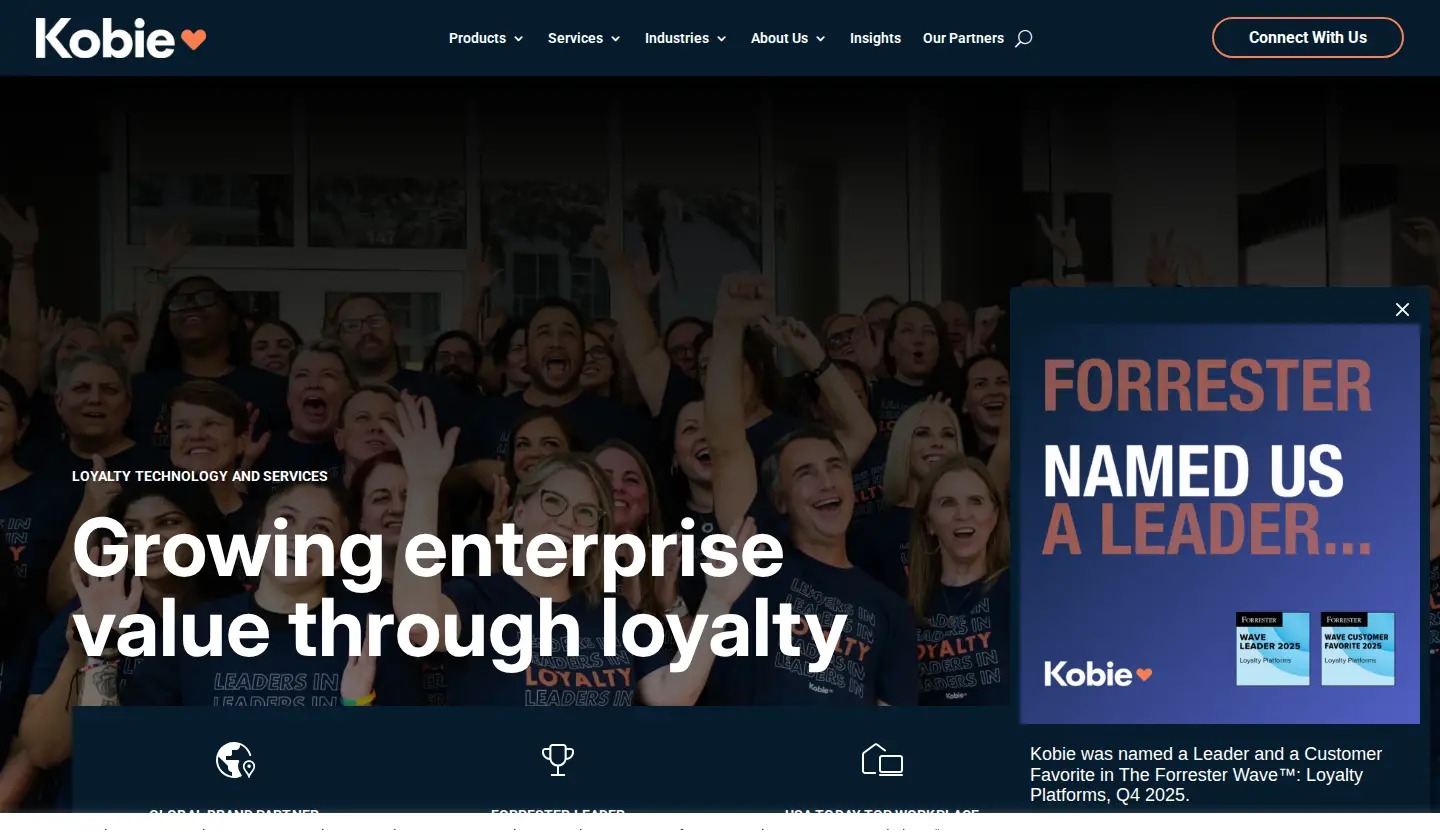
Kobie homepage
Best for: North American financial institutions that want loyalty strategy and technology from the same provider.
Kobie offers loyalty management, customer data management, personalization, rewards, and AI-supported decisioning through its wider platform. It also uses transactional, behavioral, emotional, and zero-party data to build customer profiles and support next best actions.
Kobie was named a Leader and Customer Favorite in The Forrester Wave™: Loyalty Platforms, Q4 2025 report. Receiving a full score in 21 of 27 criteria.
Key capabilities:
Pricing model: Enterprise license, quoted.
Watch out for: Kobie combines technology with substantial loyalty services. Check how much strategy and consulting support you actually need before comparing its cost with a software-focused provider.

Digital banking innovation goes beyond customer-facing applications and loyalty programs. docAlpha helps financial institutions modernize document-intensive operations through automated capture, classification, extraction, validation, and workflow processing.
Improve operational efficiency while reducing the repetitive document handling that slows internal business processes.
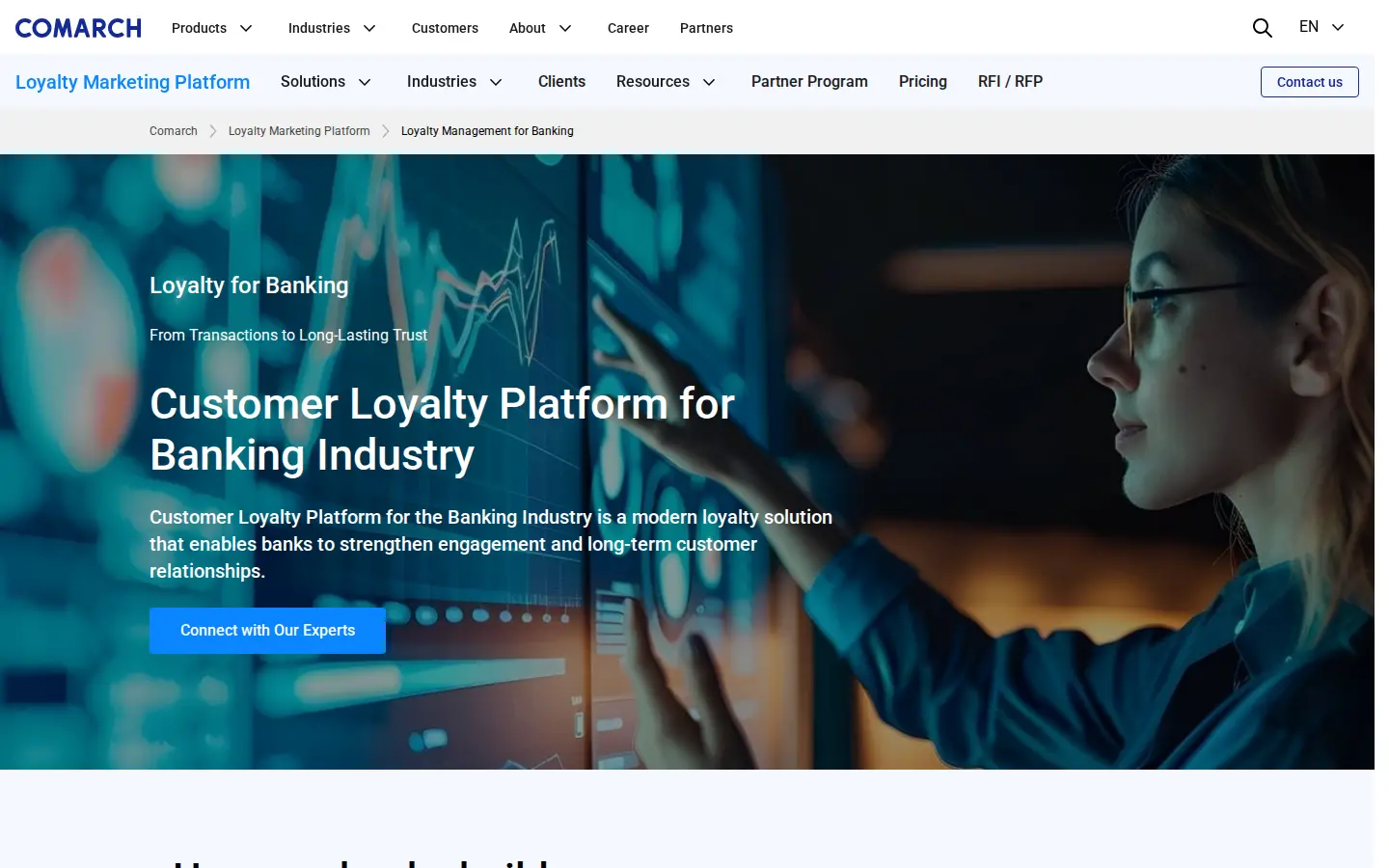
Best for: Retail banks and insurers that want to reward customers across banking and partner activities.
Comarch has dedicated banking loyalty capabilities and lists financial services clients including Bancolombia, Livelo, and Nedbank. Its platform supports multi-country programs and rewards beyond traditional banking products.
Its Livelo implementation is a useful example. Comarch migrated more than 16 million customer accounts and supported different earn rules, partner billing, fraud prevention, and redemption across web, mobile, ATM, and bank point of sale.
Comarch was named a Strong Performer in The Forrester Wave™: Loyalty Platforms, Q4 2025 report. Noted for its strong strategic suitability for complex, multi-region enterprises.
Key capabilities:
Pricing model: Modular, quoted.
Watch out for: Implementations can take time. You should factor that into your rollout plan if you need to launch quickly.
Recommended reading: Discover How Secure Payment Processing Supports Compliance and Fraud Prevention
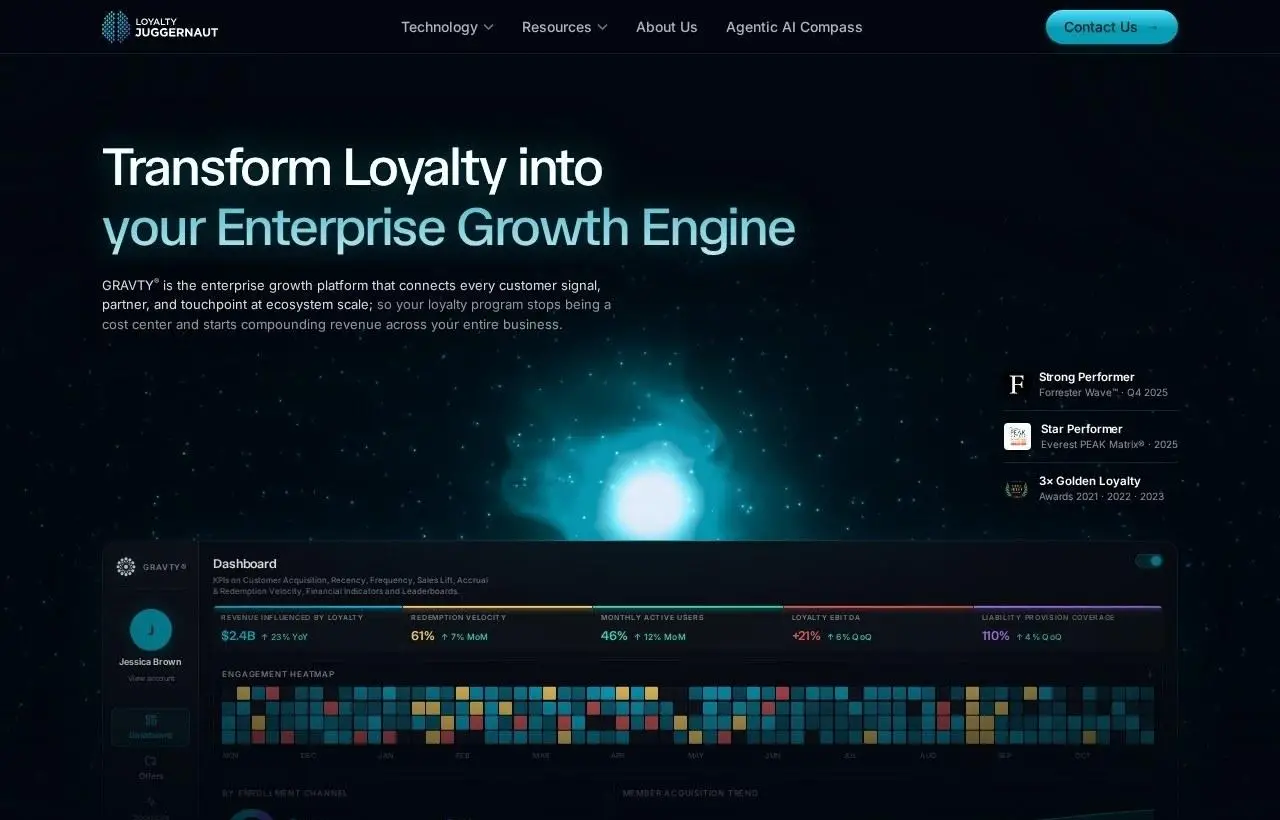
Loyalty Juggernaut homepage
Best for: Banks operating across several markets or running programs with multiple partners.
GRAVTY supports partner ecosystems, promotions, real-time engagement, AI-based decisioning, and regional data residency controls. Its current platform is built around a serverless architecture and API integrations.
Loyalty Juggernaut was named a Strong Performer in The Forrester Wave™: Loyalty Platforms, Q4 2025 report. Recognized for its highly configurable multi-brand ecosystems and a visual rules engine.
Key capabilities:
Pricing model: Enterprise license, quoted.
Watch out for: Ask for references in your market and under your specific regulatory requirements before you commit.
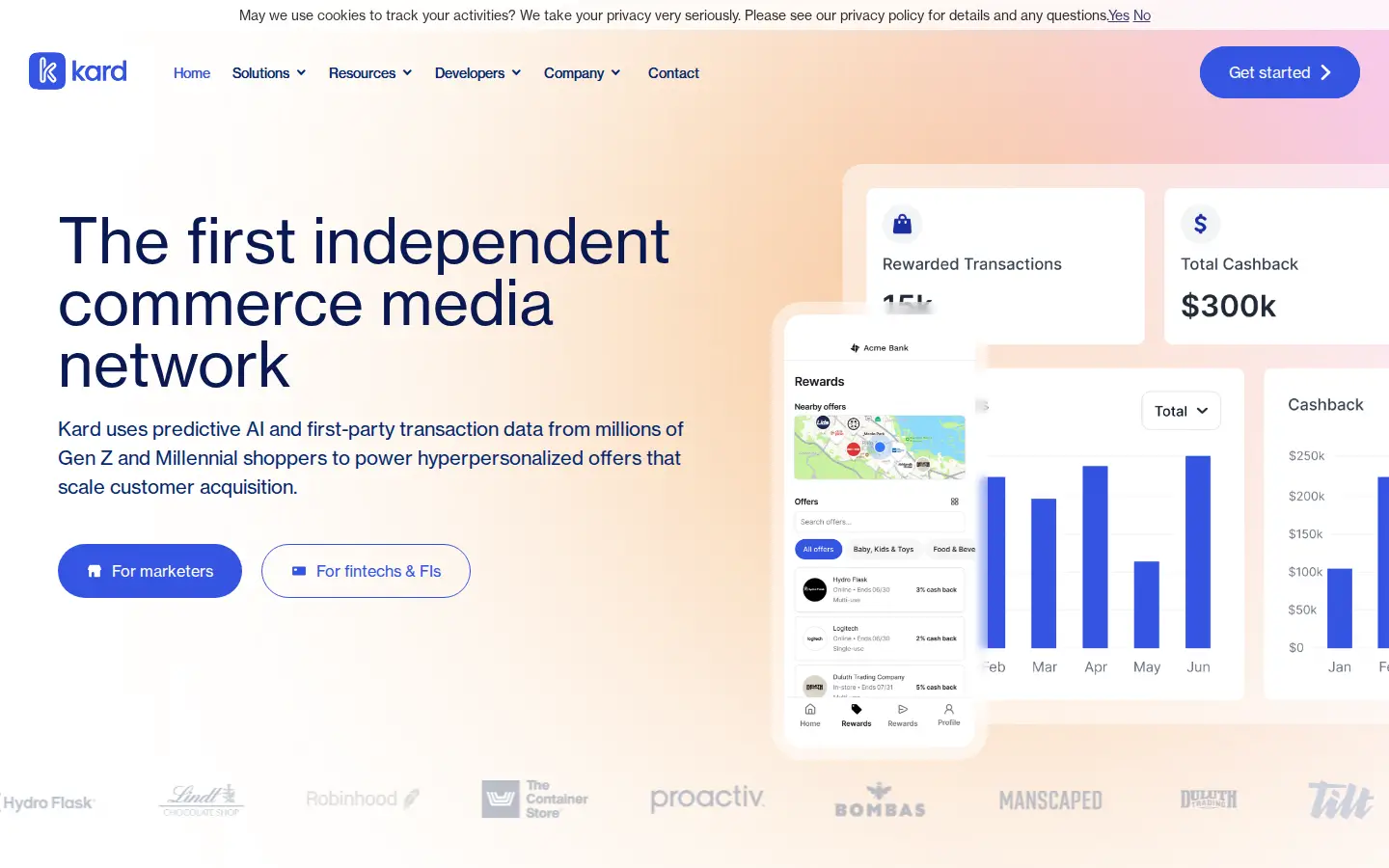
Best for: Neobanks and fintech issuers that want cardholder rewards without funding the rewards themselves.
Kard's current model is centered on merchant-funded rewards and commerce media. Its API-first platform connects brands with cardholders through fintech and issuer partners, while merchants fund rewards when qualifying purchases happen. Kard says its network reaches more than 61 million cardholders, 58% of them Gen Z or Millennial, across more than 40 fintech and modern issuer partners.
Key capabilities:
Pricing model: Performance-based and merchant-funded. Issuer terms are quoted.
Watch out for: Kard is closer to a rewards and commerce media network than a full loyalty management platform. You may still need another platform if you want complex points, tiers, or relationship-wide loyalty.

Banks and fintechs increasingly rely on intelligent technology to improve customer experiences and streamline operations. docAlpha combines AI-powered document processing, intelligent business rules, validation, and workflow automation to transform incoming business documents into actionable information.
Reduce administrative bottlenecks and help financial teams focus on higher-value work.
The best loyalty platform for one bank might not necessarily be the best for yours. So outline your needs and business complexities, then see which platform solves them more easily.
Here are some questions to consider.
If you only reward card spending, a processor-integrated program or an offers network may be enough. If you want to reward the wider relationship, such as deposits, direct deposit, product adoption, or onboarding milestones like completing KYC, you need a platform that accepts events from your core banking and digital channels.
Bank-funded points, merchant-funded offers, and partner-funded coalition rewards have very different economics. Debit and starter-card programs often rely on merchant funding, which is why some providers sell offers-only packages for them.
Ask each vendor whether points are earned at authorization or after settlement, and what “real-time” means in their demo. If your current system updates rewards overnight, test how each platform handles offers in the moment.
Some platforms include their own customer data layer, while others plug into the CDP or data warehouse you already run. Decide which system will be the source of truth before you compare features. If you don’t have a data layer yet, weigh the trade-offs of buying versus building a fintech tech stack before you decide.
Check data residency, PCI scope, and audit trails for every rule change. How you change or expire rewards also matters, so make sure the platform keeps a clear record of what changed and when.
Multi-currency programs and coalitions need partner billing, settlement, and market-level rules. Ask for live examples that match the number of markets and partners you plan to support.
In conclusion, depending upon your situation, different loyalty vendors are best suited for you:
Recommended reading: Learn How Payment Analytics Can Improve Financial Decision-Making
 How AI is Transforming Financial Institutions
  Buy vs Build Fintech Tech Stack: Scaling Decisions Guide
  Payment Processing and Payment Analytics: Understanding the Connection
  Enhancing Customer Loyalty and Sales with AI
  AI in Fintech: Comprehensive Guide to Artificial Intelligence Solutions
  Payments Industry: Digital Evolution
