How AI Can Reduce Errors in Business Documentation

Published: August 20, 2026
Business documentation carries more risk than most teams acknowledge. A misplaced clause in a contract, a factual inconsistency across quarterly reports, a compliance term copied from last year's version without being updated - these aren't hypothetical problems. They happen regularly, and the consequences range from minor rework to significant legal exposure. Manual review catches some of it. Reviewers at the end of a deadline cycle catch far less.
AI-based document tools have changed what's possible here. Not by replacing human judgment, but by handling the parts of review that are repetitive, pattern-based, and easy to miss when you're on your twelfth draft of the week.
Most documentation errors don't originate from carelessness. They come from structural problems in how documents get produced.
Version control is one of the main culprits. When multiple contributors work across shared drives and email threads, outdated content gets reused. A policy update made in March may not have reached the compliance section of a client report drafted in April. Nobody caught it because everyone assumed someone else had checked.
Inconsistency is the second source. Long documents with multiple authors develop tonal and terminological drift. One section calls something a "vendor agreement," another calls it a "supplier contract." Legal teams flag this; clients notice it; it erodes confidence in the document's reliability even when the underlying content is accurate.
Factual drift is the third problem - numbers, dates, and references that were correct when first written but weren't updated when conditions changed. In fast-moving business environments, this happens faster than most teams expect.

Relying on employees to catch every document error manually creates inconsistent results as volumes and workloads increase. docAlpha combines intelligent document processing with AI automation to capture, classify, extract, and validate business data through controlled workflows.
Create more reliable processes while giving employees more time to focus on exceptions that require judgment.
Running separate tools for clarity, originality, and fact-checking is workable but slow. Teams that review large document volumes tend to consolidate into platforms that cover several of these functions in one pass. The practical value is in the speed of the feedback loop - you run a document through an AI layer, resolve the flagged issues, and send a cleaner version to human reviewers who can focus on judgment calls rather than surface errors.
Document review workflows tend to slow down when teams switch between four or five separate tools for different checks. A well-structured AI writing assistant that lets you check for AI content, run an originality scan, and improve text clarity in one place removes that friction. The consolidation itself saves time, separate from any individual feature it offers.
Effective document review covers at least three distinct functions, and they rarely overlap enough to be handled by a single pass.
Language clarity is the first. Modern AI goes further than catching grammar mistakes. It identifies sections where meaning is ambiguous, where sentence structure creates difficulty, or where tone shifts unexpectedly. For business documents that need to be understood quickly by non-specialist readers, this matters. A proposal that requires three readings to parse is a proposal that loses deals.
Artsyl Technologies have long argued that the readability of output documents affects downstream process efficiency - a document that's clear on the first read reduces revision cycles and misunderstandings at the client end. AI clarity tools operationalize that principle at the drafting stage rather than after delivery.
Originality review is the second function. In most business contexts, the concern isn't plagiarism - it's reuse. When sections are copied from previous proposals or old templates without proper review, the document may contain outdated terms or content that no longer reflects the company's position. AI originality checkers surface these sections so they get examined rather than assumed to be fine because they've been used before. Teams producing high volumes of proposals and client-facing materials benefit most from this; the risk isn't intentional copying, it's the default habit of reusing what already exists.
Fact verification is the third. AI fact checkers cross-reference claims against available data and flag statements that appear inconsistent or unverifiable. For research reports, market analyses, and compliance documents, this catches the cases where a number was transposed, a statistic was outdated, or a reference was misattributed.
Recommended reading: Document Automation: Which Documents Can You Automate?
Document Type | Most Common Error | AI Review Function That Addresses It |
Client proposals | Outdated reused content, tone inconsistency | Originality checker, clarity tool |
Compliance reports | Factual inaccuracies, version drift | Fact checker, grammar checker |
Research summaries | Misattributed data, ambiguous phrasing | Fact checker, AI summarizer |
Internal policies | Terminological inconsistency, outdated terms | Clarity tool, originality checker |
Contracts | Copied clauses, structural ambiguity | Originality checker, clarity tool |
AI document tools are not a substitute for human expertise, and it's important to be clear about that distinction. They're exceptionally good at pattern recognition - finding inconsistencies, flagging unusual phrasing, identifying content that deviates from established norms. They're less reliable on questions of intent, strategic framing, and context-specific judgment.
A contract clause may be grammatically correct, factually accurate, and stylistically consistent - and still be the wrong clause for that particular client relationship. No AI tool catches that. An experienced account manager reading the document will. The best-performing documentation teams use AI for the first review layer and human judgment for the second. Neither replaces the other; they address different types of error.

Accuracy suffers when invoice validation depends on employees performing the same checks manually across growing transaction volumes. InvoiceAction embeds AI-powered extraction, duplicate detection, validation, matching, and approval routing directly into the AP process.
Create a more consistent invoice workflow while reducing errors, exceptions, and processing costs.
Teams that get the most from AI document review tend to share a few habits:
Recommended reading: What Types of Documents Benefit from Document Automation?
Error reduction in documentation is rarely framed as a revenue issue, but it functions as one. Proposals with unclear language close at lower rates. Contracts with inconsistencies require more legal time to finalize. Compliance documents with factual errors create regulatory exposure. Reports with tonal inconsistency undermine confidence in the underlying analysis - even when the analysis itself is sound.
Each of these error types has a cost, even if it's rarely itemized on a budget line. AI document review tools reduce that cost systematically rather than relying on the consistency of individual reviewers under deadline pressure. The investment is small relative to the rework it prevents, and the efficiency gains compound over time as teams develop cleaner first drafts that require less revision at every subsequent stage.
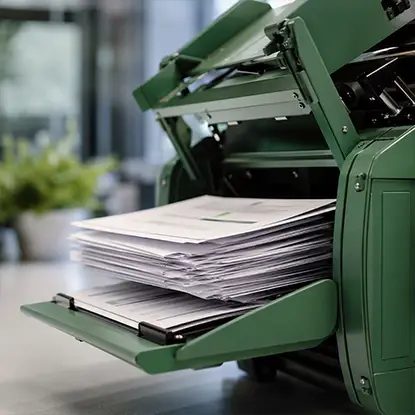
As document volumes grow, manual review becomes harder to perform consistently and repetitive errors become easier to miss. docAlpha automates document capture, classification, data extraction, and validation while escalating exceptions for human review.
Process more documents with consistent controls and fewer error-driven corrections.
Documentation quality is an operational problem before it becomes a reputational one, and AI gives teams a practical way to address it at scale. The tools available now cover the most common failure modes in business documents - clarity issues, reused content, factual inconsistencies, terminological drift. They work best when integrated into the review workflow as a first pass rather than an afterthought. Human judgment remains essential for the decisions AI can't make. For the errors that are pattern-based, repetitive, and preventable, there's no good reason to keep catching them manually.
 How AI Document Automation Maintains Quality Beyond 2026 Now
 How Automation Reduces P & L Statement Errors | Artsyl Tech
 How Document Automation Lowers Operational Costs Effectively
 Data Extraction with OCR: Extracting Data from Invoices, Forms, Receipts
 How AI Enhances Document Classification Accuracy with ML
 Reduce Manual Data Entry: 7 Simple Fixes That Save Time
