Which AI Landing Page Personalization Tools Deliver the Highest Conversions?
Published: July 23, 2026
Personalization has been a marketing priority for years. But for a long time, the gap between intention and execution was wide. Building truly relevant landing page experiences for every audience segment, keyword, or campaign required engineering resources, significant time, and a content team willing to write endless variations.
AI has closed that gap.
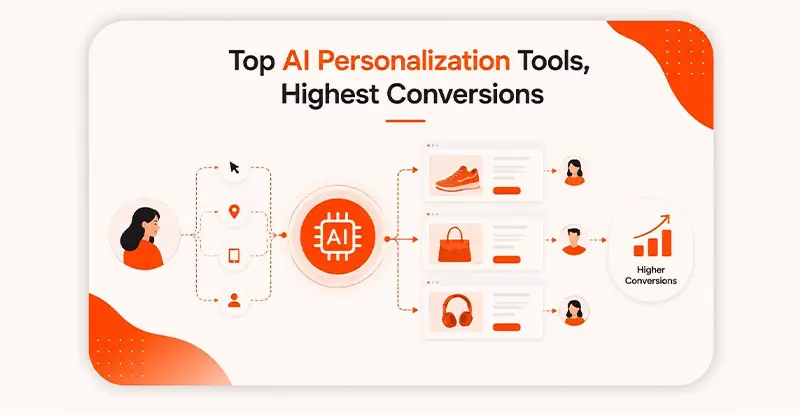
The best landing page personalization tools available in 2026 don't just serve dynamic content, they use artificial intelligence to generate it, test it, and optimize it continuously. For performance marketers and growth teams, this shift changes the math entirely. What once required months of manual page-building can now be deployed in days, at a scale no human team could match alone.
This guide covers the AI-powered tools driving the highest conversion gains and what makes each one worth your attention.
It's worth being specific about what AI contributes here, because the term gets applied loosely across the industry.
The traditional approach to landing page personalization required marketers to make three decisions manually for every variant: who is this page for, what should it say, and how do we know if it's working. Multiplied across dozens of audience segments, keyword groups, and campaigns, that manual process became the ceiling on how much personalization any team could realistically deploy.
AI removes that ceiling in three concrete ways.
First, it generates content at scale. Rather than authoring copy for every audience variant individually, AI can produce contextually relevant headlines, subheadings, and CTAs for each segment dramatically reducing the time between strategy and execution.
Second, it identifies personalization opportunities humans miss. AI-powered platforms can analyze traffic patterns and surface audience segments that perform differently from the baseline segments a marketer might never have thought to target separately.
Third, it optimizes continuously. Static pages don't improve after launch. AI-powered personalized landing pages keep learning adjusting which content is served to which visitor based on ongoing performance data rather than frozen assumptions.
Recommended reading: How AI Is Helping Marketing Teams Handle More Content Faster
Not every platform that uses the word "AI" applies it meaningfully to landing page personalization. Before committing, evaluate tools on these dimensions.
Depth of personalization signals - Does the platform personalize based only on traffic source, or can it incorporate keyword, audience segment, location, device, behavioral history, CRM data, and campaign-level signals simultaneously? The more signal types supported, the more precise the personalization.
Content generation vs. content delivery - Some tools use AI to decide which pre-built variant to show. Others use AI to generate the content itself. The latter scales more efficiently and requires less manual content preparation upfront.
Ad-to-landing page continuity - For teams running paid campaigns, the most critical personalization moment is the one immediately after the click. Tools that connect ad signals keyword, audience list, ad group directly to landing page content deliver the message match that converts.
No-code accessibility - AI-powered personalization is only as valuable as the speed at which it can be deployed. Tools that require technical resources to launch new personalization rules negate much of the efficiency advantage AI provides.
Recommended reading: AI Marketing Tools You Will Need In 2025 To Grow Your Business
Fibr AI is an AI-native web experience platform built for personalization, experimentation, and conversion optimization, rated 4.6/5 on G2. It personalizes a wide range of signals at once, including visitor intent, traffic source, campaign, keyword, location, behavior, device, CRM data, and CDP data. Rather than building separate pages per audience, the platform adapts a single URL to whoever arrives. It sees the most use in banking, financial services, healthcare, telecom, and software. Its breadth depends on connected data, so teams with thin first-party data capture less of the advantage.
Unbounce's Smart Traffic feature uses machine learning to route visitors to the landing page variant most likely to convert based on their attributes including device, location, and behavior. Combined with Dynamic Text Replacement for keyword-based personalization, it remains a well-established option for teams running focused PPC campaigns who want AI-assisted optimization without a steep learning curve.
Instapage applies AI to post-click optimization through its AdMap feature and audience-level personalization capabilities. Teams can connect specific ad variations to corresponding landing experiences, with the platform helping manage the complexity of maintaining alignment as campaigns scale. Its AI-assisted tools focus primarily on routing and variant selection rather than content generation.
Optimizely's AI layer sits within a broader enterprise experimentation and personalization platform. It supports multi-dimensional audience targeting combining behavioral, geographic, firmographic, and campaign signals and applies machine learning to identify which experiences are most likely to convert for each segment. The depth is significant; so is the implementation investment.
Mutiny uses AI to generate personalized copy suggestions for B2B landing page experiences, drawing on firmographic and account-level data to adapt messaging for different industries, company sizes, and named accounts. For account-based marketing teams, its AI content generation capabilities reduce the manual writing workload significantly when personalizing across a large target account list.
VWO applies AI primarily to its testing and optimization layer, helping teams identify winning variants faster and surface behavioral segments that perform differently from the aggregate. Its SmartStats engine reduces the time required to reach statistical significance in experiments a meaningful advantage for teams running personalization tests across multiple landing page variants simultaneously.
AB Tasty's AI capabilities are focused on audience intelligence and experience optimization. Its platform analyzes visitor behavior to identify high-value segments and recommends personalization opportunities that might not be visible through manual analysis alone. For teams that want AI to help them discover where to personalize not just how AB Tasty offers a useful starting point.
ZoomInfo is an AI platform for go-to-market teams that can strengthen personalization with B2B data, account intelligence, and intent signals. It helps marketers identify in-market buyers, segment audiences, and surface changes such as hiring surges, technology shifts, budget signals, and intent spikes. For teams connecting CRM and campaign data to landing-page experiences, ZoomInfo is most useful as the audience-intelligence layer behind more relevant messaging and targeting. Its broader platform also enriches records and unifies systems, helping teams act on buyer context rather than relying only on traffic-source data.
Recommended reading: How AI Is Revolutionizing PPC Campaign Management for Agencies
The conversion gains from AI-driven landing page personalization compound over time in a way that static personalization doesn't.
A manually built set of page variants captures the personalization insight available at the moment of creation. It doesn't improve unless someone actively rebuilds it. AI-powered personalization, by contrast, keeps adjusting content, routing, and optimization rules based on ongoing visitor behavior and conversion data.
For teams running high-volume campaigns across multiple audience segments, this compounding effect is where the largest long-term conversion gains live. The initial lift from matching the right message to the right visitor is meaningful. The sustained lift from a system that continuously refines those matches is where personalization becomes a durable competitive advantage.
Recommended reading: What are the Returns on Intelligent Automation?
Landing page personalization in 2026 isn’t just about swapping in different headlines. The best tools now help you create the content itself, and then keep improving it - so you can scale ideas across every campaign, audience, and keyword without burning out your team.
The right platform depends on where things are actually breaking down for you. If content production is the bottleneck, you’ll get more leverage from tools that can draft and refine copy on the fly, not just shuffle between a few pre-approved variants. If you already have plenty of variants but your targeting is fuzzy, you’ll see more impact from products that go deeper on audience insight and experimentation.
Enterprise teams, especially in regulated industries, tend to care most about data depth and clean integrations. They’re often willing to live with slower rollouts and more complex setups if it means getting better signals they can trust.
For most marketers, the debate isn’t whether to personalize anymore. It’s whether their current toolkit can actually keep up with the level of personalization they’ve committed to on paper.
The traffic is already there. The real upside comes from making sure every click lands on something that feels specifically meant for that person, in that moment.
Recommended reading: How AI Is Changing Digital Marketing in Business
Author bio
Ankur Goyal is the founder of Fibr, leading its vision of an agent-led web where every page adapts like a smart assistant. A Stanford and IIT Delhi graduate, he combines technical expertise with deep insights into marketing and consumer behavior. In his second entrepreneurial journey, Ankur is focused on building AI-powered tools that help brands personalize experiences, accelerate experimentation, and drive better conversions at scale.
 Smarter Content Workflows for Modern Marketing Teams
 Essential AI Tools for Business Growth in 2025
 AI’s Role in Shaping the Future of Digital Marketing
 How AI Is Revolutionizing the Marketing Industry
 Top AI Writing Tools and Technologies You Need to Know
 Scaling Cold Outreach with Personalization for Better Engagement
