How AI Is Changing Insurance for Contractors and Service Businesses

Published: October 22, 2026
AI helps insurers process applications and claims faster, which means quicker turnaround times for small contractors. It can also enable more accurate risk-based pricing, though coverage terms still depend on your specific business profile.
Not necessarily. AI makes pricing more precise, so contractors with strong safety records may see better rates. But it also identifies risks more accurately, which could mean higher premiums for businesses with elevated exposure.
No. AI handles data processing and routine tasks, freeing up agents and adjusters for complex decisions. Claims involving liability disputes, coverage interpretation, or settlement negotiations still require experienced professionals.
It's a fair concern. AI models are only as good as the data they're trained on. Regulators like the NAIC are pushing insurers to test for bias and maintain transparency in how AI-driven decisions are made.
If you run a contracting or service business, you already know that getting the right insurance coverage feels like a second job.
Between general liability, workers' comp, and professional indemnity, there's a lot to sort through. And now, AI for insurance is quietly reshaping how all of that works behind the scenes.
Here's the thing.
The changes aren't just happening at massive enterprise carriers. They're trickling down to the policies that electricians, HVAC companies, landscapers, and IT service firms actually buy. For contractors who rely on specialty insurance to cover job-specific risks, this shift matters more than most people realize.
Let's break it down.
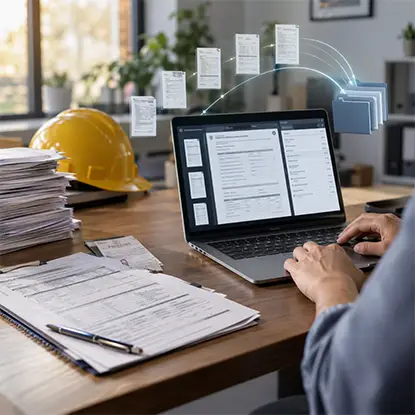
Contractor insurance applications can bring together business details, loss histories, and supporting reports in inconsistent formats. docAlpha uses AI-powered document classification, extraction, and validation to prepare information for review and downstream insurance workflows.
Reduce rekeying and help insurance teams move applications forward with fewer administrative delays.
Underwriting used to be a slow, paper-heavy process. An underwriter would review your application, pull loss history, maybe order an inspection report, and come back with a quote days or weeks later.
AI is compressing that timeline.
Machine learning models can now pull data from multiple sources at once, including public records, claims databases, weather patterns, and even satellite imagery.
For a roofing contractor, that might mean the insurer already has a read on the region's storm exposure before the application lands.
That said, AI doesn't replace the underwriter. It handles the data-heavy lifting so the human can focus on judgment calls. A contractor with a complicated loss history or a niche operation still needs an experienced set of eyes on the file.
Note: AI speeds up underwriting by organizing data faster, but final pricing and coverage decisions still depend on human review, policy language, and the specific risk profile of your business.
Recommended reading: Learn How AI Automation Combines Faster Processing With Human Oversight
Claims is where most contractors actually feel the insurance process. You file a claim after property damage on a job site or a liability incident, and then you wait.
AI is cutting down that wait time for straightforward claims. Tools like natural language processing can read intake forms, route claims to the right adjuster, and flag missing documentation automatically. Some carriers use image recognition to estimate damage from photos submitted through a mobile app.
For simple, well-documented claims, this is a genuine improvement. Contractors get faster responses. Adjusters spend less time on paperwork and more time on the claims that actually need their expertise.
But there's a catch.
Complex commercial claims, like a disputed liability incident on a multi-trade job site, still require professional judgment. Coverage interpretation, contract review, and settlement negotiations aren't tasks you want handled by an algorithm alone. The best carriers use AI to support their claims teams, not to replace them.
Risk assessment is getting more granular. AI models can analyze historical claims data alongside real-time signals to build a more detailed picture of a contractor's risk profile.
Picture this. A general contractor operating in a wildfire-prone region might see their risk scored differently than one doing the same work two counties over. AI can factor in localized weather data, building code changes, and even supply chain disruptions that affect repair costs.
For service businesses, the shift is similar. An IT services firm handling sensitive client data faces cyber risks that AI can help quantify by looking at industry breach patterns, the firm's tech stack, and comparable claims from businesses of a similar size.
Important: More granular risk assessment doesn't automatically mean lower premiums. It means pricing that better reflects your actual exposure. Contractors with strong safety records and clean loss histories could benefit. Those with red flags might see tighter scrutiny.

Complex contractor risks demand experienced underwriting decisions, but collecting and entering documentation should not consume the same attention. docAlpha automates intake of application documents, extracts relevant fields, and routes incomplete or inconsistent records for review.
Give underwriters more time to evaluate coverage decisions while reducing routine document work.
AI isn't just changing how insurance works. It's creating new risks that contractors and service businesses need to think about.
If your business uses AI-powered tools, like automated scheduling software, drone-based site inspections, or AI-driven project management platforms, you're introducing technology risks into your operations. A scheduling algorithm that misroutes a crew could cause project delays and financial losses. A drone malfunction during an inspection could result in property damage or injury.
Cyber liability is another growing concern. Contractors who store client data, project specs, or financial records digitally are targets for data breaches. AI systems that process this information can be vulnerable to hacking or system failures.
The insurance market is still catching up to these exposures. Some carriers are starting to offer coverage for AI-related algorithmic failures and performance risks. But many standard policies don't explicitly address them yet. That's worth a conversation with your broker.
Recommended reading: Discover the Different Types of AI Software and How Businesses Use Them
You don't need to become an AI expert. But asking a few pointed questions can help you figure out whether your carrier is using AI responsibly.
These aren't trick questions. They're the kind of thing that separates a carrier with a real governance framework from one that's just bolting AI onto old processes.
Quick summary: Contractors should ask their insurer how AI affects their underwriting, claims handling, and data privacy. A carrier that can't answer clearly probably hasn't thought it through.

Loss-history documents, inspection reports, and policy applications can arrive as PDFs and scans that are difficult to process consistently. docAlpha captures and validates key document data and prepares structured information for connected insurance systems.
Improve the quality of information reaching business workflows without relying on repetitive manual entry.
Contractors and service businesses operate with thin margins and high exposure. A single bad claim experience or a coverage gap can set a business back for months. AI has the potential to make insurance faster, more accurate, and better tailored to the risks contractors actually face.
But it's not magic. And it's not a guarantee of better outcomes. The contractors who'll come out ahead are the ones paying attention to how their insurers are adopting AI, asking the right questions, and making sure their coverage keeps pace with the tools they're using on the job.
Recommended reading: Learn How Accuracy Is Evaluated in Machine Learning Systems
 AI Automation: What It Is and How It Works in 2026
 The Importance of Accuracy in Machine Learning: A Comprehensive Guide
 Process Automation in Insurance
 Can Insurance Protect a Business Using AI?
 Smarter Insurance Contracts Start with Document Automation
 Optimize Business Efficiency with Contractor Management Systems

