How Intelligent Document Automation Improves Travel Booking Workflows
Published: August 05, 2026
The folio from a three-night stay in Denver lands in the AP inbox on the 28th, forwarded from a project manager's phone. It's a photo of a printout, slightly tilted, with the nightly rate buried under two lines of county tax. Behind it sit forty more attachments: airline receipts pasted into email bodies, car rental agreements as scanned PDFs, an agency invoice covering eleven trips across three cost centers. Month-end close starts in two days.
Anyone who has processed travel spend for a growing company knows this pile. Travel is one of the few expense categories where a single purchase can generate four or five separate documents, each in a different format, each arriving on its own schedule, and most of them addressed to someone outside the finance team.
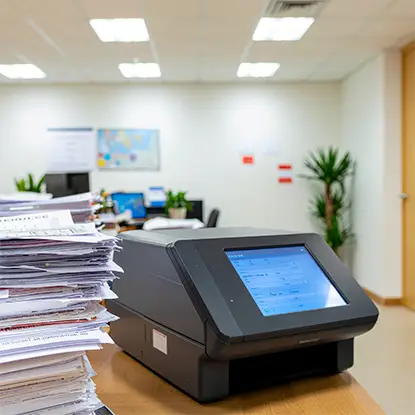
Capture hotel folios, travel receipts, and booking documents automatically with docAlpha using AI-powered OCR and intelligent data extraction. Accelerate travel expense processing while improving data accuracy and reducing manual effort.
A standard supplier invoice is a solved problem for most AP departments. It references a PO, arrives through a known channel, and follows a layout the team has seen a hundred times. Travel documents behave differently. A hotel folio itemizes room rate, occupancy tax, parking, and a minibar charge, and every property formats it its own way. An airline itinerary receipt splits the base fare from carrier surcharges and seat fees. A trip booked through an agency can produce a confirmation at booking, a folio at checkout, and an invoice weeks later, all describing the same three nights. Add international travel and the pile picks up foreign currencies, VAT lines that may be reclaimable, and folios in other languages.
The volume keeps growing. The Global Business Travel Association projected in its July 2025 Business Travel Index Outlook that global business travel spending would reach $1.57 trillion in 2025, up 6.6% year over year. Every one of those dollars leaves a paper trail, and a large share of it still reaches AP as unstructured PDFs, scans, and phone photos.
Manual keying is the usual answer, and it costs more than most teams realize. Rekeying a folio line by line invites transposed digits, missed tax lines, and duplicate payments when the corporate card statement arrives carrying the same charge under a slightly different merchant name.
Recommended reading: Document Automation Software: What Is it and How to Use
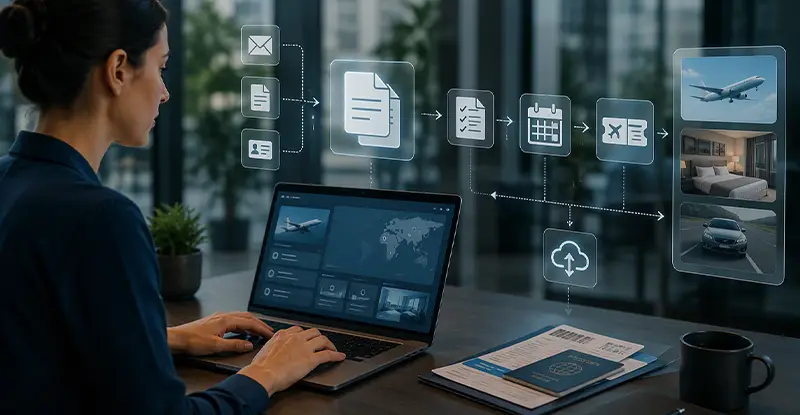
Intelligent document processing treats the AP inbox as a capture point. The software watches the mailbox, picks up each attachment, and classifies it before anything else happens: this one is a folio, that one is a rental agreement, the third is an agency invoice. Classification sounds mundane, but it decides everything downstream, since a folio and an invoice follow different approval paths and post to different accounts.
OCR then reads the text, including the tilted phone photo, and extraction models pull the fields that matter: check-in and check-out dates, property name, guest, nightly rate, taxes, incidentals, total, currency. Good systems validate as they extract. A total that doesn't equal the sum of its line items gets flagged, and so does a checkout date earlier than the check-in, or a currency that contradicts the booking record.
From there the data flows into the ERP or AP platform already coded to the right entity and cost center. The folio that took eight minutes to key takes seconds to review. There are proven ways to reduce manual data entry across every finance workflow, and travel documents are where the effort pays back fastest, because that's where formats vary most and volumes spike hardest.
Intelligent AP Automation for Travel Finance
Let InvoiceAction validate travel invoices against booking information and automate approval workflows using AI-driven process automation. Process more invoices with greater accuracy and significantly less manual work.
Book a demo now
In classic AP, three-way matching compares the purchase order, the receiving report, and the invoice before payment goes out. Travel spend has its own version of the triangle. The booking confirmation plays the role of the PO: it records what was authorized, at what rate, for whom. The folio or ticket receipt proves the service was actually delivered. The invoice or card charge is the request for money.
When all three agree within tolerance, payment can proceed without a human touching it. When they disagree, the mismatch is usually worth a look. The discrepancies tend to be specific: an extra night added at the front desk, a rate that jumped after a rebooking, a cancellation fee for a room nobody slept in, or an agency invoice and a card charge that both bill the same ticket. A clerk keying documents one at a time will miss most of these. Software that lines the three records up automatically catches them in the same pass it uses to post the clean ones.
The economics support the effort. Ardent Partners' 2025 State of ePayables report puts the average cost of processing a single invoice at $12.42, while best-in-class AP teams, the heaviest adopters of automation, handle the same document for $2.65. Travel documents sit at the expensive end of that average because of their formatting sprawl, which also means they offer the most room for improvement.
Recommended reading: What Types of Documents Benefit from Document Automation?
There's an upstream fix too. The easiest document to process is one that never arrives as a loose PDF, and booking habits decide how many of those a company generates each month. When employees book through corporate travel software such as Engine, the finance picture changes shape: hotels, flights, and rental cars are booked in one place, trips carry a project or cost code from the moment of booking, and direct billing replaces dozens of individual traveler reimbursements with one itemized monthly statement. Reconciliation gets easier because the booking data and the billing data come out of the same system.
Document automation covers everything that still arrives the old way: the property-issued folio listing the parking and room service charges the confirmation never mentioned, the receipt from a conference hotel booked on the venue's own site, the agency invoice for a group block, the baggage fee bought at the gate. Booking platforms shrink the flood of loose documents, and IDP processes the remainder without anyone retyping it. A finance team that runs both ends up with structured data across the whole trip, whichever door each document came through.
Bring Intelligence to Travel Document Processing
With docAlpha, AI classifies, extracts, and validates travel documents before they enter your ERP or workflow automation platform. Improve data quality while reducing processing costs across travel operations.
Book a demo now
Extraction and matching solve the data problem. Approvals are a workflow problem, and travel spend has a specific one: the people who need to sign off are frequently the ones on the road. An email-based approval chain stalls the moment an approver boards a flight, and a folio that waits nine days for a signature can miss the close it belonged to.
Workflow rules take over that routing. Amounts under a threshold with a clean three-way match post automatically. Larger amounts route by cost center or project to the right manager, who can approve from a phone between meetings. Exceptions land in a dedicated queue with the extracted data and the source document displayed together, so the reviewer sees the discrepancy without hunting through attachments. Every step gets logged with a timestamp and a name, which turns audit season and VAT reclaim from an archaeology project into a query.
Recommended reading: Best Automation Tools for Intelligent Processes
Hotel folios are the right first target. They're high volume, and no other travel document varies as much in format from one vendor to the next. A workable pilot fits inside a single quarter:
Expand from there to agency invoices and card reconciliation once the folio flow runs quietly. By the second close, the numbers will say whether it's working: touchless rates going up, exceptions per hundred documents going down, and a 28th of the month that ends at a reasonable hour.
Transform Booking Requests Into ERP Transactions
Using AI-powered document automation, OrderAction converts travel booking documents into validated ERP orders with minimal user intervention. Improve processing speed while eliminating costly
data entry errors.
Book a demo now
 Reduce Manual Data Entry: 7 Simple Fixes That Save Time
 Three-Way Match in Invoice Processing
 How AI Is Transforming Business Travel Efficiency Today
 Expense Management Software: What Is It and How It Helps
 AI-Powered Invoice Data Extraction: Beyond OCR
 What Are Invoice Approvals?
