How AI-Powered Document Processing Improves Data Security in Remote Hiring Pipelines

Published: September 23, 2026
Remote hiring has made recruitment faster and more flexible. At the same time, it has also created new challenges for data security. Recruiters may receive resumes, identification documents, contracts, certificates, and other sensitive files from candidates located across different states or countries. Every document entering the hiring process contains information that needs to be handled carefully.
AI-powered document processing can help HR and security teams manage this information more efficiently. These tools can classify documents, extract relevant information, flag sensitive data, and support automated validation. When combined with appropriate security controls, they can reduce manual work and limit unnecessary exposure of personal information.

Distributed teams need to process growing document volumes without requiring employees to manually review and route every incoming file. docAlpha applies AI-powered document understanding and intelligent rules to capture, classify, extract, and validate information automatically.
Reduce administrative workload and create more scalable document processes for remote and distributed operations.
In a traditional office environment, sensitive documents are often handled through established internal processes. Those workflows can be even more complicated if you’re hiring remotely. Candidates' information can flow via email, applicant tracking systems, cloud storage, messaging platforms, and more.
Every extra system adds another layer where it is possible for information to get lost, go to the wrong person, be accessed without permission, or be stored longer than necessary. With an increasing number of applications, it can be hard for HR departments to know where documents are stored and who can access them.
Choosing the right hiring platform and document-handling process therefore matters. When evaluating solutions, teams should look for security features:
The exact capabilities vary between platforms. So, organizations should evaluate both the security features themselves and how well they integrate with existing workflows.
Recommended reading: Discover How AI Automation Powers Secure Document Processing
Intelligent document processing typically combines optical character recognition (OCR), machine learning, automated data extraction, and similar technologies. Instead of requiring an employee to manually review every incoming file, the system can identify different document types and route them through the appropriate workflow.
For example, it may distinguish a resume from a signed NDA, identification document, or diploma. Automating this classification reduces repetitive administrative work and can help prevent documents from being stored or processed incorrectly.
Once a document has been classified, the system can extract specific information such as names, dates, identification numbers, or certification details. Depending on the platform and its configuration, sensitive fields can then be masked, encrypted, or made available only to authorized users.
Automated validation can add another layer of protection. A system may check whether information follows expected formats, compare data across documents, or flag inconsistencies for further review. Instead of assuming that every document is valid, recruiters can focus their attention on files that require closer inspection.

Downloading invoices, rekeying information, forwarding files, and manually checking transactions create additional touchpoints around sensitive financial data. InvoiceAction uses AI and intelligent rules to automate invoice capture, validation, matching, and exception processing.
Reduce repetitive handling and create a more consistent, controlled AP workflow.
The most significant benefit of automated document processing is that it helps to minimize the amount of information that is processed manually, which can have a negative impact on sensitive data. Encryption is an important part of that process. When a platform supports encryption during transmission and storage, candidate documents can be protected from the moment they enter the system.
Access controls can further limit exposure. The hiring manager evaluating the professional experience of a candidate may not require access to an entire copy of the candidate's ID. Role-based or field-level permissions can help ensure that employees see only the information necessary for them.
Automated systems can also create more consistent audit trails. Uploading, viewing, modifying, deleting documents, and any other actions can be logged, depending on the platform. If a security incident occurs, these records can help organizations understand what happened and who accessed the information.
Another aspect where automation can assist is data retention. Employees don't have to remember when to review or delete old candidate files, but can set up workflows to flag or delete files based on retention policies and legal requirements.
Document fraud is another concern in remote recruitment. It is especially relevant when employers cannot verify credentials or identification in person. AI-assisted tools can help identify signs that a document may have been altered or requires additional review. Depending on the technology, this could include unusual formatting, inconsistent information, suspicious metadata, or visual anomalies.
This can be particularly useful for roles that require specific qualifications or certifications. For example, candidates applying for remote cyber security jobs may list professional certifications as part of their credentials. Automated checks can support the verification process and flag inconsistencies. However, important credentials should still be verified through appropriate authoritative sources when necessary.
Recommended reading: Learn How AI-Powered Document Capture Improves Accuracy and Security
Hiring remotely may also make it more challenging to comply with privacy regulations. If an organization is recruiting in more than one jurisdiction, it is important to think about variations in the requirements for collecting, processing, storing, and deleting personal information.
AI-based document processing can be used to automate these tasks, helping to support these processes. These include data classification, access control, data retention workflows, or masking sensitive data. The rules and capabilities, however, vary by organization, the location of the candidate, applicable law, and the technology being used.
Candidates increasingly care about how employers collect and protect their personal information. A hiring process with clear and secure document-handling procedures can help demonstrate that the organization takes data protection seriously.
Automation can also make parts of the recruitment process more efficient. Documents can be classified and routed more quickly. At the same time, information that requires additional review can be flagged earlier. This can reduce unnecessary delays for both recruiters and candidates. Security does not have to come at the expense of candidate experience. When implemented thoughtfully, automation can support both.
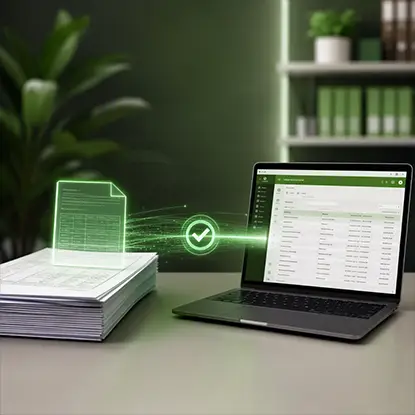
Customer orders often arrive as PDFs and other documents that employees must manually interpret before downstream processing can begin. OrderAction uses AI and intelligent rules to extract and validate PO information before transforming it into ERP-ready sales order data.
Eliminate repetitive rekeying while improving order-processing speed and accuracy.
Remote hiring is likely to be an important part of recruitment. This means that companies should have workflows in place to securely manage increasing amounts of candidate information. As companies grow in number of locations and jurisdictions, manual document review can become challenging. With the help of AI-driven document processing, HR and security teams can streamline their repetitive tasks, gain visibility into document workflows, and minimize any unnecessary exposure of your company's sensitive information.
The goal is not to remove people from the process entirely. It is to use automation where it makes sense while keeping appropriate human oversight in place. By leveraging technology, policies, and access controls, businesses can create more efficient and secure remote hiring processes.
 AI Automation: What It Is and How It Works in 2026
  Document Scanning and Capture with AI Technology
  HR Workflow Automation for Remote Teams in 2026
  Automate HR Workflows with AI for Faster, Smarter Teams
  Long-Term Employee Record Retention and Document Management
  Automating Remote HR Workflows for Connected Teams
